组成图示
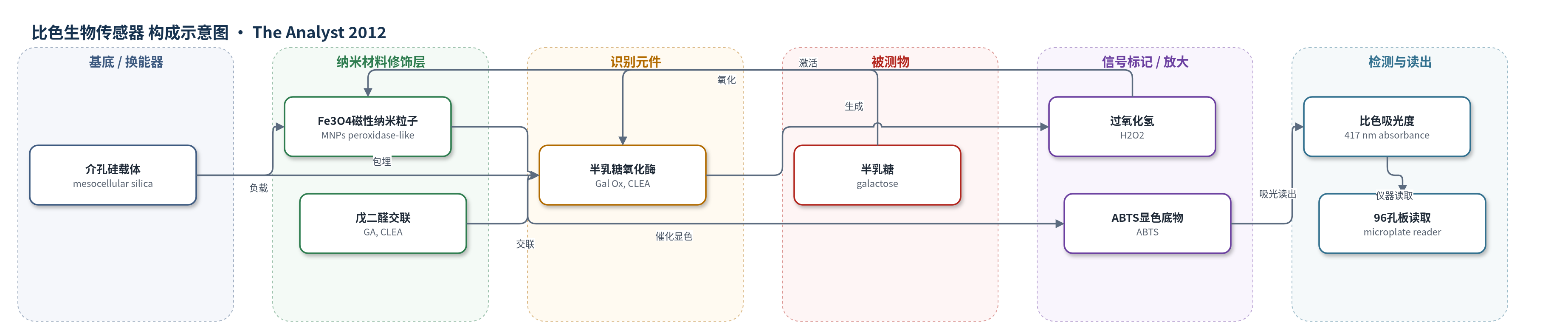
点击图片查看大图 · 依据论文自动绘制
传感器类型
比色生物传感器
检测对象
半乳糖(galactose);样品基质:临床干血斑/人血(dried blood spot, human blood)
检测原理
该比色生物传感器以半乳糖氧化酶(Gal Ox)作为识别与催化元件,特异性氧化半乳糖并生成过氧化氢(H2O2)。生成的H2O2进入介孔硅(MMS)孔道,激活负载其中的Fe3O4磁性纳米粒子(MNPs)的类过氧化物酶活性。MNPs在酸性醋酸钠缓冲液中催化ABTS氧化,生成在417 nm处有强吸收的绿色有色产物。半乳糖浓度越高,Gal Ox产生的H2O2越多,ABTS显色越深,吸光度线性增加。MMS大孔结构同时容纳酶与MNPs,提高分散性和传质;CLEA交联防止酶泄漏,增强稳定性;磁场捕获实现复用。整体通过酶促产H2O2与纳米酶模拟物催化显色实现信号放大。
检测灵敏度
LOD: 5 mg L−1;线性范围: 10–200 mg L−1
效应效果
系统对葡萄糖、阿拉伯糖、果糖无明显显色,对半乳糖选择性良好;乳糖有信号但人血中乳糖可被水解,不干扰临床检测。LOD为5 mg L−1,比先前酶促比色法低10倍,可区分正常与半乳糖血症水平。96孔板内/批间CV<8%,回收率99–103%;临床干血斑内/批间回收率100.7–104.1%和101.3–105.2%,CV<7%,正常/患者样品CV 2.5–6.7%、回收率93–104%。20次磁分离循环后活性几乎完全保留,吸附型Gal Ox损失约60%;室温20 d无明显活性下降,吸附型和游离酶分别损失60%和80%。作者认为其可替代HPLC/MS/MS等繁琐方法,用于新生儿半乳糖血症筛查。
传感器的构成
- 载体基质:介孔硅(mesocellular silica, MMS),大孔介孔结构,包埋Gal Ox与MNPs,提供稳定多孔微环境
- 磁性纳米材料:Fe3O4磁性纳米粒子(magnetic nanoparticles, MNPs),负载于MMS介孔中,作为过氧化物酶模拟物催化ABTS显色
- 识别/催化元件:半乳糖氧化酶(galactose oxidase, Gal Ox),包埋于MMS介孔中,特异性催化半乳糖氧化生成H2O2
- 交联固定剂:戊二醛(glutaraldehyde, GA),用于CLEA交联Gal Ox,减少酶泄漏并提高稳定性
- 封闭剂:Tris-HCl缓冲液,封闭未反应醛基,完成Gal Ox固定
- 比色底物:2,2'-偶氮双(3-乙基苯并噻唑-6-磺酸)二铵盐(ABTS),在MNPs类过氧化物酶催化下氧化生成有色产物
- 反应介质:磷酸钠缓冲液(sodium phosphate buffer, pH 6.5)与醋酸钠缓冲液(sodium acetate buffer, pH 4.0),分别维持Gal Ox反应和ABTS显色
- 分离/复用部件:外部磁场,用于快速磁性捕获和再生多催化系统
中文摘要
本文报道了一种用于定量检测半乳糖的比色方法,其核心是由Fe3O4磁性纳米粒子(MNPs)和半乳糖氧化酶(Gal Ox)同时包埋于大孔介孔硅(mesocellular silica)中构成的纳米结构多催化系统。固定于硅基质中的Gal Ox催化半乳糖氧化生成H2O2,随后H2O2激活介孔中的MNPs,使其表现出类过氧化物酶活性,将比色底物转化为有色产物,从而实现半乳糖的特异性检测。通过采用交联酶聚集体(CLEA)法固定Gal Ox,有效防止酶从介孔硅孔道中泄漏,提高了操作稳定性;同时借助简单磁场捕获实现系统重复使用。该比色生物传感器在微孔板格式中具备多通道分析能力,并用于临床干血斑样品中半乳糖的测定,以辅助诊断半乳糖血症。该方法为人体血液中半乳糖的快速、便捷、低成本定量提供了新途径,有望替代现有繁琐检测流程。
英文摘要
A colorimetric method for quantification of galactose, which utilizes a nanostructured multi-catalyst system consisting of Fe(3)O(4) magnetic nanoparticles (MNPs) and galactose oxidase (Gal Ox) simultaneously entrapped in large pore sized mesocellular silica, is described. Gal Ox, immobilized in a silica matrix, promotes reaction of galactose to generate H(2)O(2) that subsequently activates MNPs in silica mesopores to convert a colorimetric substrate into a colored product. By using this colorimetric method, galactose can be specifically detected. Along with excellent reusability via application of simple magnetic capturing, enhanced operational stability was achieved by employing a cross-linked enzyme aggregate (CLEA) method for Gal Ox immobilization. This protocol leads to effective prevention of enzyme leaching from the pores of mesocellular silica. The analytical utility of the new colorimetric biosensor was demonstrated by its use in diagnosing galactosemia, a genetic metabolic disorder characterized by the inability to utilize galactose, through analysis of clinical dried blood spot specimens. A microscale well-plate format was employed that possesses a multiplexing capability. The multi-catalyst system entrapping Gal Ox and MNPs represents a new approach for rapid, convenient, and cost-effective quantification of galactose in human blood and it holds promise as an alternative method for galactosemia diagnosis, replacing the laborious procedures that are currently in use.