组成图示
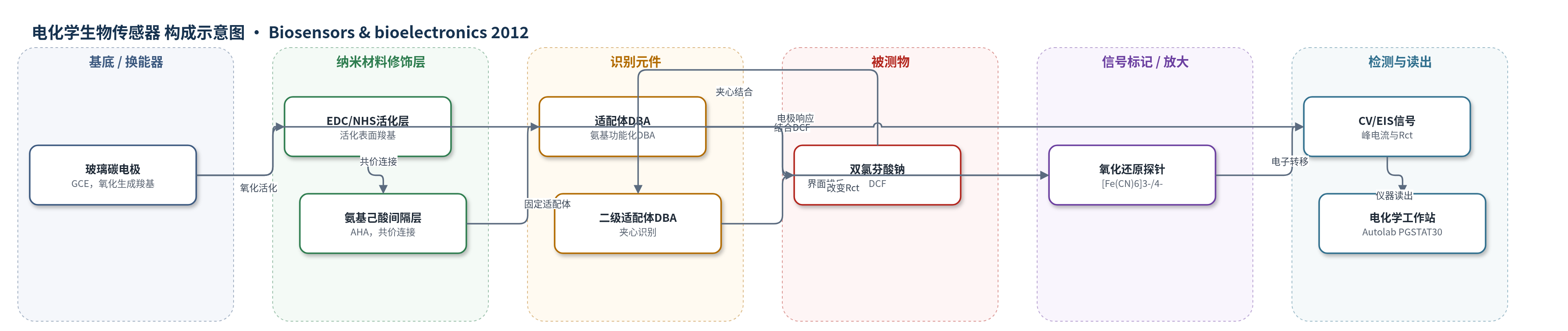
点击图片查看大图 · 依据论文自动绘制
传感器类型
电化学生物传感器
检测对象
双氯芬酸钠(sodium diclofenac, DCF);样品基质:人血清(blood serum)及 PBS 标准溶液
检测原理
该传感器采用无标记电化学阻抗检测。玻璃碳电极经氧化生成羧基,经 EDC/NHS 活化后与 6-氨基己酸(AHA)共价连接,再固定氨基功能化双氯芬酸结合适配体(DBA)。DBA 磷酸骨架带负电,排斥 [Fe(CN)6]3−/4− 探针,使界面电荷转移电阻增大。加入双氯芬酸钠(DCF)后,DCF 与 DBA 特异性结合并引起构象变化;低浓度范围内 DCF 占据 DBA 位点,二级 DBA 进一步结合形成夹心结构,使界面负电荷密度和阻碍增加,Rct 随 DCF 浓度升高而增大。高浓度 DCF 引起 DBA 空间构象改变,降低界面负电荷密度,使 Rct 下降。通过 CV 峰电流和 EIS 的 Rct 变化实现定量检测。
检测灵敏度
LOD: 2.7 × 10⁻⁷ M;线性范围: 0–5.0 μM 和 10 μM–1 mM;灵敏度斜率: 14.26 kΩ μM−1(ΔRct 拟合);报告灵敏度: 15.66 kΩ μM−1;R^2 = 0.998
效应效果
该适配体传感器在 10 μM DCF 检测中三个电极间相对标准偏差为 4.7%,重现性良好。传感器在 PBS(pH 7.4)、4 °C 保存 5 天后信号仅下降 3%,稳定性较好。在人血清样品中,DCF 的 Rct 响应与标准溶液几乎一致,表明血清基质无明显干扰。加标回收率分别为:10 μM 加标回收 103.0%,14 μM 回收 101.4%,20 μM 回收 99.0%。作者认为该无标记电化学适配体传感器可用于复杂生物基质中双氯芬酸钠的监测,具有简单、低成本、可重复使用和应用潜力。
传感器的构成
- 基底/换能器电极:玻璃碳电极(GCE),经氧化铝抛光、乙醇/水超声清洗并在 PBS 中 0.5 V 氧化生成表面羧基,作为电化学换能基底
- 活化连接层:EDC/NHS 活化 GCE 表面羧基,6-氨基己酸(AHA)共价连接形成 GCE/AHA,提供间隔臂和末端羧基
- 识别元件:氨基功能化双氯芬酸结合适配体(DBA),经 EDC/NHS 共价固定于 AHA 末端,形成 GCE/AHA/DBA,特异性识别 DCF
- 被测物结合层:双氯芬酸钠(DCF)与表面 DBA 结合,引起适配体构象变化,形成 GCE/AHA/DBA/DCF
- 夹心识别层:二级 DBA 与 DCF 结合形成夹心结构,改变界面电荷密度和电荷转移电阻
- 氧化还原探针:K3[Fe(CN)6]/K4[Fe(CN)6](0.5 mM)作为电子转移探针,用于 CV 和 EIS 监测界面变化
- 缓冲清洗体系:PBS(pH 7.4)用于孵育、清洗和去除非特异吸附,维持识别环境
- 信号读出:三电极体系(Ag/AgCl/3 M KCl 参比、铂丝辅助)配合 Autolab PGSTAT30 进行 CV/EIS 测量
中文摘要
本文报道了一种用于检测双氯芬酸钠(DCF)的无标记电化学适配体传感器。为构建该生物传感器,将氨基功能化的双氯芬酸结合适配体(DBA)共价固定于玻璃碳电极(GCE)表面。当电极暴露于不同浓度 DCF 时,表面 DBA 的构象发生改变。DCF 的引入引起固定 DBA 构象变化,导致适配体传感器的电荷转移电阻降低;但将 GCE/DBA/DCF 与二级 DBA 孵育后,电荷转移电阻增加。采用循环伏安法和电化学阻抗谱(EIS)监测电荷转移电阻变化。该适配体传感器在 0–5.0 μM 和 10 μM–1 mM 范围内呈现两个线性动态范围,灵敏度为 15.7 kΩ μM−1,检出限为 2.7×10⁻⁷ M。通过在人血清样品中检测 DCF 验证了方法的有效性和适用性,且未受样品基质干扰。此外,该适配体传感器表现出良好稳定性。
英文摘要
The present manuscript describes a label free electrochemical aptasensor for the detection of sodium diclofenac (DCF). In order to construct the biosensor, the amino-functionalized diclofenac binding aptamer (DBA) was covalently immobilized on the surface of the glassy carbon electrode (GCE). The conformation of the DBAs on the surface of the electrode is changed when this is exposed to different concentrations of DCF. The introduction of DCF induces an alteration in the conformation of the surface immobilized DBA and causes a decrease in the charge transfer resistance of the aptasensor. However, the charge transfer resistance is increased by incubation of GCE/DBA/DCF in the secondary DBA. The changes in the charge transfer resistance have been monitored using the voltammetric and electrochemical impedance spectroscopic (EIS) techniques. The aptasensor shows two different linear dynamic ranges over 0-5.0 μM and 10 μM to 1mM, and the sensitivity of 15.7 kΩ μM(-1) and detection limit of 2.7 × 10(-7)M were obtained. The validity of the method and applicability of the aptasensor were successfully evaluated by detection of DCF in a blood serum sample without interference from the sample matrix. Furthermore, the aptasensor has shown good stability.