组成图示
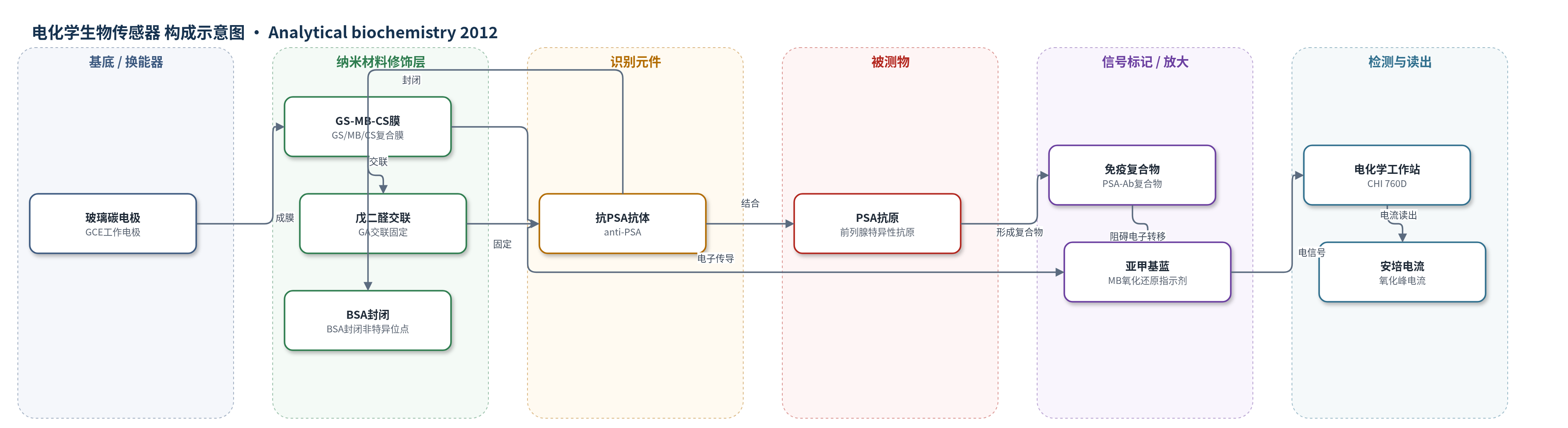
点击图片查看大图 · 依据论文自动绘制
传感器类型
电化学生物传感器
检测对象
前列腺特异性抗原 (PSA);样品基质:血清
检测原理
该传感器采用无标记安培检测原理。抗 PSA 抗体通过戊二醛交联固定在 GS-MB-CS 纳米复合膜上,BSA 封闭非特异性位点。当 PSA 与固定抗体特异性结合时,电极表面形成 PSA-抗体免疫复合物,疏水蛋白层阻碍亚甲基蓝 (MB) 与玻璃碳电极之间的电子转移,使 MB 在 -0.16 V 处的氧化峰电流下降。石墨烯片 (GS) 的高比表面积和优良导电性可负载更多 MB 并增强其电活性,壳聚糖 (CS) 提供氨基/羟基并稳定复合膜,从而提高抗体负载量和信号响应。PSA 浓度越高,界面电子转移受阻越强,安培电流下降越明显,因此通过峰电流变化实现定量检测。
检测灵敏度
LOD: 13 pg mL-1;线性范围: 0.05–5.00 ng mL-1;基于 S/N = 3
效应效果
该传感器在 1 ng/mL PSA 检测中,5 个电极间相对标准偏差 (RSD) 为 5.0%,重现性良好。选择性测试中,在 1 ng/mL PSA 溶液中加入 100 ng/mL 甲胎蛋白 (AFP)、BSA、维生素 C 或葡萄糖,电流变化均小于无干扰信号的 5%,抗干扰能力可接受。传感器在 4°C 保存 14 天后无明显变化,稳定性良好。血清样品采用标准加入法测定 PSA,回收率为 99.7%–101.6%,RSD 为 1.58%–1.74%。作者认为该方法制备简单、成本低、选择性好,可拓展用于多种癌症生物标志物的超灵敏检测。
传感器的构成
- 基底电极:玻璃碳电极 (GCE),工作电极,提供导电基底。
- 纳米复合修饰层:石墨烯片 (GS)-亚甲基蓝 (MB)-壳聚糖 (CS) 纳米复合膜,提供高比表面积、良好导电性和氨基/羟基,增强 MB 电活性并稳定成膜。
- 交联固定层:戊二醛 (GA),交联 MB 与抗 PSA 抗体,实现抗体固定。
- 识别元件:抗 PSA 抗体 (anti-PSA),特异性识别并捕获 PSA。
- 封闭层:牛血清白蛋白 (BSA),封闭非特异性结合位点。
- 信号指示剂:亚甲基蓝 (MB),氧化还原活性指示剂,在 -0.16 V 产生氧化峰电流,作为无标记安培信号。
中文摘要
前列腺特异性抗原(PSA)是前列腺癌筛查、诊断及治疗监测的重要标志物,正常男性血清中 PSA 含量通常仅为 0–4 ng/mL。本文构建了一种用于 PSA 检测的无标记电化学生物传感器,以石墨烯片–亚甲基蓝–壳聚糖(GS-MB-CS)纳米复合膜作为电极修饰材料。该纳米复合膜与电极结合牢固,可用于固定抗 PSA 抗体,修饰过程通过循环伏安法(CV)进行监测。基于 PSA 捕获后抗原–抗体反应引起的峰电流变化,建立了安培型生物传感器。在最佳条件下,安培信号随 PSA 浓度在 0.05–5.00 ng/mL 范围内线性下降,检出限为 13 pg/mL,并表现出较高选择性。该免疫传感器还用于血清样品中 PSA 的分析,结果令人满意。所提方法具有高选择性、良好重现性和稳定性,在生化检测中具有应用前景。
英文摘要
For the specificity of prostate cancer markers, prostate specific antigen (PSA) has been widely used in prostate cancer screening, diagnosis, and treatment after monitoring. In normal male serum, PSA can only be detected in traces of 0-4 ng mL(-1). In this paper, we constructed an electrochemical immunosensor for PSA detection using a nanocomposite film of graphene sheets-methylene blue-chitosan (GS-MB-CS) as electrode material. The nanocomposite film showed high binding affinity to the electrode and was used to immobilize the antibody of PSA. The modification procedure was monitored by cyclic voltammetry (CV). An amperometric biosensor was easily developed based on the response of peak current to the capture of PSA induced by specific antigen-antibody reactions. Under optimum conditions, the amperometric signal decreased linearly with PSA concentration (0.05-5.00 ng mL(-1)). A low limit of detection (13 pg mL(-1)) and a high selectivity are obtained. Moreover, the prepared immunosensor was applied for the analysis of PSA in serum samples with satisfactory results. The proposed method may have a promising future in biochemical assays for high selectivity, good reproducibility, and stability.