组成图示
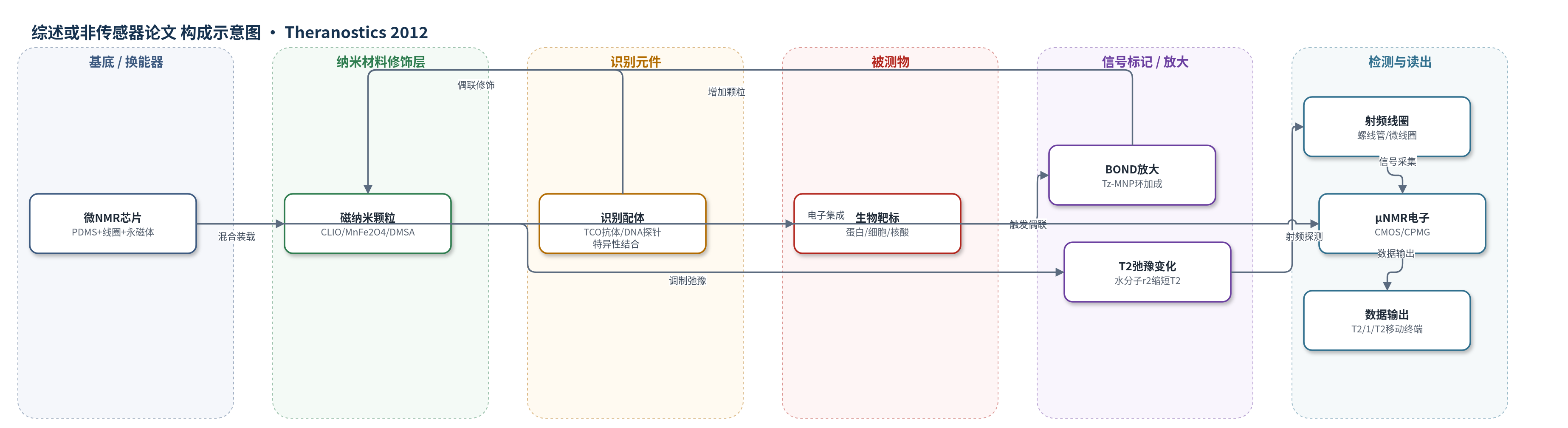
点击图片查看大图 · 依据论文自动绘制
传感器类型
综述或非传感器论文
检测对象
肿瘤细胞(tumor cells)、蛋白标志物(HER2/neu、EGFR、EpCAM、Muc-1)、DNA/mRNA、代谢物(metabolites)、药物(drugs)、病毒(viruses)、细菌(bacteria);样品基质:细针穿刺抽吸物(fine needle aspirates)、全血(whole blood)、生物样品(biological samples)
检测原理
DMR利用超顺磁性MNP在局部产生强磁场,破坏周围水质子自旋相干性,使纵向T1和横向T2弛豫时间缩短,通常以T2或1/T2变化作为信号。小分子靶标采用磁弛豫开关(MRSw):靶标交联MNP使其聚集,r2改变导致T2下降;反向开关中酶切或竞争结合使预聚集MNP解聚,T2上升。大靶标采用磁标记:识别元件将MNP结合到细胞或大分子上,去除未结合MNP后,结合MNP数量增加使1/T2增大。BOND通过TCO抗体与Tz-MNP生物正交偶联提高颗粒结合价态,实现信号放大。微型NMR线圈以CPMG脉冲序列测量T2,信号随靶标浓度或表达量增加而增强。
检测灵敏度
LOD: approximately two cells (in 1 µl sample volume);可检测: picomolar avidin、single cancer cells in whole blood samples
效应效果
DMR利用生物样品磁背景极低的优势,可在最少处理样品中快速检测,且支持多靶标并行。µNMR-2相比µNMR-1质量检测灵敏度提高10倍,样品体积约1 µl;µNMR-3温度补偿开启时T2波动<1%,关闭时波动>200%。肿瘤细胞检测阈值约2个细胞/1 µl,结果与流式细胞术、Western blot和免疫荧光相关,且所需细胞更少、时间<15分钟。临床细针穿刺抽吸物研究中,50例患者样本经四蛋白标志物(HER2/neu、EGFR、EpCAM、Muc-1)诊断准确率达96%,优于免疫组化。作者认为其适合即时、低成本、床旁分子诊断。
传感器的构成
- 换能器/微NMR探针:PDMS微流控芯片、平面微线圈或螺线管线圈、0.5 T永磁体、CMOS射频电路,产生射频脉冲并接收NMR信号
- 磁纳米颗粒信号标记:CLIO、MnFe2O4、Fe-core/ferrite shell、Fe@MnFe2O4,DMSA水溶性涂层,提供高r2并缩短T2
- 识别元件:TCO修饰抗体、寡核苷酸/DNA探针、酚类分子(多巴胺/5-羟色胺),特异性结合靶标或响应酶活
- 信号放大/偶联层:四嗪(Tz)修饰MNP与TCO抗体经生物正交环加成偶联(BOND),提高颗粒结合价态
- 样品处理/微流控层:微流控网络混合样品与MNP并引导至线圈,支持µL体积
- 读出电子/仪器:µNMR-1/2/3、CPMG脉冲序列、温度反馈补偿、移动设备接口,输出T2/1/T2变化
中文摘要
对临床相关蛋白生物标志物、病原体和细胞进行高灵敏、定量的检测,对疾病诊断、恶性程度监测和治疗疗效评估具有重要价值。基于磁性纳米颗粒(MNPs)的生物传感策略因生物样品磁背景极低而受到关注,可在处理较少的样品中获得高灵敏测量。本综述聚焦于利用MNPs基于核磁共振(NMR)效应在体外检测细胞生物标志物。该平台称为诊断磁共振(DMR),将MNPs作为邻近传感器,通过改变分子靶向纳米颗粒周围水分子的自旋-自旋弛豫时间来产生信号。随着更高弛豫率MNP生物传感器、先进偶联策略和高灵敏微型化NMR系统的发展,DMR检测能力显著提升,可在微升级样品体积中快速、并行检测全细胞、蛋白、DNA/mRNA、代谢物、药物、病毒和细菌等靶标,从而成为适用于生物医学和临床即时检测的稳健、易用传感系统。
英文摘要
Sensitive and quantitative measurements of clinically relevant protein biomarkers, pathogens and cells in biological samples would be invaluable for disease diagnosis, monitoring of malignancy, and for evaluating therapy efficacy. Biosensing strategies using magnetic nanoparticles (MNPs) have recently received considerable attention, since they offer unique advantages over traditional detection methods. Specifically, because biological samples have negligible magnetic background, MNPs can be used to obtain highly sensitive measurements in minimally processed samples. This review focuses on the use of MNPs for in vitro detection of cellular biomarkers based on nuclear magnetic resonance (NMR) effects. This detection platform, termed diagnostic magnetic resonance (DMR), exploits MNPs as proximity sensors to modulate the spin-spin relaxation time of water molecules surrounding the molecularly-targeted nanoparticles. With new developments such as more effective MNP biosensors, advanced conjugational strategies, and highly sensitive miniaturized NMR systems, the DMR detection capabilities have been considerably improved. These developments have also enabled parallel and rapid measurements from small sample volumes and on a wide range of targets, including whole cells, proteins, DNA/mRNA, metabolites, drugs, viruses and bacteria. The DMR platform thus makes a robust and easy-to-use sensor system with broad applications in biomedicine, as well as clinical utility in point-of-care settings.