组成图示
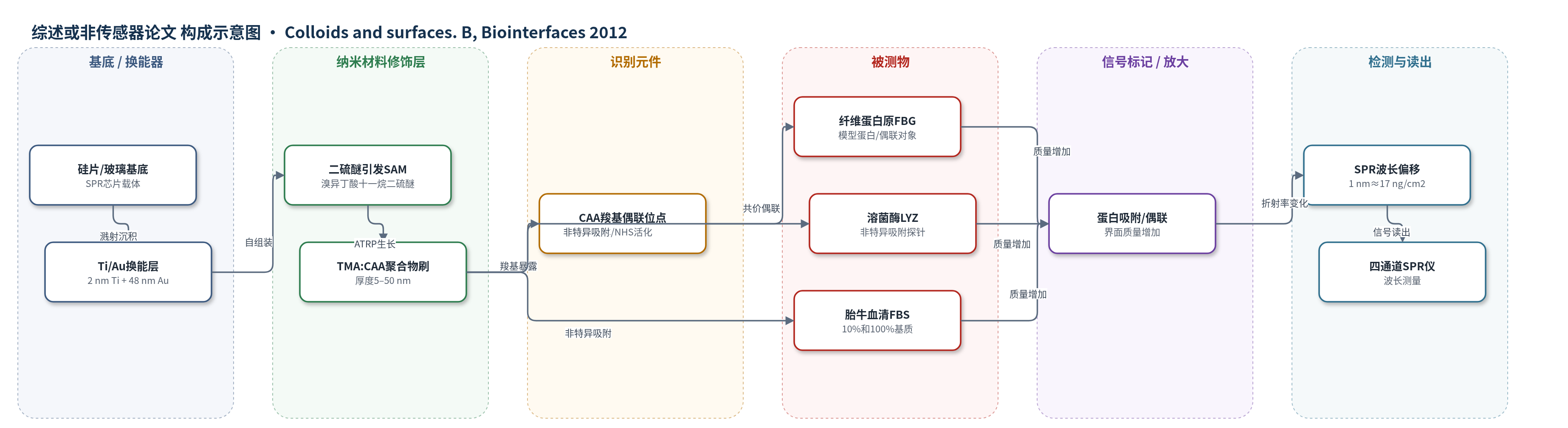
点击图片查看大图 · 依据论文自动绘制
传感器类型
综述或非传感器论文
检测对象
非特异性蛋白吸附量:纤维蛋白原(fibrinogen, FBG)、溶菌酶(lysozyme, LYZ)及胎牛血清(fetal bovine serum, FBS)中的蛋白;样品基质为PBS蛋白溶液、10% FBS和100% FBS。
检测原理
TMA:CAA共聚物刷由阳离子TMA和阴离子CAA组成,其厚度决定链构象与水化层强度。较薄刷水化层不足,蛋白易吸附;约18 nm时链处于非缔合状态,形成强水化层,非特异性吸附最低;更厚时发生链内/链间缔合,水化层破坏,吸附回升。FBG、LYZ或FBS接触表面后,若发生非特异吸附,或CAA羧基经EDC/NHS活化后与FBG共价偶联,界面质量与折射率增加。SPR通过金层表面等离子体共振波长偏移读出该变化,1 nm偏移约对应17 ng/cm2蛋白,并按刷厚度用灵敏度因子校正。因此信号随吸附或偶联蛋白量增加而增大。
检测灵敏度
原文未报告LOD、线性范围、灵敏度斜率或R^2;SPR换算:750 nm处1 nm波长偏移约等于17 ng/cm2吸附蛋白。
效应效果
在约18 nm最优厚度下,TMA:CAA刷对FBG和LYZ的非特异性吸附最低,10% FBS非特异吸附为2.1±2.0 ng/cm2,100% FBS为4.3±1.7 ng/cm2(n=3),达到超低污水平,与PEG、PC和polyHEMA等抗污表面相当。偶联实验显示,10 nm刷偶联FBG为68.0 ng/cm2,18 nm刷为160.7 ng/cm2,结论约150 ng/cm2;更厚刷因链缔合使羧基可及性下降,偶联量降低。SPR灵敏度因子为1.01–1.18,每组n=6或n=5,表明测量具有可重复性。作者认为该平台可用于生物传感器和生物材料。
传感器的构成
- 基底/换能器:硅片或玻璃载片溅射2 nm Ti粘附层和48 nm Au层,作为SPR换能基底。
- 引发/锚定层:0.1 mM溴异丁酸十一烷二硫醚(bromoisobutyrate undecyl disulfide)自组装单分子层,提供ATRP引发位点。
- 聚合物刷层:TMA:CAA两性共聚物刷,由TMA和CAA经表面引发ATRP形成,厚度5–50 nm,提供抗污水化层和羧基偶联位点。
- 偶联化学层:EDC/NHS活化CAA羧基,使FBG共价偶联;NaCl-PBS(pH 8.9)去质子化恢复抗污态。
- 模型蛋白层:纤维蛋白原(FBG)作为偶联模型蛋白,用于评估共价偶联容量。
中文摘要
消除非特异性蛋白吸附是许多生物材料应用中的重要挑战。针对该问题,本研究报道了由带正电的[2-(丙烯酰氧基)乙基]三甲基氯化铵(TMA)和带负电的2-羧乙基丙烯酸酯(CAA)单体组成的两性共聚物的双功能特性。此前TMA:CAA共聚物已被证明具有抗污性能,但最佳抗污条件尚未确定。为此,作者通过调控表面引发原子转移自由基聚合(ATRP)条件改变聚合物刷厚度,并利用表面等离子共振(SPR)生物传感器测定纤维蛋白原和溶菌酶的非特异性吸附随共聚物刷厚度的变化。在最佳抗污厚度下,进一步测定了10%和100%胎牛血清(FBS)中的非特异性吸附。结果表明,在最佳共聚物刷厚度下,TMA:CAA两性材料即使暴露于100% FBS也具有超低污特性。通过在一系列刷厚度上将纤维蛋白原偶联到共聚物刷上,证明了TMA:CAA共聚物的双功能特性。偶联实验清楚表明,TMA:CAA共聚物在最佳抗污厚度下仍具有蛋白偶联能力,但聚合物刷链的构象状态会影响整体偶联容量。研究结果表明,TMA:CAA两性聚合物表面在生物传感器和生物材料应用中具有潜力。
英文摘要
The elimination of nonspecific protein adsorption is an important challenge in many biomaterial applications. To address this issue, numerous nonfouling chemistries have been investigated. This work reports on the dual functional properties of a polyampholyte copolymer composed of positively charged [2-(acryloyloxy) ethyl] trimethyl ammonium chloride (TMA) and negatively charged 2-carboxy ethyl acrylate (CAA) monomers. TMA:CAA copolymers have previously been shown to have nonfouling properties, but the optimal conditions for nonfouling have not been determined. To accomplish this, the thickness of the polymer brush coating was varied by manipulating the surface-initiated atom transfer radical polymerization conditions. The nonspecific adsorption of fibrinogen and lysozyme was measured as a function of the copolymer brush thickness using a surface plasmon resonance biosensor. At the optimal thickness for nonfouling, nonspecific adsorption from 10% and 100% fetal bovine serum (FBS) was determined. The results indicate that at the optimal copolymer brush thickness, TMA:CAA polyampholyte materials have ultralow fouling characteristics even upon exposure to 100% FBS. The dual functional properties of TMA:CAA copolymers were demonstrated by conjugating fibrinogen to the copolymer brush over a range of brush thicknesses. The conjugation experiments clearly demonstrate that TMA:CAA copolymers have the capacity for protein conjugation at the optimal thickness for nonfouling. However, the conformational state of the copolymer brush chains impacts the overall conjugation capacity of the system. The results of this investigation indicate that TMA:CAA polyampholyte surfaces show promise for biosensor and biomaterial applications where their dual functional properties would be beneficial.