组成图示
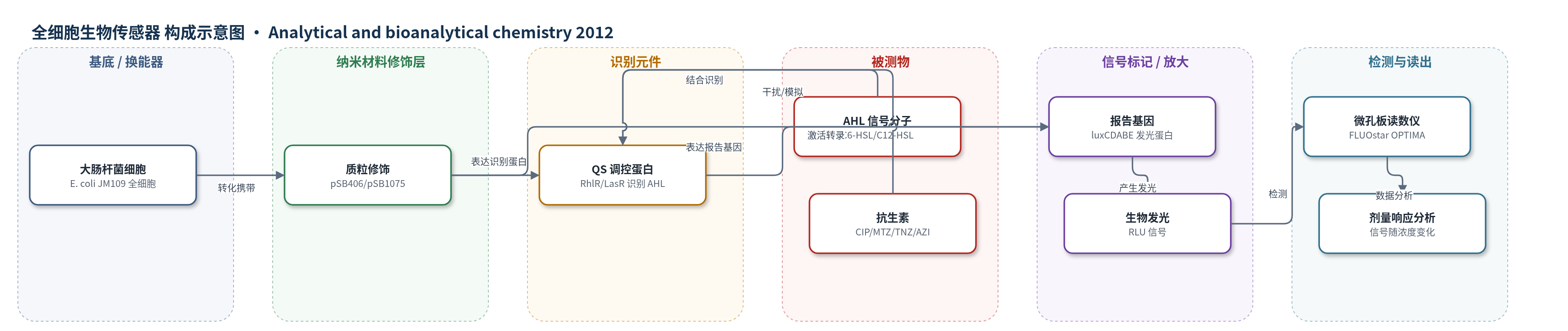
点击图片查看大图 · 依据论文自动绘制
传感器类型
全细胞生物传感器
检测对象
AHL(N-酰基高丝氨酸内酯,C6-HSL、C12-HSL)、抗生素(环丙沙星 ciprofloxacin、甲硝唑 metronidazole、替硝唑 tinidazole、阿奇霉素 azithromycin);样品基质:LB 肉汤/大肠杆菌传感细胞悬液
检测原理
该全细胞生物传感器以大肠杆菌 JM109 为基底,携带 pSB406 或 pSB1075 质粒,表达铜绿假单胞菌 P. aeruginosa 的 LuxR 型调控蛋白 RhlR 或 LasR 以及 luxCDABE 报告基因盒。当 AHL(C6-HSL 或 C12-HSL)进入细胞并与 RhlR/LasR 结合后,形成蛋白-配体复合物,结合 PrhlI 或 PlasI 启动子,激活 luxCDABE 转录与翻译,产生发光蛋白并催化生物发光反应。发光强度以相对光单位(RLU)读出,随 AHL 浓度呈剂量依赖性增加。抗生素若具有 AHL 样效应或干扰 QS 调控,可改变调控蛋白-启动子-报告基因通路的激活程度,使发光信号增强或降低,从而用于筛选 QS 干扰物。
检测灵敏度
原文未报告 LOD、线性范围、灵敏度斜率或相关系数。
效应效果
两种传感系统分别对短链 C6-HSL(pSB406)和长链 C12-HSL(pSB1075)选择性响应。重复性较好,%RSD 约 0.24%–9.38%。细胞活力显示阿奇霉素 1–16 μg/mL 使活菌降至 67%–97%,环丙沙星 0.156–2.5 μg/mL 使活菌降至 32%–66%,甲硝唑/替硝唑 50–250 μg/mL 活菌 87%–100%;信号按活菌归一化。阿奇霉素剂量依赖降低发光,呈抗 AHL 样效应;环丙沙星、甲硝唑、替硝唑在有无 AHL 时均剂量依赖增强发光,呈 AHL 样效应。作者认为该系统可用于高通量筛选 QS 干扰物,并提示抗生素治疗 IBD 的益处可能部分来自改变肠道细菌 QS 行为。
传感器的构成
- 传感细胞基底/换能器:大肠杆菌 JM109(E. coli JM109)全细胞,作为生物传感载体与反应基质
- 遗传修饰层:质粒 pSB406 或 pSB1075,携带 P. aeruginosa QS 调控基因 rhlR/lasR 与 luxCDABE 报告基因盒
- 识别元件:调控蛋白 RhlR 或 LasR,识别 C6-HSL 或 C12-HSL 等 AHL 信号分子
- 调控启动子:PrhlI 或 PlasI,位于 luxCDABE 上游,介导 AHL-调控蛋白复合物激活转录
- 信号标记物:luxCDABE 报告基因编码发光蛋白,产生与 AHL 浓度相关的生物发光信号
- 反应介质:LB 肉汤/琼脂,含 100 μg/mL 氨苄青霉素(ampicillin),用于细胞培养与质粒维持
中文摘要
群体感应(quorum sensing, QS)使细菌通过 QS 信号分子相互通讯,并以群体方式调控致病性、生物膜形成等行为。肠道菌群可能参与炎症性肠病(IBD)发病,抗生素是克罗恩病(CD)的可选治疗手段之一。本研究采用基因工程发光细菌全细胞传感系统,评估常用于慢性炎症治疗的抗生素干扰 QS 的能力。作者考察了环丙沙星(ciprofloxacin)、甲硝唑(metronidazole)和替硝唑(tinidazole)对 QS 的影响:将多种浓度的单一抗生素分别与两种细菌传感细胞相互作用,并在存在或不存在固定浓度 N-酰基高丝氨酸内酯(AHL)QS 分子条件下,通过监测传感系统的生物发光响应判断抗生素效应。结果显示,环丙沙星、甲硝唑和替硝唑在两种传感系统中均引起剂量依赖性信号增强,表现出 AHL 样效应;且无论是否存在 AHL 均观察到增强。数据表明这些抗生素可能干扰细菌通讯系统,并在测试浓度下本身可作为细菌信号分子。这些抗生素治疗肠道炎症的益处可能部分源于其对肠道 QS 相关细菌行为的改变。
英文摘要
Quorum sensing (QS) allows bacteria to communicate with one another by means of QS signaling molecules and control certain behaviors in a group-based manner, including pathogenicity and biofilm formation. Bacterial gut microflora may play a role in inflammatory bowel disease pathogenesis, and antibiotics are one of the available therapeutic options for Crohn's disease. In the present study, we employed genetically engineered bioluminescent bacterial whole-cell sensing systems as a tool to evaluate the ability of antibiotics commonly employed in the treatment of chronic inflammatory conditions to interfere with QS. We investigated the effect of ciprofloxacin, metronidazole, and tinidazole on quorum sensing. Several concentrations of individual antibiotics were allowed to interact with two different types of bacterial sensing cells, in both the presence and absence of a fixed concentration of N-acylhomoserine lactone (AHL) QS molecules. The antibiotic effect was then determined by monitoring the biosensor's bioluminescence response. Ciprofloxacin, metronidazole, and tinidazole exhibited a dose-dependent augmentation in the response of both bacterial sensing systems, thus showing an AHL-like effect. Additionally, such an augmentation was observed, in both the presence and absence of AHL. The data obtained indicate that ciprofloxacin, metronidazole, and tinidazole may interfere with bacterial communication systems. The results suggest that these antibiotics, at the concentrations tested, may themselves act as bacterial signaling molecules. The beneficial effect of these antibiotics in the treatment of intestinal inflammation may be due, at least in part, to their effect on QS-related bacterial behavior in the gut.