组成图示
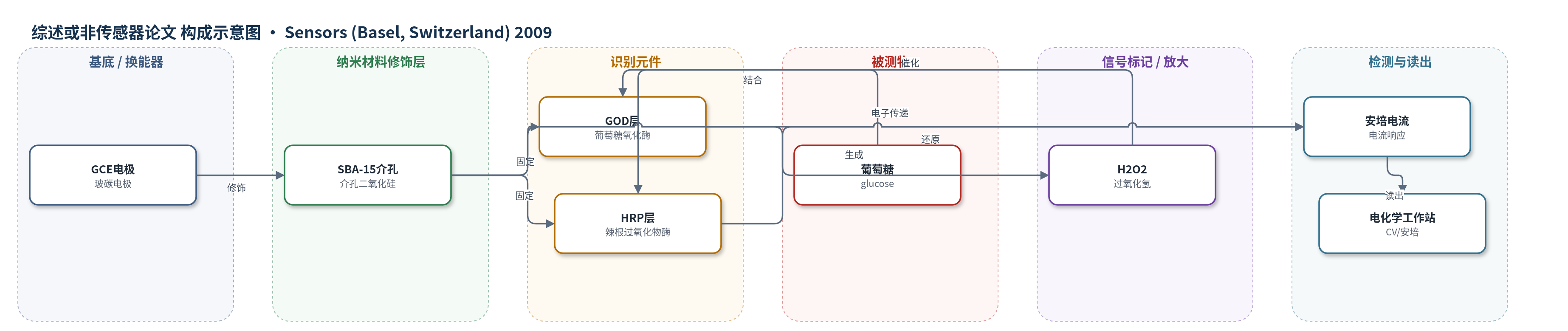
点击图片查看大图 · 依据论文自动绘制
传感器类型
综述或非传感器论文
检测对象
葡萄糖(glucose,PBS缓冲液)、过氧化氢(H2O2,PBS缓冲液)、药物(利多卡因 lidocaine、BUP、CPA,PBS缓冲液)、亚硝酸盐(NO2−,HAc-NaAc缓冲液)、酶活性(GDH/LDH,Tris-HCl缓冲液)
检测原理
以GOD–HRP/SBA-15葡萄糖传感器为例,SBA-15介孔二氧化硅修饰GCE并共固定GOD与HRP。葡萄糖进入介孔后,GOD催化葡萄糖与溶解氧反应生成H2O2;H2O2在同一介孔内被HRP电催化还原,在−0.40 V产生阴极电流。SBA-15介孔结构缩短扩散距离并加速电子传递,使电流随葡萄糖浓度增加而增大,最终达到平台。对于HRP/H2O2、CYP2B6/药物和Hb/亚硝酸盐体系,纳米材料同样通过促进血红素蛋白直接电子传递或电催化反应,将生物识别/催化事件转换为电流信号。
检测灵敏度
LOD: 2.7 × 10⁻⁷ M;线性范围: 3.0 × 10⁻⁶–3.4 × 10⁻² M(GOD–HRP/SBA-15葡萄糖传感器);线性范围: 0.08–3.6 mM(Hb/PUE/MWNT亚硝酸盐传感器)
效应效果
综述报道多类纳米材料电化学生物传感器:GOD–HRP/SBA-15葡萄糖传感器LOD 2.7×10⁻⁷ M,线性3.0×10⁻⁶–3.4×10⁻² M,无介质且响应快;Hb/PUE/MWNT亚硝酸盐传感器线性0.08–3.6 mM;GOD/ZrO2/Pt-PLL葡萄糖电流约4 mmol/mL饱和;TPSP-ZnO比球形ZnO负载更高、电催化更好;CYP2B6传感器可检测利多卡因、BUP、CPA。文中未系统报告选择性、稳定性、RSD与实际样品回收率,作者主张用于诊断、治疗和药物递送相关高灵敏生物电子器件。
传感器的构成
- 基底/换能器电极:GCE(玻碳电极),提供电子传递与电化学信号读出界面
- 纳米材料修饰层:SBA-15(有序六方介孔二氧化硅),作为多孔载体共固定双酶并加速电子传递
- 识别/催化元件:GOD(葡萄糖氧化酶),催化葡萄糖氧化并生成H2O2
- 识别/催化元件:HRP(辣根过氧化物酶),电催化还原H2O2并产生安培电流
- 反应物/电子供体:溶解氧(O2),参与GOD催化葡萄糖氧化
- 信号输出:无外加介质,H2O2在HRP作用下的还原电流作为葡萄糖浓度信号
中文摘要
生物传感器被定义为将生物材料、生物来源材料或生物模拟物与物理化学换能器或转导微系统紧密关联或集成的分析装置。将酶与纳米材料结合的电化学生物传感器兼具酶的识别与催化特性和多种纳米材料的电子特性,是来源于复合组分协同作用的新材料。因此,这类体系有望通过电子信号转导生物识别事件,用于设计具有高灵敏度和高稳定性的新一代生物电子器件。本综述描述了纳米材料参与氧化还原蛋白直接电化学的方法,特别是作者团队在固定葡萄糖氧化酶(GOD)、辣根过氧化物酶(HRP)、细胞色素P450(CYP2B6)、血红蛋白(Hb)、谷氨酸脱氢酶(GDH)和乳酸脱氢酶(LDH)的传感器设计中的工作。综述重点为基于电极材料修饰的纳米材料不同功能,以及电化学生物传感器的应用。
英文摘要
A biosensor is defined as a kind of analytical device incorporating a biological material, a biologically derived material or a biomimic intimately associated with or integrated within a physicochemical transducer or transducing microsystem. Electrochemical biosensors incorporating enzymes with nanomaterials, which combine the recognition and catalytic properties of enzymes with the electronic properties of various nanomaterials, are new materials with synergistic properties originating from the components of the hybrid composites. Therefore, these systems have excellent prospects for interfacing biological recognition events through electronic signal transduction so as to design a new generation of bioelectronic devices with high sensitivity and stability. In this review, we describe approaches that involve nanomaterials in direct electrochemistry of redox proteins, especially our work on biosensor design immobilizing glucose oxidase (GOD), horseradish peroxidase (HRP), cytochrome P450 (CYP2B6), hemoglobin (Hb), glutamate dehydrogenase (GDH) and lactate dehydrogenase (LDH). The topics of the present review are the different functions of nanomaterials based on modification of electrode materials, as well as applications of electrochemical enzyme biosensors.