组成图示
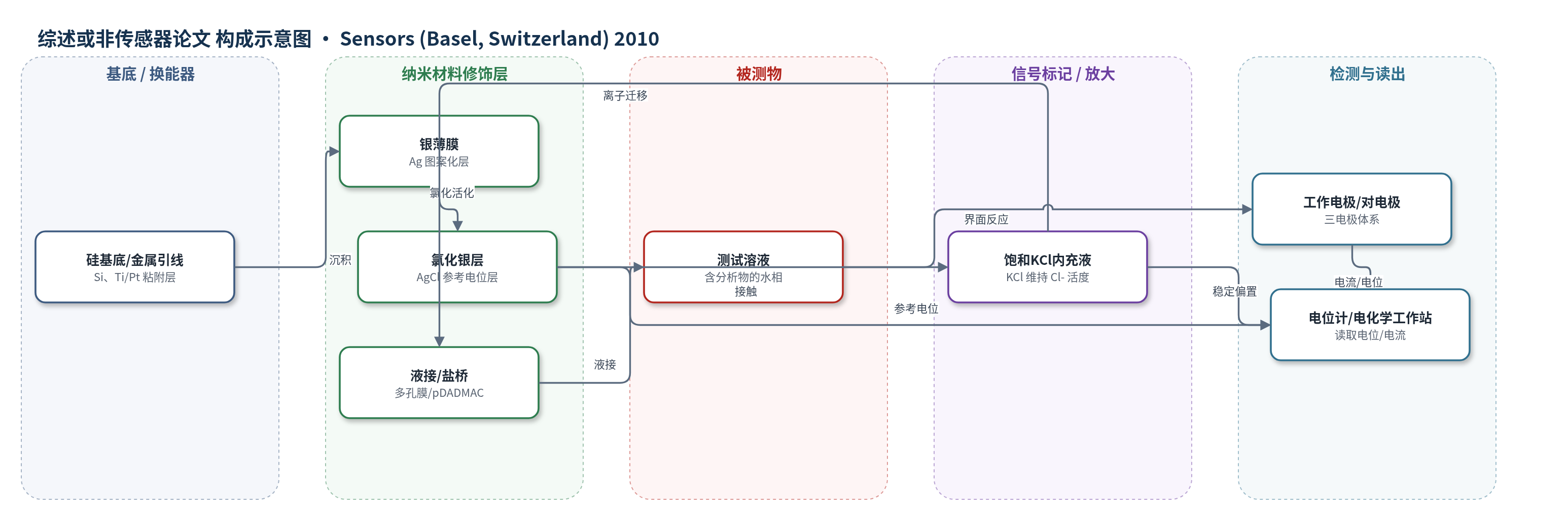
点击图片查看大图 · 依据论文自动绘制
传感器类型
综述或非传感器论文
检测对象
综述未限定单一被测物;涉及 pH(H3O+,水溶液/缓冲液)、葡萄糖(glucose,血液/缓冲液)、氧气(O2)与二氧化碳(CO2,血液/缓冲液)、DNA/ssDNA(水样/缓冲液)、白蛋白(albumin,缓冲液/血清)等。
检测原理
微加工参考电极通常以 Ag/AgCl 半反应为核心:AgCl(s)+e- ⇌ Ag(s)+Cl-(aq),其电位由 Nernst 方程取决于 Cl- 活度。通过饱和 KCl 内充液或 KCl 掺杂凝胶/离子液体维持恒定 Cl- 浓度,并借助多孔膜、盐桥或微通道限制对流混合,从而获得高交换电流密度和稳定参考电位。在三电极体系中,工作电极与参考电极之间的电位差被电位计读出;分析物与工作电极或 FET 栅极识别层作用后,引起电位、电流、阻抗或栅极电荷变化。部分应用利用葡萄糖氧化酶产 H+ 改变界面 pH,或利用 ISFET/BioFET 将界面电荷转换为电流,实现信号放大与读出。
检测灵敏度
未报告(综述,无单一传感器灵敏度数据)
效应效果
综述强调参考电极电位稳定性是核心指标。文献中微加工 Ag/AgCl 电极常见漂移为 <1 mV/24 h、<1 mV/3 h、<2 mV/100 h、<1.5 mV/42 h;准参考型可 <30 mV/14 d、<70 mV/12 h。固态 KCl 琼脂修饰使电极在 pH 4–10 和 Cl- 10^-6–0.3 M 范围内不敏感;PFCP 涂层抗卤素污染,80 d 漂移 <10 mV。毛细管 calomel 电极重现性可 <1 mV,静息电位 1–3 min 内稳定至 10.1 mV。IrOx 电极 9 d 不确定度 <20 mV,标准差 4 mV。作者认为低成本、易集成、可批量制造使其适用于血糖、血气、pH、DNA 和 FET 生物传感。
传感器的构成
- 基底/换能器电极:硅(Si)基底、金属引线或 Ti/Pt 粘附层,提供导电支撑与微加工图案化。
- 参考电极金属层:银(Ag)薄膜或银丝,作为 Ag/AgCl 半反应的金属相。
- 参考电位材料层:氯化银(AgCl)涂层,经 FeCl3 化学氯化或电化学阳极氧化形成,决定稳定参考电位。
- 内充液/固态电解质:饱和 KCl 溶液、KCl 琼脂凝胶、PVC/离子液体或 KCl 粉末聚合物,维持 Cl- 活度并降低液接电位。
- 液接/扩散屏障:多孔玻璃、琼脂糖凝胶、聚丙烯酰胺凝胶、聚酰亚胺(PI)、PDMS 微通道或 pDADMAC 盐桥,隔离内外溶液并控制离子迁移。
- 读出接口:三电极电位计/电化学工作站或 ISFET/BioFET 栅偏置电路,读取相对参考电位的电位、电流或阻抗。
中文摘要
过去二十年来,生物与化学传感器及其样品前处理和分析系统的小型化趋势不断增强。芯片实验室器件具有成本低、样品量小、分析速度快、易于自动化以及可靠性和重复性高等优点。基于电学的方法将生物或化学信号转换为电学信号,是芯片实验室器件的重要组成部分。任何电化学传感系统的关键部件是参考电极,它能够测量电化学界面溶液侧的电位。关于这一关键部件的小型化研究,以及影响其性能、稳定性和寿命的参数分析仍较稀少。本文阐述这些参考电极的基本电化学和热力学原理,说明参考电极在电化学和生物测量中的应用,介绍用作参考电极的不同电化学体系,并概述电极小型化及性能方面的最新进展。
英文摘要
Over the past two decades, there has been an increasing trend towards miniaturization of both biological and chemical sensors and their integration with miniaturized sample pre-processing and analysis systems. These miniaturized lab-on-chip devices have several functional advantages including low cost, their ability to analyze smaller samples, faster analysis time, suitability for automation, and increased reliability and repeatability. Electrical based sensing methods that transduce biological or chemical signals into the electrical domain are a dominant part of the lab-on-chip devices. A vital part of any electrochemical sensing system is the reference electrode, which is a probe that is capable of measuring the potential on the solution side of an electrochemical interface. Research on miniaturization of this crucial component and analysis of the parameters that affect its performance, stability and lifetime, is sparse. In this paper, we present the basic electrochemistry and thermodynamics of these reference electrodes and illustrate the uses of reference electrodes in electrochemical and biological measurements. Different electrochemical systems that are used as reference electrodes will be presented, and an overview of some contemporary advances in electrode miniaturization and their performance will be provided.