组成图示
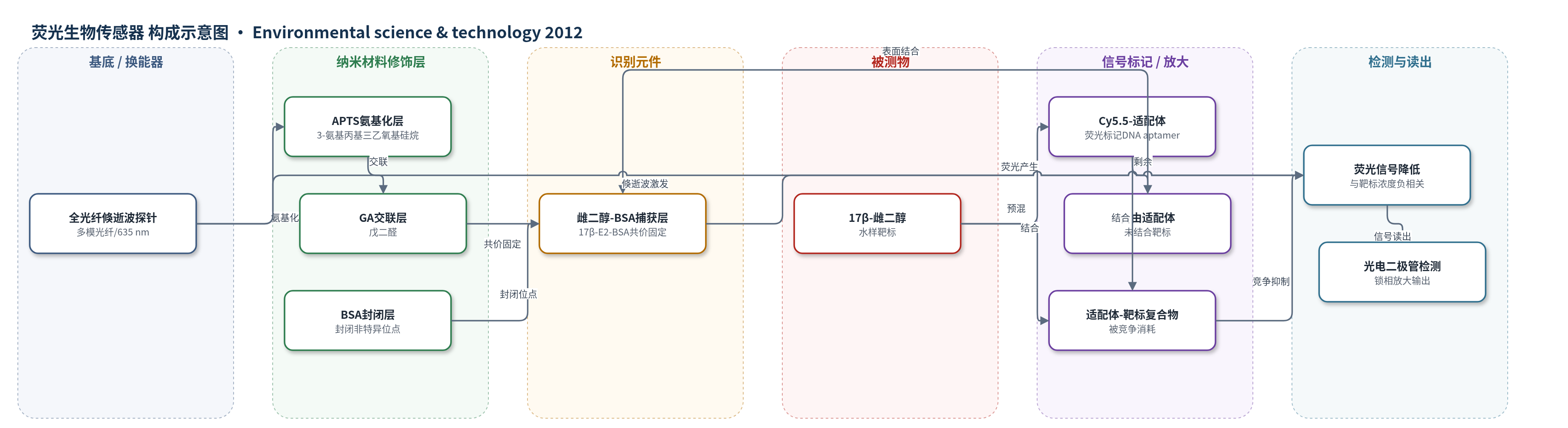
点击图片查看大图 · 依据论文自动绘制
传感器类型
荧光生物传感器
检测对象
17β-雌二醇(17β-estradiol, 17β-E2);样品基质:环境水样、三级污水处理厂出水
检测原理
传感器表面先经APTS氨基化,再用GA交联共价固定17β-E2-BSA捕获分子。检测时,水样中的17β-E2与固定浓度Cy5.5标记DNA适配体预混,目标物与适配体特异性结合形成复合物,从而消耗自由适配体。混合液流经光纤倏逝波传感区后,剩余自由适配体与表面固定的雌二醇捕获分子结合。635 nm激光经多模光纤产生倏逝波,激发表面Cy5.5荧光,光电二极管以锁相方式检测荧光峰。17β-E2浓度越高,被消耗的自由适配体越多,结合到表面的荧光适配体越少,荧光信号越低;信号ΔS=S0-S与靶标浓度呈剂量响应,用四参数逻辑方程拟合。该机制无需酶催化放大,依靠竞争结合实现信号转换。
检测灵敏度
LOD: 2.1 nM (0.6 ng mL−1)
效应效果
传感器对17β-雌二醇具有高度特异性,对雌三醇、西维因、4-壬基酚、林可霉素盐酸盐、EDPC和丝裂霉素C等20 ng/mL潜在干扰物响应显著更低。实际废水基质抗干扰能力强,5、10和25 nM加标三级污水处理厂出水的回收率为95–105%,平行测试相关系数大于0.99(n=2)。标准点CV小于5%。传感器可用0.5% SDS(pH 1.9)再生,4个月内重复使用上百次无明显性能损失;4 °C间歇储存90天后仍保留约90%原始响应。单次检测含再生小于10 min。LOD为2.1 nM(0.6 ng/mL),与电化学适配体传感器0.3 ng/mL、安培免疫传感器0.5 ng/mL及HPLC 1.15 nM相当,且更便携、快速,适合现场实时监测。
传感器的构成
- 基底/换能器:全光纤倏逝波传感探针(多模光纤,600 μm,NA 0.22;635 nm脉冲二极管激光激发,光电二极管与锁相检测),产生倏逝波并收集表面荧光。
- 表面氨基化层:3-氨基丙基三乙氧基硅烷(APTS),在光纤表面引入氨基反应位点。
- 交联固定层:戊二醛(GA),桥接氨基化表面与17β-E2-BSA并实现共价固定。
- 表面捕获识别元件:17β-雌二醇6-(O-羧甲基)肟-BSA(17β-E2-BSA),作为固定捕获分子结合自由荧光适配体。
- 封闭剂:牛血清白蛋白(BSA),封闭剩余醛基和非特异吸附位点以降低背景。
- 溶液识别/信号探针:Cy5.5标记17β-雌二醇DNA适配体(5′-Cy5.5-aptamer-3′),特异性结合17β-E2并提供荧光标记。
- 竞争靶标:17β-雌二醇(17β-E2),与荧光适配体预混并竞争消耗自由适配体。
- 再生/清洗液:0.5% SDS(pH 1.9)和PBS,洗脱非共价结合的荧光适配体以实现传感器再生。
中文摘要
为满足美国环保署非管制污染物法规(UCMR3)对水样内分泌干扰物(EDCs)的常规监测需求,本研究报道一种可重复使用的倏逝波适配体光学生物传感器,用于快速、灵敏且高选择性地检测环境水样中的17β-雌二醇(17β-estradiol)。该传感器将17β-雌二醇6-(O-羧甲基)肟-牛血清白蛋白(17β-E2-BSA)共价固定于光纤传感表面,并采用间接竞争检测模式:含不同浓度17β-雌二醇的样品与固定浓度的Cy5.5标记DNA适配体预混,目标物与适配体特异性结合后,剩余自由适配体再结合传感器表面固定的雌二醇捕获分子;目标浓度越高,结合到表面的荧光适配体越少,荧光信号越低。研究建立了17β-雌二醇剂量-响应曲线,检出限为2.1 nM(0.6 ng/mL)。通过多种潜在干扰内分泌物评价了传感器的高特异性与选择性,并在多个三级污水处理厂出水加标样品中评估了实际基质效应。传感器可用0.5% SDS(pH 1.9)再生数十次以上且性能无明显下降,有望用于环境水样中17β-雌二醇的现场、实时、低成本监测。
英文摘要
Required routine monitoring of endocrine disrupting compounds (EDCs) in water samples, as posed by EPA Unregulated Contaminant Regulation (UCMR3), demands for cost-effective, reliable and sensitive EDC detection methods. This study reports a reusable evanescent wave aptamer-based biosensor for rapid, sensitive and highly selective detection of 17β-estradiol, an EDC that is frequently detected in environmental water samples. In this system, the capture molecular, β-estradiol 6-(O-carboxy-methyl)oxime-BSA, was covalently immobilized onto the optical fiber sensor surface. With an indirect competitive detection mode, samples containing different concentrations of 17β-estradiol were premixed with a given concentration of fluorescence-labeled DNA aptamer, which highly specifically binds to 17β-estradiol. Then, the sample mixture is pumped to the sensor surface, and a higher concentration of 17β-estradiol leads to less fluorescence-labeled DNA aptamer bound to the sensor surface and thus to lower fluorescence signal. The dose-response curve of 17β-estradiol was established and a detection limit was determined as 2.1 nM (0.6 ng mL(-1)). The high specificity and selectivity of the sensor were demonstrated by evaluating its response to a number of potentially interfering EDCs. Potential interference of real environmental sample matrix was assessed by spiked samples in several tertiary wastewater effluents. The sensor can be regenerated with a 0.5% SDS solution (pH 1.9) over tens of times without significant deterioration of the sensor performance. This portable sensor system can be potentially applied for on-site real-time inexpensive and easy-to-use monitoring of 17β-estradiol in environmental samples such as effluents or water bodies.