组成图示
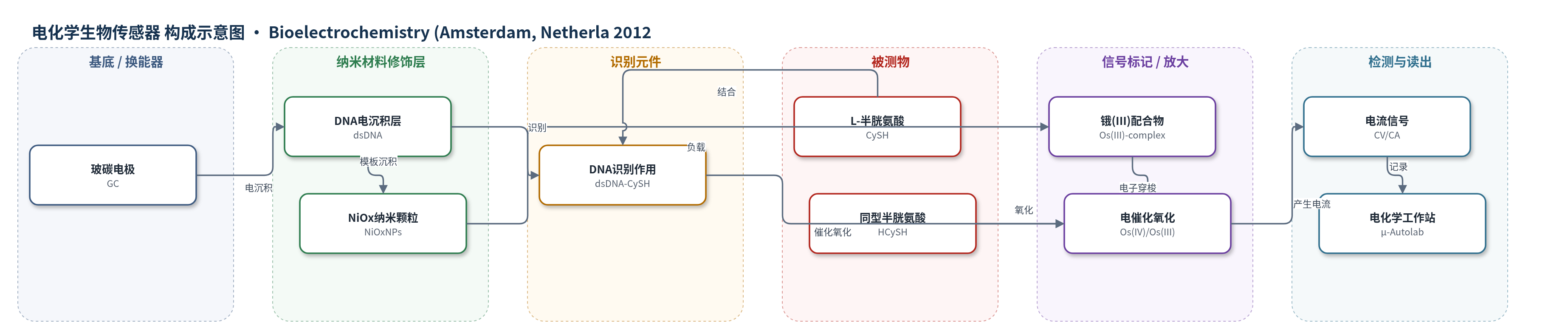
点击图片查看大图 · 依据论文自动绘制
传感器类型
电化学生物传感器
检测对象
L-半胱氨酸(L-cysteine, CySH)、同型半胱氨酸(homocysteine, HCySH);样品基质:PBS缓冲液、血清(serum)
检测原理
该传感器以GC/DNA/NiOxNPs纳米复合材料负载Os(III)-complex。DNA磷酸骨架可吸附CySH巯基质子,NiOxNPs降低电荷转移电阻并提高Os(III)-complex负载量。在+0.10 V(vs. Ag/AgCl)下,Os(III)-complex被氧化为Os(IV),随后氧化CySH生成CyS•并再生Os(III),CyS•二聚为胱氨酸,形成EC'电催化循环,电流随CySH浓度增加而增大。Os(III)/Os(IV)媒介循环实现信号放大。由于DNA/NiOx/Os(III)-complex界面使CySH在低过电位氧化,而HCySH在约0.6 V出现分离峰,因此可在无分离条件下同时伏安测定两者。
检测灵敏度
LOD: 0.07 μM;线性范围: 1–1000 μM;灵敏度: 44 μA mM−1;计时电流法1.0–11 μM: I/μA=0.044(±0.009)[CySH]/μM+0.0098(±0.002)/μA,R^2=0.9993;0.0 V下LOD: 0.27 μM,线性范围: 3–400 μM,灵敏度: 23 μA mM−1;CV 0–0.6 mM: I/μA=4.15(±0.08)[CySH]/mM+0.037(±0.002)/μA,R^2=0.9942;CV 0.6–2.4 mM: I/μA=2.0958(±0.15)[CySH]/mM+1.2158(±0.09)/μA,R^2=0.9956。
效应效果
该电极CySH氧化过电位仅0.10 V,低于多数报道电极。0.0 V下,100倍浓度的HCySH、胱氨酸、蛋氨酸、硫代胞嘧啶、谷胱甘肽、草酸、多巴胺、尿酸和葡萄糖无明显干扰;对仅差一个亚甲基的HCySH亦无响应。220次循环峰电流变化<3%,PBS中24 h下降3%,空气中30 d保留94%;500 s保持95%。10次重复20 μM CySH RSD=3.5%,8电极RSD=4%,4 ℃保存1个月稳定。血清加标回收率95%–102%,测得CySH 195.5–210.5 μM,可用于复杂样品中CySH与HCySH同时检测。
传感器的构成
- 基底电极:玻碳电极(GC),提供导电基底与电子转移动力
- DNA修饰层:双链DNA(dsDNA,牛胸腺DNA)电沉积,形成网络并静电吸附Ni2+
- NiOx纳米颗粒层:电沉积镍氧化物纳米颗粒(NiOxNPs),提高Os(III)-complex负载量并降低电荷转移电阻
- 识别元件:DNA(dsDNA)磷酸骨架与CySH巯基质子相互作用,增强对CySH的选择性
- 信号媒介:四氮杂环十四烷锇(III)氯化物(Os(III)-complex),通过Os(IV)/Os(III)循环电催化氧化CySH
- 抗干扰层:Nafion薄膜(仅血清检测时覆盖),抑制抗坏血酸干扰
中文摘要
本研究将玻碳电极(GC)修饰以电沉积镍氧化物纳米颗粒(NiOxNPs)和脱氧核糖核酸(DNA),作为包埋锇(III)配合物的高效新平台。采用场发射扫描电镜、循环伏安法和电化学阻抗谱研究了所得纳米复合材料修饰电极(GC/DNA/NiOxNPs/Os(III)-complex)的表面形貌和电化学性质。循环伏安结果表明,该电极对L-半胱氨酸(CySH)氧化具有优异电催化活性,氧化过电位降至0.1 V(vs. Ag/AgCl)。计时电流法检测CySH的灵敏度和检出限分别为44 μA mM−1和0.07 μM,浓度范围可达1000 μM。该修饰电极对谷胱甘肽、L-胱氨酸、L-蛋氨酸等低分子量生物硫醇衍生物以及多巴胺、尿酸、葡萄糖等电活性生物物种的氧化响应可忽略;对结构非常相似的同型半胱氨酸(HCySH)在所选电位窗口也无明显响应。此外,本文首次报道了无需分离或前处理即可同时伏安测定L-半胱氨酸和同型半胱氨酸。最后,成功验证了该传感器用于复杂血清样品中CySH浓度分析。高选择性、优异电催化活性和稳定性、对硫醇及其氧化产物显著抗污性,以及同时检测L-半胱氨酸和同型半胱氨酸的能力,是该DNA基生物传感器的突出优点。
英文摘要
The modification of glassy carbon (GC) electrode with electrodeposited nickel oxide nanoparticles (NiOxNPs) and deoxyribonucleic acid (DNA) is utilized as a new efficient platform for entrapment of osmium (III) complex. Surface morphology and electrochemical properties of the prepared nanocomposite modified electrode (GC/DNA/NiOxNPs/Os(III)-complex) were investigated by FESEM, cyclic voltammetry and electrochemical impedance spectroscopy techniques. Cyclic voltammetric results indicated the excellent electrocatalytic activity of the resulting electrode toward oxidation of l-cysteine (CySH) at reduced overpotential (0.1 V vs. Ag/AgCl). Using chronoamperometry to CySH detection, the sensitivity and detection limit of the biosensor are obtained as 44 μA mM(-1) and 0.07 μM with a concentration range up to 1000 μM. The electrocatalytic activity of the modified electrode not only for oxidation of low molecular-mass biothiols derivatives such as, glutathione, l-cystine, l-methionine and electroactive biological species ( dopamine, uric acid, glucose) is negligible but also for very similar biothiol compound (homocysteine) no recognizable response is observed at the applied potential window. Furthermore, the simultaneous voltammetric determination of l-cysteine and homocysteine compounds without any separation or pretreatment process was reported for the first time in this work. Finally, the applicability of sensor for the analysis of CySH concentration in complex serum samples was successfully demonstrated. Highly selectivity, excellent electrocatalytic activity and stability, remarkable antifouling property toward thiols and their oxidation products, as well as the ability for simultaneous detection of l-cysteine and homocysteine are remarkably advantageous of the proposed DNA based biosensor.