组成图示
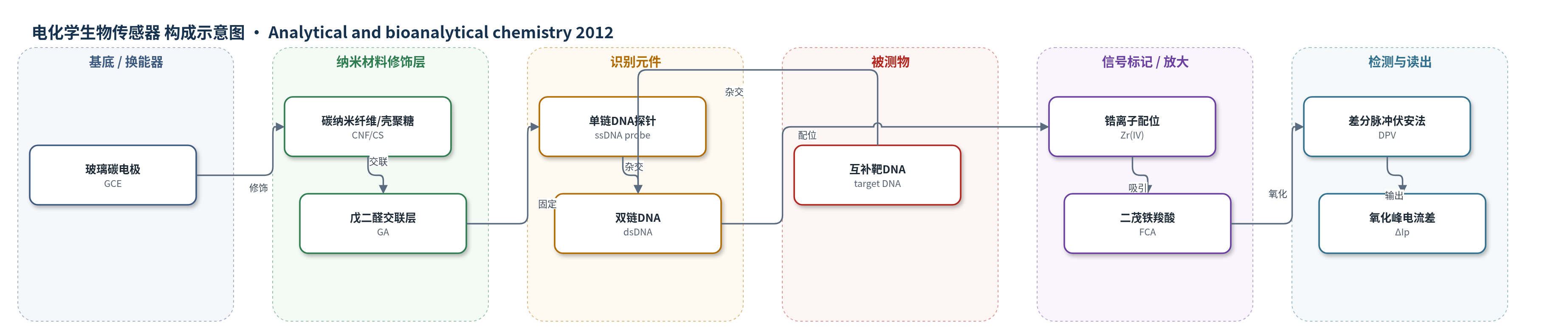
点击图片查看大图 · 依据论文自动绘制
传感器类型
电化学生物传感器
检测对象
互补靶DNA(complementary target DNA)、三点错配DNA(3-mismatched DNA)、非互补DNA(non-complementary DNA);样品基质:PBS缓冲液(pH 7.4)中的寡核苷酸溶液。
检测原理
传感器以戊二醛交联的碳纳米纤维/壳聚糖修饰玻璃碳电极为基底,将5′-氨基单链DNA探针共价固定。靶DNA与探针杂交形成双链DNA后,双链骨架磷酸基团数量增加;随后用Zr(IV)溶液孵育,Zr(IV)与磷酸基团配位,并在双链中形成带正电的配位位点。Zr(IV)对含氧电活性标记物二茂铁羧酸(FCA)有强静电/配位吸引,使FCA富集到电极界面并被氧化。杂交前(ssDNA-Zr(IV))与杂交后(dsDNA-Zr(IV))的FCA氧化峰电流差ΔIp随靶DNA浓度增加而增大,差分脉冲伏安法读出该电流差,实现无标记检测。
检测灵敏度
LOD: 88 pM;线性范围: 0.5–40 nM;灵敏度斜率: 0.91 ± 0.25 μA nM^-1;相关系数: 0.9999
效应效果
该传感器对互补靶DNA选择性良好:30 nM时,互补、三点错配和非互补序列平均ΔIp分别为32.0、11.5和2.10 μA,互补信号比三点错配和非互补分别高64%和93%。5、15、30 nM下批内RSD为1.9%–4.7%,批间RSD为2.3%–3.0%。经去杂交再生后响应2天降2.1%、1周降15%、2周降50%;未再生2周变化可忽略。作者认为LOD 88 pM和0.5–40 nM动态范围优于多数电化学DNA传感器,且无标记、探针自由取向、空间位阻小,适用于DNA杂交检测。
传感器的构成
- 基底/换能器电极:玻璃碳电极(GCE),提供导电基底与电子转移动态界面。
- 纳米材料修饰层:羧基功能化碳纳米纤维(CNFs)/壳聚糖(CS)复合层,CNFs增大比表面积并提供DNA结合位点,CS作为阳离子黏附剂分散CNFs。
- 交联锚定层:戊二醛(GA),作为双功能交联剂连接CS氨基与DNA探针5′-氨基。
- 识别元件:17碱基对单链DNA探针(ssDNA probe),通过氨基与GA共价固定,用于识别互补靶DNA。
- 靶标结合层:互补靶DNA(target DNA),与ssDNA探针杂交形成双链DNA(dsDNA)。
- 信号配位/放大元件:四价锆离子(Zr(IV)),与DNA骨架磷酸基团配位,并吸引含氧电活性标记物。
- 信号标记物:二茂铁羧酸(FCA),作为电活性标记物被Zr(IV)吸引至界面发生氧化。
中文摘要
本文报道了一种用于检测DNA杂交的无标记电化学生物传感器。该传感器通过监测生物传感器–溶液界面处二茂铁羧酸(FCA)伏安活性的变化来指示杂交事件。传感器先在玻璃碳电极(GCE)上构建由壳聚糖(CS)、羧基功能化碳纳米纤维(CNFs)和戊二醛(GA)组成的锚定层;其中CS作为黏附剂,CNFs提供大比表面积和DNA固定位点,GA作为DNA探针的交联连接剂。基于双因素实验设计,采用[Fe(CN)6]3−/4−循环伏安法优化锚定层组成。随后将17碱基对DNA探针固定于锚定层,再与互补靶DNA杂交。已知对含氧电活性标记物具有亲和力的Zr(IV)离子随后配位于DNA双链中,使FCA被吸引至传感器表面发生氧化。杂交前后FCA伏安氧化电流的变化用于指示DNA杂交。该传感器对DNA靶标实现了0.5–40 nM的线性动态范围和88 pM的检出限,并表现出良好的选择性、重复性和稳定性。
英文摘要
A label-free electrochemical biosensor for detecting DNA hybridisation was developed by monitoring the change in the voltammetric activity of ferrocenecarboxylic acid at the biosensor–solution interface. The biosensor was constructed by initially immobilising on a glassy carbon electrode an anchoring layer consisting of chitosan, carboxyl group functionalised carbon nanofibres and glutaraldehye. Chitosan acted as an adhering agent and carbon nanofibres were strategically used to provide a large surface area with binding points for DNA immobilisation, while glutaraldehye was a linker for DNA probes on the electrode surface. Based on a two-factorial design, cyclic voltammetry of [Fe(CN)(6)](3-/4-) was performed to optimise the composition of the anchoring layer.Next, a 17-base pair DNA probe was attached to the anchoring layer, followed by its complementary target. Zr(IV) ion, known to exhibit affinity for oxygen-containing electroactive markers, for example, ferrocenecarboxylic acid, was then coordinated in the DNA duplex. In this way, ferrocenecarboxylic acid was attracted towards the biosensor for oxidation. A change in the voltammetric oxidation current of ferrocenecarboxylic acid pre- and post-hybridisation was used to provide an indication of hybridisation. A linear dynamic range between 0.5 and 40 nM and a detection limit of 88 pM of DNA target were then achieved. In addition, the biosensor exhibited good selectivity, repeatability and stability for the determination of DNA sequences.