组成图示
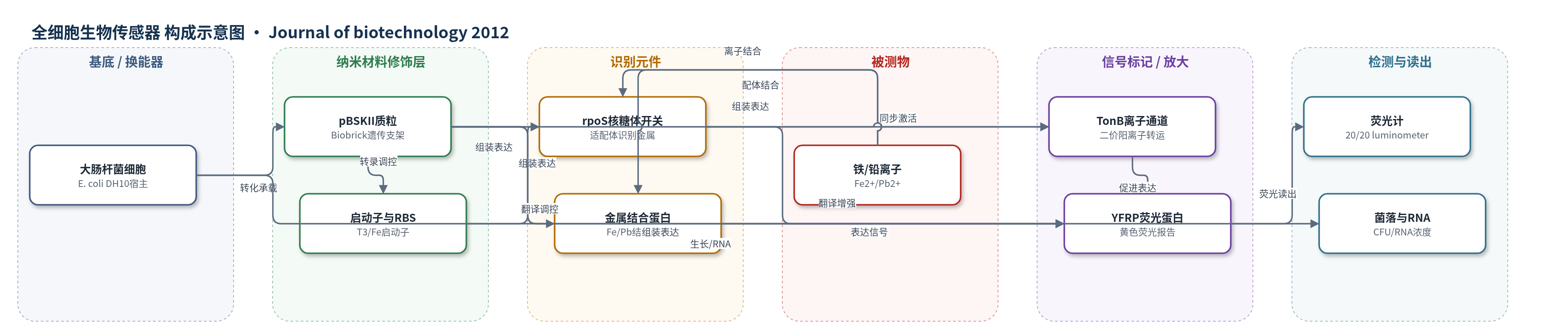
点击图片查看大图 · 依据论文自动绘制
传感器类型
全细胞生物传感器
检测对象
铁离子(Fe2+)、铅离子(Pb2+);样品基质:铁/铅硫酸盐溶液(5 µg/mL)
检测原理
该传感器以工程化大肠杆菌为活细胞换能器。当样品中的Fe2+或Pb2+进入细胞环境时,rpoS核糖体开关的适配体结合金属配体或响应氧化应激,RNA三级结构改变,使核糖体更易结合下游RBS,从而启动TonB离子通道和YFRP的翻译。TonB嵌入细胞膜后允许二价阳离子进入并在进入时被氧化,可能增强细胞代谢与ATP生成,进一步支持报告蛋白表达。YFRP表达量增加后,在20/20 luminometer中产生更高的相对荧光单位RFU;菌落数CFU和RNA浓度也同步升高。文中仅在5 µg/mL铁/铅硫酸盐溶液中验证,未给出定量浓度响应曲线。
检测灵敏度
原文未报告LOD、线性范围、灵敏度斜率或相关系数。
效应效果
该传感器以含rpoS核糖体开关–TonB离子通道的大肠杆菌为检测单元,在5 µg/mL铁或铅硫酸盐溶液中测试。与无开关装置和未转化对照相比,含开关装置在铁溶液中菌落生长更明显;荧光RFU为16,731,无开关为8227,对照为218。CFU由1×10^7 cells/mL提高到3×10^8 cells/mL,RNA由22 ng/µL提高到105 ng/µL。结果表明rpoS–TonB同步可增强翻译和荧光报告,对Fe检测较明显,Pb亦被测试但选择性/定量性能未充分验证。未报告RSD、稳定性、回收率或方法对比。作者认为可用于环境、医学、食品等领域特定金属检测。
传感器的构成
- 宿主细胞/换能器:大肠杆菌 E. coli DH10 感受态细胞,作为活细胞传感平台,承载并表达遗传元件
- 遗传支架:pBSKII 高拷贝质粒,按 Biobrick 协议组装 T3 启动子、Fe 启动子、rpoS 核糖体开关、TonB 离子通道、Fe/Pb 结合蛋白、YFRP 和终止子
- 识别/调控元件:rpoS 核糖体开关(含适配体),响应金属配体/氧化应激,改变 RNA 三级结构并调控下游翻译
- 离子通道元件:TonB 电压门控离子通道蛋白,嵌入细胞膜,允许 Fe2+ 等二价阳离子进入并在进入时被氧化
- 金属结合蛋白:Fe 结合蛋白和 Pb 结合蛋白,用于结合/识别 Fe、Pb 金属离子
- 信号报告元件:黄色荧光报告蛋白 YFRP,表达量随翻译调控增加,产生可测荧光信号
- 筛选/读出标记:氨苄青霉素抗性基因 AmpR 用于筛选转化菌落;20/20 luminometer 读取相对荧光单位 RFU
中文摘要
分子生物传感器是检测金属离子等潜在有毒化学物质的有用工具,但传统传感器在混合金属基质中效率受限。本研究采用合成生物学方法,将不同遗传元件组装到同一生物砖中,构建可在大肠杆菌中检测特定金属的微生物生物传感器。遗传元件包括同步的核糖体开关–铁离子通道、启动子、金属结合蛋白(Fe、Pb)、核糖体结合位点、黄色荧光报告蛋白(YFRP)和终止子。所用rpoS核糖体开关含适配体,可响应特定金属配体,并与铁离子通道TonB同步。该开关显著增强翻译,表现为大肠杆菌中更高的荧光强度、菌落数和RNA浓度。在铁溶液中的测试表明,利用遗传定制的同步核糖体开关–离子通道构建微生物生物传感器检测特定金属是有效的。
英文摘要
Molecular biosensors are useful tools that detect metal ions or other potentially toxic chemicals. However, the efficiency of conventional sensors is limited in mixed metals substrates, which is the common way they are found in nature. The use of biosensors constructed from genetically modified living microbial systems has the potential of providing sensitive detection systems for specific toxic targets. Consequently, our investigation was aimed at assembling different genetic building blocks to produce a focused microbial biosensor with the ability to detect specific metals. This objective was achieved by using a synthetic biology approach. Our genetic building blocks, including a synchronized ribosomal switch-iron ion channel, along with sequences of promoters, metal-binding proteins (Fe, Pb), ribosomal binding sites, yellow fluorescence reporter protein (YFRP), and terminators, were constructed within the same biobrick in Escherichia coli. We used an rpoS ribosomal switch containing an aptamer, which responds to the specific metal ligands, in synchronization with an iron ion channel, TonB. This switch significantly stimulates translation, as expressed by higher fluorescence, number of colonies, and concentration of RNA in E. coli. The positive results show the effectiveness of using genetically tailored synchronized ribosomal switch-ion channels to construct microbial biosensors to detect specific metals, as tested in iron solutions.