组成图示
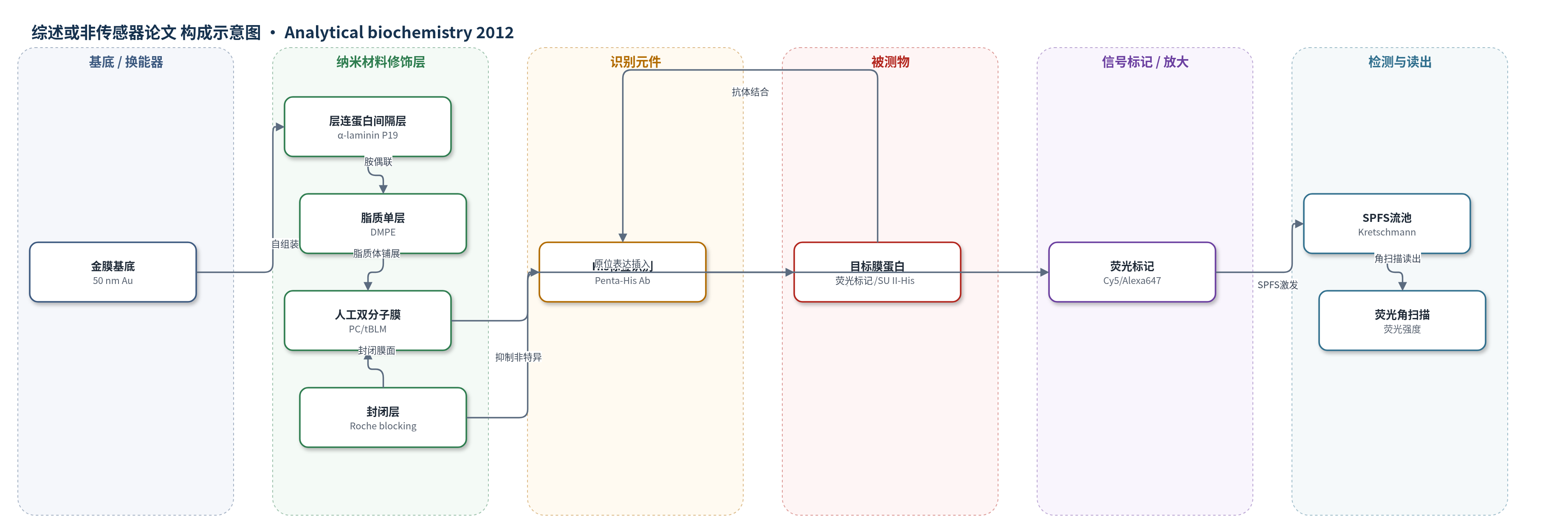
点击图片查看大图 · 依据论文自动绘制
传感器类型
综述或非传感器论文
检测对象
Cyt-bo3(cytochrome bo3 ubiquinol oxidase);样品基质:人工脂质双分子膜/无细胞表达体系
检测原理
在无细胞表达体系中,含 Cyt-bo3 基因的质粒 DNA 加入 E. coli T7 S30 提取物,在 tBLM 表面 37°C 原位翻译。Cyt-bo3 四亚基复合物在人工脂质双分子膜中折叠并插入,SU II 的 6×His 标签暴露。表达后加入封闭剂阻断膜表面非特异位点,随后 Penta-His 一抗特异性结合 His 标签;若使用二抗体系,Cy5 标记山羊抗小鼠 IgG 再结合一抗,形成荧光夹心。SPFS 在金膜 Kretschmann 结构中激发表面等离子体,增强近场荧光,角扫描得到荧光峰强度。Cyt-bo3 表达/插入量越高,结合抗体和荧光标记越多,荧光信号越强;阴性对照无 DNA 时信号低。功能上,Cyt-bo3 催化 UQH2 氧化并消耗 O2,氧电极可测耗氧速率,氰化物抑制活性。
检测灵敏度
原文未报告 LOD、线性范围、灵敏度斜率或 R^2。
效应效果
SPFS 与 SDS-PAGE/Western blot 结果一致,证明 Cyt-bo3 在 tBLM 中表达并插入;无 DNA 阴性对照荧光显著低于表达样品,说明信号来自目标蛋白。pETcyo(T7 启动子)表达量高于 pJRHisA,SPFS 荧光约高 10 倍;Western blot 估算 pETcyo 约 79.0 ng/μL,pJRHisA 约 9.1 ng/μL。in vivo 纯化蛋白在封闭条件下无插入信号,提示非特异结合被控制。酶活测试显示 pETcyo Cyt-bo3 在 25°C、400 μM UQH2 下比活为 0.1 μmol/min/mg,略低于天然/Ni-NTA 纯化蛋白,但接近细胞膜样品;氰化物抑制耗氧支持功能。数据至少三次独立测量并扣除基线。作者认为该平台可简化复杂膜蛋白表达与器件化表征。
传感器的构成
- 基底/换能器:50 nm 金膜(Au),提供 SPR/SPFS 表面等离子体激发基底
- 间隔肽层:α-laminin peptide P19,自组装于金膜,作为脂质锚定间隔层
- 偶联层:EDC/NHS 介导胺偶联,连接 P19 与 DMPE 单分子层
- 脂质单层:DMPE,形成锚定单分子层
- 人工双分子膜:PC 脂质体铺展形成 tBLM,为 Cyt-bo3 提供膜环境
- 目标膜蛋白:Cyt-bo3(SU I–IV,SU II 带 6×His),无细胞原位表达并插入 tBLM
- 识别抗体:Penta-His 一抗(Alexa Fluor 647 标记或无标记),识别 His 标签
- 荧光标记/封闭:Cy5 标记山羊抗小鼠 IgG 二抗或 Alexa Fluor 647 一抗;Roche blocking solution 封闭非特异位点
- 读出装置:自制 SPR/SPFS 流池(Kretschmann 配置,50 μL),角扫描荧光
中文摘要
膜蛋白的结构与功能分析长期面临困难,因为分离和去垢剂重构常破坏蛋白完整性。本文提出一种将无细胞蛋白合成与人工膜技术相结合的新策略,用于在体外从头合成膜蛋白并维持其结构—功能完整性,同时提供稳定基质以便分析工具表征目标膜蛋白。作者以大肠杆菌细胞色素 bo3 泛醇氧化酶(Cyt-bo3)为例,无需传统细胞培养、分离和纯化,直接实现 Cyt-bo3 的无细胞表达,并将其整合到 tethered bilayer lipid membrane(tBLM)人工平面膜中。通过表面等离子体增强荧光光谱(SPFS)检测蛋白插入,并通过耗氧实验验证酶功能。结果表明,不同体外合成体系与生物传感器应用具有兼容性,体外合成蛋白的行为与细胞来源蛋白相似。该方法适合复杂膜蛋白的可重复、稳定表达,并可为膜蛋白器件化表征提供平台。
英文摘要
The analysis of membrane proteins is notoriously difficult because isolation and detergent-mediated reconstitution often results in compromising the protein structure and function. We introduce a novel strategy of combining a cell-free expression method for synthesis of a protein species coping with one of the most important obstacles in membrane protein research-preserving the structural-functional integrity of a membrane protein species and providing a stable matrix for application of analytical tools to characterize the membrane protein of interest. We address integration and subsequent characterization of the cytochrome bo(3) ubiquinol oxidase (Cyt-bo(3)) from de novo synthesis without the effort of conventional cell culture, isolation, and purification procedures. The experimental output supports our idea of a suitable platform for in vitro protein synthesis and functional integration into a membrane-mimicking structure. We show the compatibility of different concepts of in vitro synthesis toward biosensor applicability by the example of Cyt-bo(3) protein expression. Our results obtained from in vitro synthesized proteins displayed similar behavior to proteins isolated from the cellular context. Overall, our approach is suitable for the in vitro expression of "complex" protein species such as Cyt-bo(3), which can be reproducible and stably synthesized and preserved in robust, synthetic planar membrane architecture.