组成图示
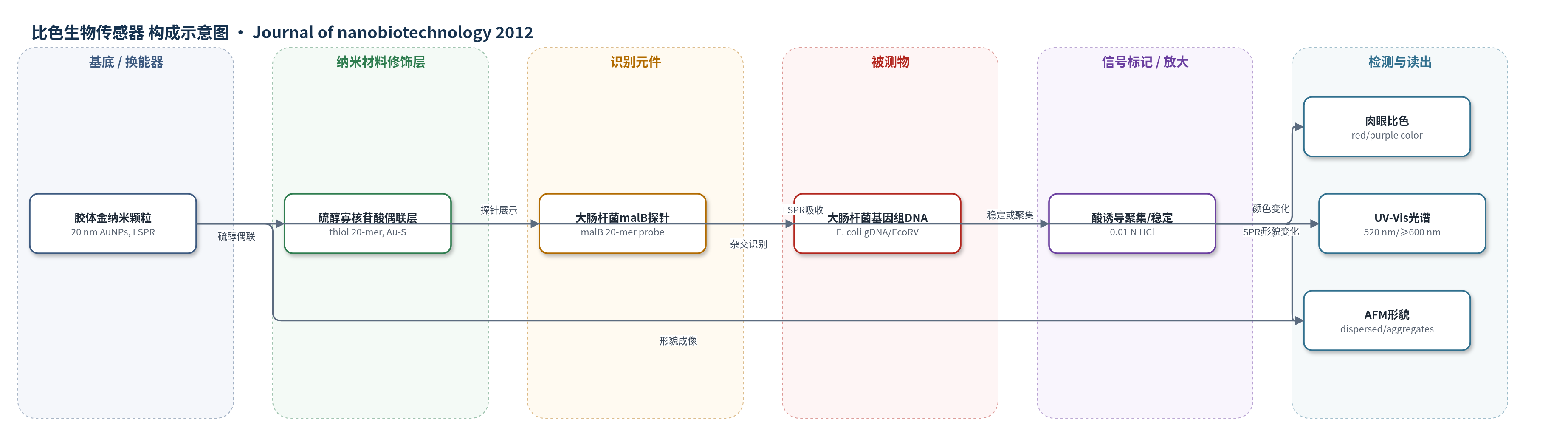
点击图片查看大图 · 依据论文自动绘制
传感器类型
比色生物传感器
检测对象
大肠杆菌基因组DNA(Escherichia coli genomic DNA, E. coli gDNA;含UPEC与E. coli O157),样品基质:临床菌株培养物提取基因组DNA、加标尿液样品。
检测原理
该检测以AuNP-oligo探针为识别与信号单元。20 nt硫醇修饰寡核苷酸通过Au-S键固定在20 nm AuNP表面,形成均相比色探针。当样品中存在大肠杆菌malB基因互补序列时,探针与目标基因组DNA在65°C杂交形成双链,双链结构增强AuNP表面稳定性,使颗粒在0.01 N HCl酸化后仍保持分散,LSPR吸收峰位于520 nm,溶液呈红色。若不存在互补DNA,单链探针AuNP在酸作用下聚集,颗粒间LSPR耦合导致吸收峰红移至≥600 nm,溶液呈紫色。目标DNA浓度越高,杂交稳定比例越大,520 nm吸收越强、红移越小;低于检出限时聚集占主导而变紫。酶切片段化可提高目标序列可及性,使检出限由约54 ng降至11.4 ng。
检测灵敏度
LOD: ~54 ng(未扩增基因组DNA);LOD: 11.4 ng(酶切未扩增基因组DNA)
效应效果
方法对31株临床大肠杆菌(含UPEC和E. coli O157)均呈阳性,对30株非大肠杆菌(肺炎克雷伯菌、铜绿假单胞菌、奇异变形杆菌、伤寒沙门菌、副伤寒A沙门菌各6株)均呈阴性,特异性和重复性达100%(n=5)。30份加标尿液UPEC样品全部检出,对铜绿假单胞菌、肺炎克雷伯菌、奇异变形杆菌零交叉,并与PCR结果一致。阳性样品室温过夜仍保持颜色,AuNP-oligo探针室温保存超过6个月,三批探针在6个月内重复阳性(n=3)。酶切预处理使实际临床样品检测限提高约5倍,DNA提取后30 min内完成,作者认为其适合低成本、快速、无需PCR的即时检测筛查。
传感器的构成
- 纳米换能层:20 nm胶体金纳米颗粒(AuNPs),提供局域表面等离子共振(LSPR)光学信号,分散态呈红色、聚集态呈紫色。
- 识别元件:5'-烷基硫醇修饰20 nt寡核苷酸探针(5'-TACAAAGGGAGAAGGGCATG-3'),通过Au-S键偶联于AuNP表面,特异性识别大肠杆菌malB基因区域互补序列。
- 目标物:大肠杆菌基因组DNA(未扩增或EcoRV酶切片段),含探针互补序列,杂交后稳定AuNP。
- 酸化触发层:0.01 N HCl,使未杂交AuNP-oligo探针聚集,诱导LSPR红移和颜色变化。
- 杂交缓冲层:10 mM PBS(pH 5),提供杂交环境并维持探针/DNA构象。
- 制备稳定层:10 mM PBS(pH 7)、NaCl、SDS,用于AuNP-oligo探针偶联、盐析纯化与分散稳定。
- 信号读出:肉眼比色观察,辅以UV-Vis光谱(520 nm峰/≥600 nm红移)与AFM聚集形貌。
中文摘要
临床与法医诊断需要高灵敏、快速且特异的DNA检测方法。PCR虽快速,但依赖熟练人员和昂贵设备。金纳米颗粒(AuNPs)因光学性质和易功能化,被用作超灵敏DNA检测信号探针。本文报道单链寡核苷酸功能化金纳米颗粒(AuNP-oligo probe)用于快速、特异性检测大肠杆菌。探针与含互补序列的目标DNA杂交后保持红色;无互补DNA时,酸诱导AuNP-oligo probe聚集而变紫。颜色变化可肉眼观察,无需PCR即可直接检测致病大肠杆菌基因组DNA。未扩增基因组DNA检出限约54 ng,DNA提取后30 min内完成;酶切未扩增基因组DNA时检出限达11.4 ng。UV-Vis和AFM支持聚集判别。临床菌株和加标尿液验证显示100%敏感、高度特异,无交叉反应。该策略可发展为低成本、稳健的即时比色DNA生物传感器。
英文摘要
BACKGROUND: In situation like diagnosis of clinical and forensic samples there exists a need for highly sensitive, rapid and specific DNA detection methods. Though conventional DNA amplification using PCR can provide fast results, it is not widely practised in diagnostic laboratories partially because it requires skilled personnel and expensive equipment. To overcome these limitations nanoparticles have been explored as signalling probes for ultrasensitive DNA detection that can be used in field applications. Among the nanomaterials, gold nanoparticles (AuNPs) have been extensively used mainly because of its optical property and ability to get functionalized with a variety of biomolecules.
RESULTS: We report a protocol for the use of gold nanoparticles functionalized with single stranded oligonucleotide (AuNP- oligo probe) as visual detection probes for rapid and specific detection of Escherichia coli. The AuNP- oligo probe on hybridization with target DNA containing complementary sequences remains red whereas test samples without complementary DNA sequences to the probe turns purple due to acid induced aggregation of AuNP- oligo probes. The color change of the solution is observed visually by naked eye demonstrating direct and rapid detection of the pathogenic Escherichia coli from its genomic DNA without the need for PCR amplification. The limit of detection was ~54 ng for unamplified genomic DNA. The method requires less than 30 minutes to complete after genomic DNA extraction. However, by using unamplified enzymatic digested genomic DNA, the detection limit of 11.4 ng was attained. Results of UV-Vis spectroscopic measurement and AFM imaging further support the hypothesis of aggregation based visual discrimination. To elucidate its utility in medical diagnostic, the assay was validated on clinical strains of pathogenic Escherichia coli obtained from local hospitals and spiked urine samples. It was found to be 100% sensitive and proves to be highly specific without any cross reaction with non-Escherichia coli strains.
CONCLUSION: This work gives entry into a new class of DNA/gold nanoparticles hybrid materials which might have optical property that can be controlled for application in diagnostics. We note that it should be possible to extend this strategy easily for developing new types of DNA biosensor for point of care detection. The salient feature of this approach includes low-cost, robust reagents and simple colorimetric detection of pathogen.