组成图示
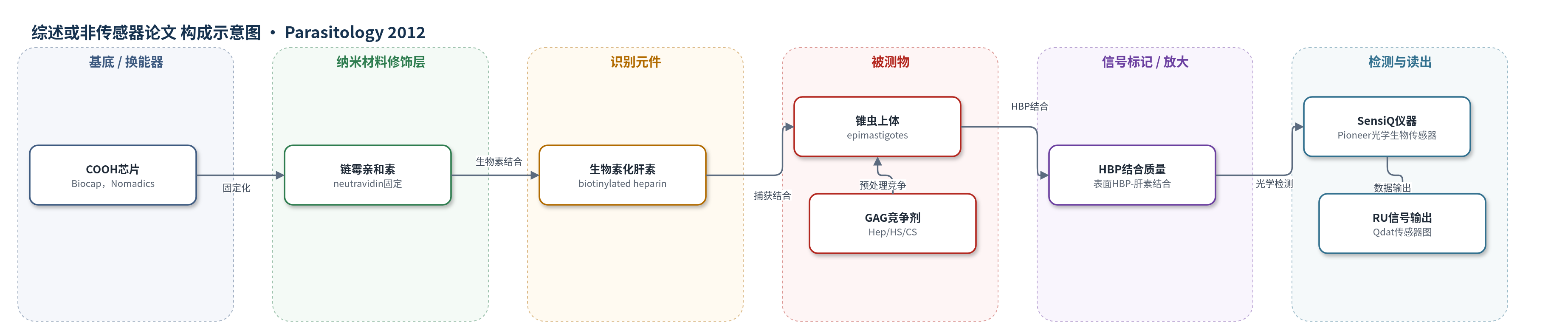
点击图片查看大图 · 依据论文自动绘制
传感器类型
综述或非传感器论文
检测对象
锥虫上体(Trypanosoma cruzi epimastigotes,PBS 缓冲液);肝素结合蛋白(HBP,寄生虫表面)
检测原理
COOH SPR芯片先固定链霉亲和素,再固定生物素化肝素,形成肝素配体界面。将PBS中的锥虫上体流过芯片时,寄生虫表面HBP与肝素发生特异性受体-配体结合,结合质量增加改变芯片表面等离子共振条件,使共振单位(RU)升高;解离阶段RU下降反映结合稳定性。肝素、HS或CS预处理可占据HBP结合位点,减少寄生虫与固定化肝素结合,RU降低。BSA阴性对照无显著结合。该体系无酶促或核酸放大,信号直接来自表面结合质量变化。
检测灵敏度
原文未报告LOD、线性范围、灵敏度斜率或相关系数。
效应效果
SPR显示锥虫上体与固定化肝素结合稳定,解离值61.62±2.87 RU,约为肝素对照8.4±1.7 RU的7.3倍;GAG竞争使结合降低39%、40%和22%,BSA无显著结合。黏附实验中,HBP预处理上皮细胞使黏附由192.5±27.4降至50.3±24.4个/100细胞,抑制3.8倍;肝素0.1和1.0 μg/ml使黏附降至0.84±0.29和0.67±0.46,HS降至102.08±18.08和29.8±12.02,C4S亦显著降低黏附,SEM证实。作者认为HBP是寄生虫-媒介识别关键靶点。
传感器的构成
- 基底/换能器:COOH羧基SPR芯片(Biocap,Nomadics),提供表面等离子共振检测界面
- 固定化层:链霉亲和素(neutravidin)固定于COOH芯片,用于捕获生物素化肝素
- 识别/配体层:生物素化肝素(biotinylated heparin,1 μg/ml)固定于链霉亲和素,作为配体捕获寄生虫表面HBP
- 分析物:锥虫上体(T. cruzi epimastigotes,10^6 cells,PBS),表面HBP与肝素结合
- 竞争抑制元件:肝素(Hep)、硫酸乙酰肝素(HS)、硫酸软骨素(CS/C4S)预处理寄生虫,竞争HBP结合位点
- 信号读出:共振单位(RU)变化,反映表面结合质量
- 读出系统:SensiQ Pioneer光学生物传感器与Qdat软件,实时记录传感器图
中文摘要
肝素结合蛋白(HBP)已被证明存在于克氏锥虫的感染型中,并参与对哺乳动物细胞的识别与侵入。本研究评估这些蛋白在寄生虫-媒介相互作用中的潜在生物学功能。通过肝素亲和层析从锥虫上体中分离出分子量分别为65.8 kDa和59 kDa的HBP,并用生物素标记的硫酸化糖胺聚糖(GAG)进行鉴定。表面等离子共振(SPR)生物传感器分析根据结合与解离值显示稳定的受体-配体结合。用GAG预处理锥虫上体可抑制寄生虫与固定化肝素的结合。竞争实验评估HBP-GAG相互作用在锥虫上体识别和黏附于Rhodnius prolixus中肠上皮细胞中的作用。上皮细胞经HBP预处理后,锥虫上体黏附被抑制3.8倍。用肝素、硫酸乙酰肝素和硫酸软骨素预处理锥虫上体显著抑制寄生虫对中肠上皮细胞的黏附,扫描电镜证实该结果。研究证明HBP位于锥虫上体表面,并在识别昆虫媒介中肠上皮细胞表面硫酸化GAG中起关键作用。
英文摘要
Heparin-binding proteins (HBPs) have been demonstrated in both infective forms of Trypanosoma cruzi and are involved in the recognition and invasion of mammalian cells. In this study, we evaluated the potential biological function of these proteins during the parasite-vector interaction. HBPs, with molecular masses of 65·8 kDa and 59 kDa, were isolated from epimastigotes by heparin affinity chromatography and identified by biotin-conjugated sulfated glycosaminoglycans (GAGs). Surface plasmon resonance biosensor analysis demonstrated stable receptor-ligand binding based on the association and dissociation values. Pre-incubation of epimastigotes with GAGs led to an inhibition of parasite binding to immobilized heparin. Competition assays were performed to evaluate the role of the HBP-GAG interaction in the recognition and adhesion of epimastigotes to midgut epithelial cells of Rhodnius prolixus. Epithelial cells pre-incubated with HBPs yielded a 3·8-fold inhibition in the adhesion of epimastigotes. The pre-treatment of epimastigotes with heparin, heparan sulfate and chondroitin sulfate significantly inhibited parasite adhesion to midgut epithelial cells, which was confirmed by scanning electron microscopy. We provide evidence that heparin-binding proteins are found on the surface of T. cruzi epimastigotes and demonstrate their key role in the recognition of sulfated GAGs on the surface of midgut epithelial cells of the insect vector.