组成图示
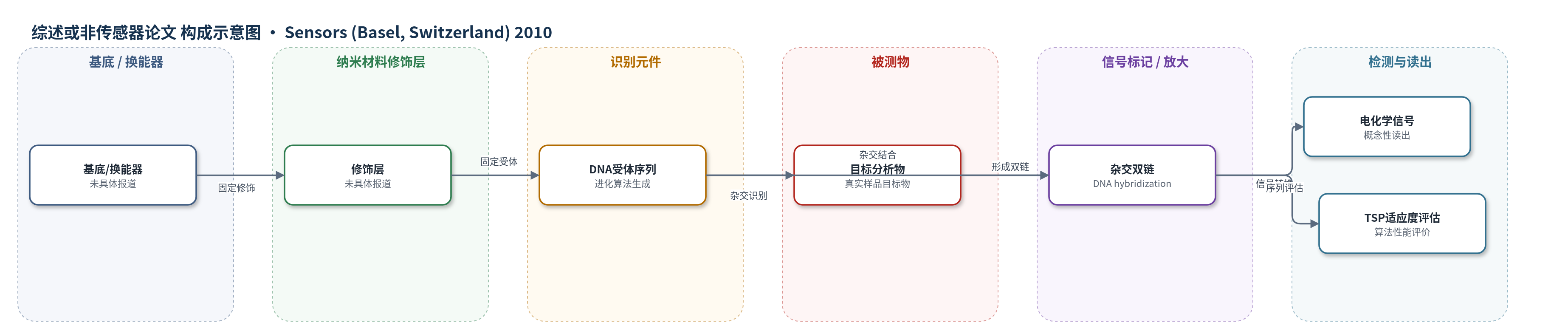
点击图片查看大图 · 依据论文自动绘制
传感器类型
综述或非传感器论文
检测对象
未明确具体被测物;目标分析物(target analyte),样品基质:真实目标样品(real target analyte samples),未具体说明。
检测原理
本文未构建实际传感装置,而是提出DNA生物传感器识别序列设计算法。其核心是将目标DNA序列按起始密码子ATG和终止密码子TAA/TGA/TAG编码为图论中的顶点、边与权重,利用进化编程生成可变长候选受体序列,并通过适应度评价、两点交叉和碱基变异筛选稳定序列。后处理模拟DNA计算中的合成、分离、PCR和凝胶电泳,以抗体亲和反应选择通过所有顶点一次的路径。若将该受体用于DNA生物传感器,识别事件为受体DNA与目标分析物互补杂交,形成双链并改变界面状态,再由换能器转换为电信号;文中未报告具体换能机制、信号放大策略或浓度-响应关系。
检测灵敏度
原文未报告LOD、线性范围、灵敏度斜率或相关系数。
效应效果
论文仅评估算法性能,未报告实际样品检测、选择性、抗干扰、稳定性、重现性(RSD)或加标回收率。实验在2 GHz P4 PC、512 MB RAM上以C语言模拟,总反应次数设为1000次,序列长度10–20 bp。表4显示10顶点时,本文算法搜索时间为3.92×10^4 s,Adleman算法为7.83×10^4 s,约降低50%;文中称平均适应度更高,但表4数值为0.747对0.927,存在表述不一致。适应度曲线显示本文算法第8代后稳定,第31代找到成功路径,而Adleman算法第52代才找到。作者主张该算法更适合生成稳定、可变长的DNA生物受体序列。
传感器的构成
- 识别元件:DNA生物受体识别分子(DNA bioreceptor recognition molecule),由进化算法生成,用于与目标分析物杂交
- 换能器:文中仅概念性提及电化学装置与换能器(electro-chemical device and transducer),未给出具体材料
- 基底/电极:未报道具体基底或电极材料
- 纳米材料修饰层:未报道
- 信号标记物:未报道
- 封闭剂/电子供体:未报道
中文摘要
生物传感器由生物受体、识别分子和信号换能器组成,可选择性检测目标物质。基于DNA的生物传感器利用能与目标分析物杂交的受体分子,但多数研究以寡核苷酸为目标,未考虑真实样品中识别分子选择的问题。本文分析DNA作为生物受体的特性,提出一种基于DNA计算的混合进化式DNA序列生成算法,用于筛选可与真实目标物质稳定杂交的DNA生物受体识别分子。算法将旅行商问题(TSP)用于评估生成序列的安全性与适应度,通过编码、初始化、适应度评价、交叉、变异及后处理中的合成、分离、PCR和凝胶电泳等步骤,实现可变长DNA序列的生成与筛选。结果表明,该算法可提高序列生成效率与稳定性,并支持不同受体识别需求下的可变长序列扩展。
英文摘要
A biosensor is composed of a bioreceptor, an associated recognition molecule, and a signal transducer that can selectively detect target substances for analysis. DNA based biosensors utilize receptor molecules that allow hybridization with the target analyte. However, most DNA biosensor research uses oligonucleotides as the target analytes and does not address the potential problems of real samples. The identification of recognition molecules suitable for real target analyte samples is an important step towards further development of DNA biosensors. This study examines the characteristics of DNA used as bioreceptors and proposes a hybrid evolution-based DNA sequence generating algorithm, based on DNA computing, to identify suitable DNA bioreceptor recognition molecules for stable hybridization with real target substances. The Traveling Salesman Problem (TSP) approach is applied in the proposed algorithm to evaluate the safety and fitness of the generated DNA sequences. This approach improves efficiency and stability for enhanced and variable-length DNA sequence generation and allows extension to generation of variable-length DNA sequences with diverse receptor recognition requirements.