组成图示
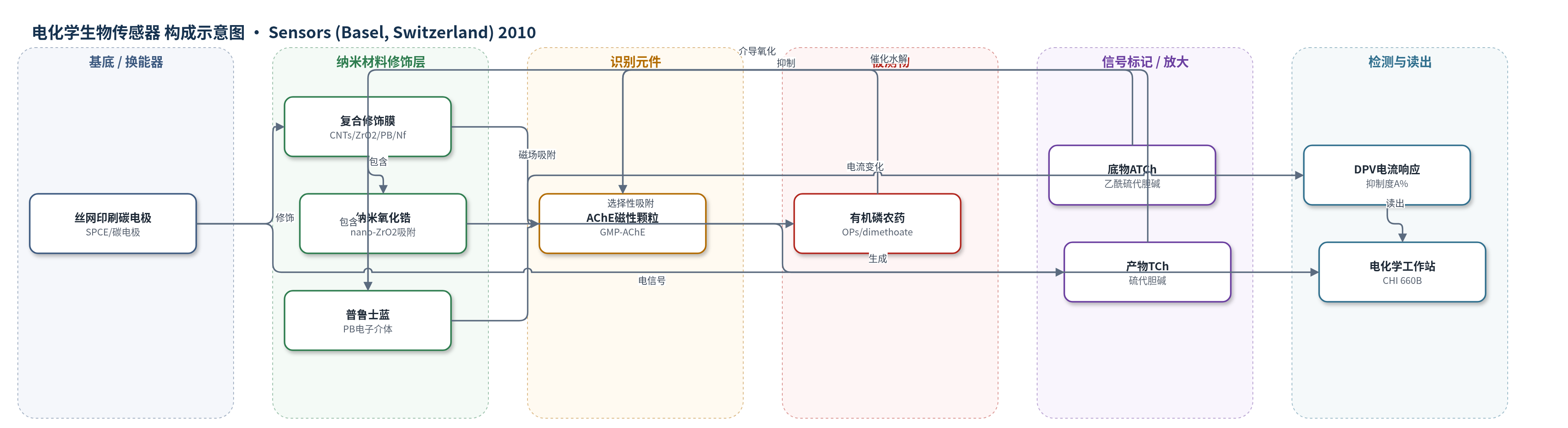
点击图片查看大图 · 依据论文自动绘制
传感器类型
电化学生物传感器
检测对象
有机磷农药(organophosphorus pesticides, OPs),代表物灭多威(dimethoate);样品基质:白菜(Chinese cabbage)丙酮提取物及加标样品、KNO3 缓冲液
检测原理
该传感器基于 AChE 抑制机制。AChE 催化底物 ATCh 水解生成 TCh,PB 作为电子转移介体在低过电位下介导 TCh 的氧化还原,在 SPCE 上产生可测电流。当样品中存在 OPs 时,OPs 与 AChE 活性位点结合并抑制其催化活性,TCh 生成量减少,PB 还原电流下降。通过比较抑制前后电流 I0 与 I,计算抑制度 A%=(I0-I)/I0×100%,A% 随 OPs 浓度升高而增大。CNTs 和 GMP 增大电极界面面积并促进电子转移,nano-ZrO2 对有机磷磷酸基团具有亲和吸附作用,可增强选择性并降低干扰,PB 降低酶反应介导电位,从而提高灵敏度。
检测灵敏度
LOD: 5.6 × 10⁻⁴ ng·mL-1 (S/N = 3);线性范围: 1.0 × 10⁻³–10 ng·mL-1;回归方程: A% = 148.13-11.20c;R^2 = 0.9983
效应效果
优化条件下检测时间为 10 min,4 °C 保存 30 d 和 40 d 后响应保持 93.0% 和 88.0%。同一电极对 1、5、10 ng/mL 灭多威重复检测 RSD 为 3.2%、3.5%、2.9%(n=5),不同电极 RSD 为 5.2%(n=4)。移除磁场并重新吸附 GMP-AChE 后响应恢复 97.0%,可再生。白菜加标回收率 88.0%–105%,与 GC 法一致。与 AChE/Au//PB/GCE、AChE/Nf/TCNQ/SPCE 和 AChE/Au-Fe3O4/GCE 相比,线性范围和检出限更优;加入 ZrO2 后线性范围由 5.0×10^-2–10 ng/mL 扩展至 1.0×10^-3–10 ng/mL,LOD 由 2.0×10^-2 ng/mL 降至 5.6×10^-4 ng/mL,适合蔬菜中 OPs 快速筛查。
传感器的构成
- 基底/换能器电极:丝网印刷碳电极(SPCE),含碳工作电极、碳辅助电极和 Ag/AgCl 参比电极,提供电化学检测平台。
- 复合修饰膜:CNTs/nano-ZrO2/PB/Nafion(Nf)复合膜,CNTs 促进电子转移,nano-ZrO2 选择性吸附有机磷,PB 作电子转移介体,Nf 成膜固定。
- 磁性酶纳米颗粒:Fe3O4/Au 磁性纳米颗粒(GMP)负载乙酰胆碱酯酶(AChE),形成 GMP-AChE,经外磁场吸附于膜表面。
- 识别/催化元件:AChE 催化水解底物 ATCh,被有机磷农药(OPs)抑制。
- 底物与介体信号链:ATCh 水解生成 TCh,PB 介导 TCh 氧化还原产生电流。
- 外部磁场:NdFeB 磁铁,用于吸附和移除 GMP-AChE,实现一次性/再生。
中文摘要
本文报道了一种基于磁性复合纳米颗粒修饰丝网印刷碳电极(SPCE)的一次性有机磷农药(OPs)酶生物传感器。首先合成乙酰胆碱酯酶(AChE)负载的 Fe3O4/Au 磁性纳米颗粒(GMP-AChE),再在外磁场作用下将其吸附到由碳纳米管(CNTs)、纳米氧化锆(nano-ZrO2)、普鲁士蓝(PB)和 Nafion(Nf)复合膜修饰的 SPCE 表面,构建 SPCE│CNTs/ZrO2/PB/Nf│GMP-AChE 传感器。采用扫描电镜和 X 射线荧光光谱表征表面,并用循环伏安法和差分脉冲伏安法研究电化学性能。检测时,AChE 催化乙酰硫代胆碱(ATCh)水解生成硫代胆碱(TCh),PB 介导其氧化还原产生电流;OPs 抑制 AChE 活性后电流下降,抑制度 A% 与 OPs 浓度相关。在 pH 7.5 KNO3 中,对灭多威(dimethoate)在 1.0×10^-3–10 ng/mL 呈线性,检出限 5.6×10^-4 ng/mL。白菜样品回收率为 88%–105%,与气相色谱法一致。该传感器灵敏、选择性好、可一次性使用且表面可经磁场移除再生。
英文摘要
A disposable organophosphorus pesticides (OPs) enzyme biosensor based on magnetic composite nanoparticle-modified screen printed carbon electrodes (SPCE) has been developed. Firstly, an acetylcholinesterase (AChE)-coated Fe(3)O(4)/Au (GMP) magnetic nanoparticulate (GMP-AChE) was synthesized. Then, GMP-AChE was absorbed on the surface of a SPCE modified by carbon nanotubes (CNTs)/nano-ZrO(2)/prussian blue (PB)/Nafion (Nf) composite membrane by an external magnetic field. Thus, the biosensor (SPCE│CNTs/ZrO(2)/PB/Nf│GMP-AChE) for OPs was fabricated. The surface of the biosensor was characterized by scanning electron micrography (SEM) and X-ray fluorescence spectrometery (XRFS) and its electrochemical properties were studied by cyclic voltammetry (CV) and differential pulse voltammetry (DPV). The degree of inhibition (A%) of the AChE by OPs was determined by measuring the reduction current of the PB generated by the AChE-catalyzed hydrolysis of acetylthiocholine (ATCh). In pH = 7.5 KNO(3) solution, the A was related linearly to the concentration of dimethoate in the range from 1.0 × 10(-3)-10 ng · mL(-1) with a detection limit of 5.6 × 10(-4) ng · mL(-1). The recovery rates in Chinese cabbage exhibited a range of 88%-105%. The results were consistent with the standard gas chromatography (GC) method. Compared with other enzyme biosensors the proposed biosensor exhibited high sensitivity, good selectivity with disposable, low consumption of sample. In particular its surface can be easily renewed by removal of the magnet. The convenient, fast and sensitive voltammetric measurement opens new opportunities for OPs analysis.