组成图示
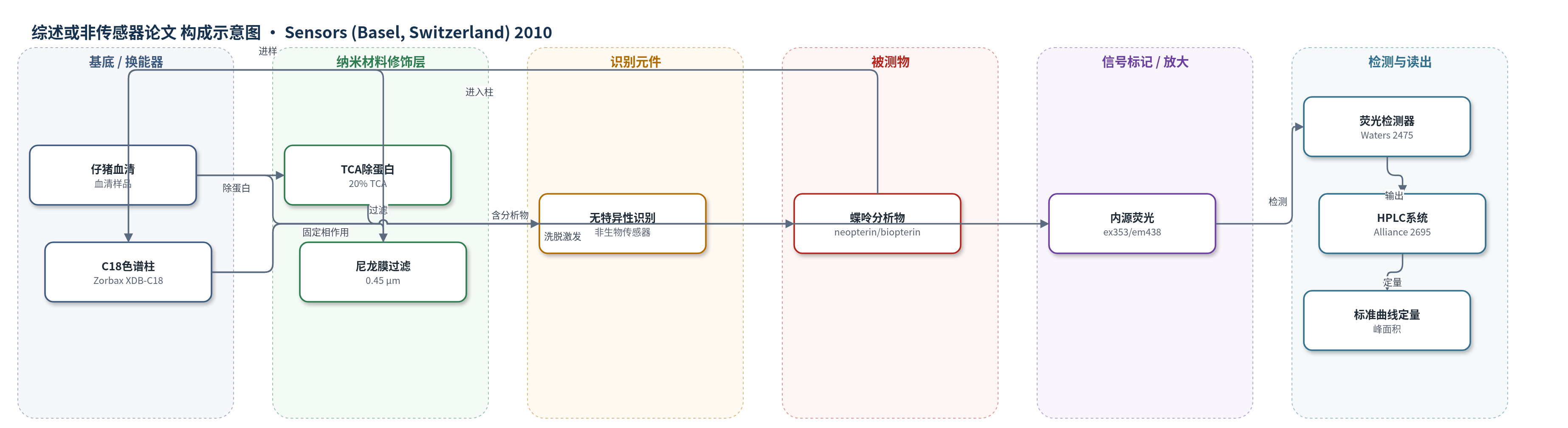
点击图片查看大图 · 依据论文自动绘制
传感器类型
综述或非传感器论文
检测对象
新蝶呤(neopterin)、生物蝶呤(biopterin)、皮质醇(cortisol)、铁(Fe);样品基质:仔猪血清(铁为血浆)
检测原理
本文并非基于特异性识别元件的生物传感器,而是采用 HPLC 检测血清生物标志物。Fe3+-右旋糖酐注射后,仔猪体内铁负荷升高并诱发免疫激活,单核/巨噬细胞在 IFN-γ 等刺激下增加新蝶呤和生物蝶呤合成,使血清浓度随应激/免疫激活程度升高。样品经 20% TCA 除蛋白、0.45 μm 过滤后,在 C18 反相柱上以水/乙腈等度洗脱分离;蝶呤具有内源荧光,在 353 nm 激发、438 nm 发射下被检测,峰面积随浓度线性增加。皮质醇经 SPE 富集后以 UV 245 nm 检测,铁与 ferrozine 形成有色配合物后光度检测。
检测灵敏度
LOD: neopterin 0.5 ng/mL (3 S/N);biopterin 1.3 ng/mL;cortisol 20.1 ng/mL (3 S/N);线性范围: neopterin 0.6–250 ng/mL (y = 9369.5x + 2111.4; R^2 = 0.999);biopterin 1.6–52.0 ng/mL (y = 18602x – 7446; R^2 = 0.999);cortisol 0.01–20.0 μg/mL (y = 23.71x + 538.87; R^2 = 0.999);定量限: neopterin 1.49 ng/mL (10 S/N);biopterin 4.33 ng/mL;cortisol 64.6 ng/mL (10 S/N)
效应效果
实验组血清铁浓度较对照组高约一个数量级,24 h 达 331.03±44.82 ng/mL,对照组 22.92±6.31 ng/mL。新蝶呤在 1、4、24 h 均显著高于对照,生物蝶呤在 1、4、24 h 也显著升高;皮质醇在 24 h 两组均升高至 502.39±89.35 和 501.56±157.77 nmol/L,提示其受操作应激影响而非铁右旋糖酐特异响应。白细胞计数变化亦主要反映应激。方法回收率为新蝶呤 91%、生物蝶呤 94%、皮质醇 89%,峰保留时间用于识别。作者认为蝶呤可作为评价仔猪免疫激活和铁应激的补充指标,但个体应激差异导致重复样品变异较大。
传感器的构成
- 样品基质:仔猪血清,提供新蝶呤、生物蝶呤和皮质醇等分析物
- 前处理层:20% 三氯乙酸(TCA),沉淀蛋白并释放分析物
- 过滤层:0.45 μm 尼龙膜,去除颗粒杂质
- 分离层:Zorbax Eclipse XDB-C18 柱(150×4.6 mm,5 μm),反相 HPLC 分离蝶呤
- 流动相:水/乙腈(97:3, v/v),等度洗脱
- 检测器:Waters 2475 荧光检测器,ex 353 nm/em 438 nm 检测蝶呤内源荧光
- 标准品:新蝶呤、生物蝶呤和皮质醇标准品,用于峰识别与定量
中文摘要
本研究旨在评估单次注射 Fe3+-右旋糖酐对仔猪免疫细胞计数及蝶呤类生物分子生成的影响,并将新蝶呤和生物蝶呤作为仔猪免疫系统激活的新型传感器,同时测定皮质醇这一传统应激激素生物传感器。仔猪血清中的新蝶呤和生物蝶呤采用反相高效液相色谱法分离检测。单次 Fe3+-右旋糖酐给药在实验仔猪体内造成特殊应激状态,表现为实验组新蝶呤(p<0.05)和生物蝶呤(p<0.01)生成显著增加。皮质醇浓度和白细胞计数的变化主要受操作应激影响,与铁右旋糖酐给药无特异性相关。实验组内环境铁浓度较对照组高约一个数量级,给药后 24 h 血清铁浓度达到最高(p<0.01)。研究结果为动物机体应激状态评价提供新视角,并补充了蝶呤在家畜动物中作用的研究资料。
英文摘要
The aim of the presented study was to assess the effect of a single administration of Fe(3+)-dextran on immune cell counts and pterin biomolecule production as novel sensors of the piglets' immune system activation, and to determine concentrations of cortisol, a traditional hormonal biosensor of the stress response. Pterins (neopterin and biopterin) in the piglets' blood serum were analyzed by separation using reversed-phase HPLC. A single dose of Fe(3+)-dextran produced a special stress situation in the piglets' organism which manifested itself by an increased production of neopterin (p < 0.05) and biopterin (p < 0.01) in the experimental piglets. Changes in cortisol concentrations and leukocyte counts were influenced by handling stress and were not specifically correlated to iron dextran application. Iron concentrations in the internal environment of the experimental piglets' group were higher by an order of magnitude compared with the controls, and the highest serum concentrations of iron (p < 0.01) were reached 24 h following Fe(3+)-dextran administration. The data presented offer a new perspective on the evaluation of stress situations in the animal organism and, not least importantly, extends the rather modest current list of references on the role of pterins in livestock animals.