组成图示
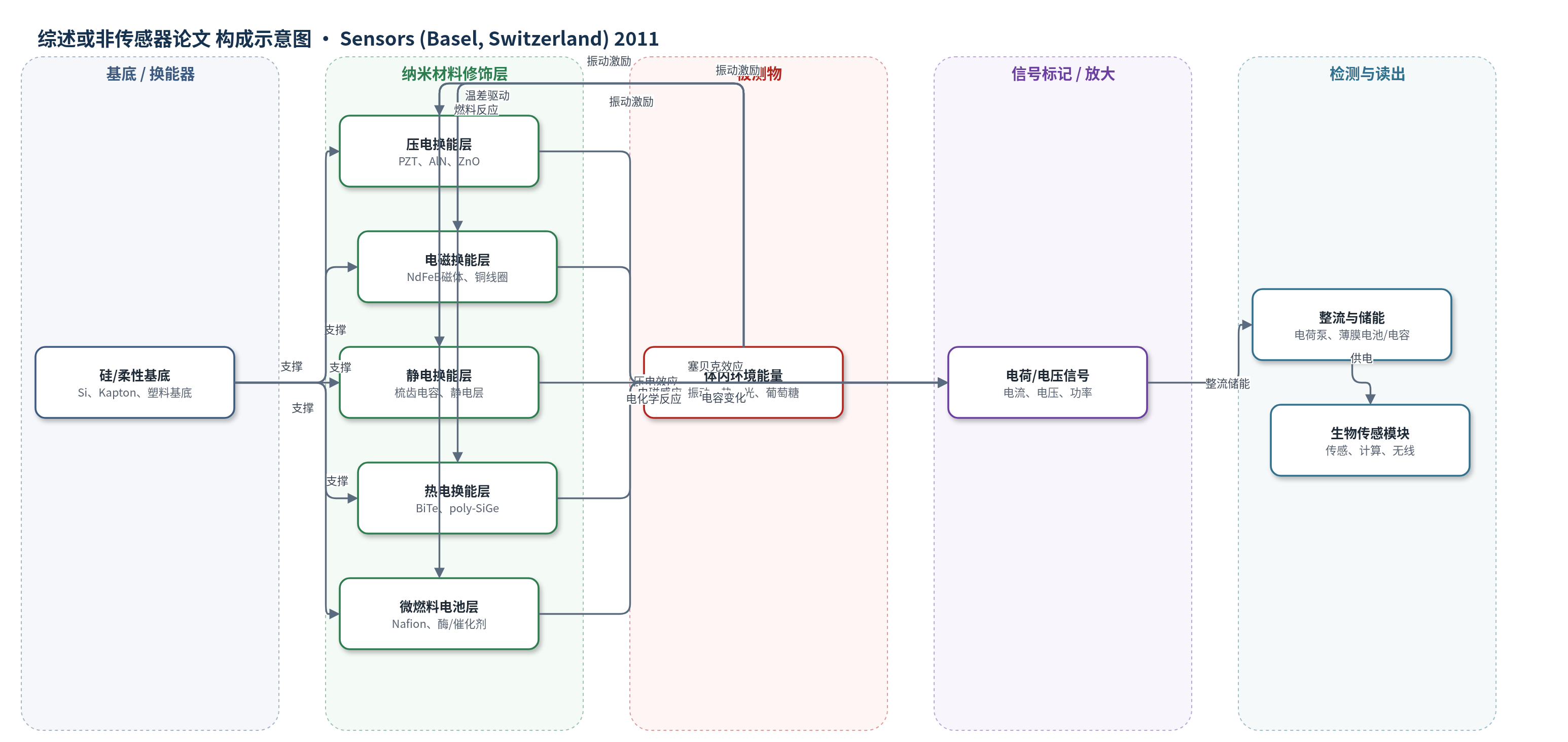
点击图片查看大图 · 依据论文自动绘制
传感器类型
综述或非传感器论文
检测对象
无单一检测对象;综述面向植入式生物传感,可监测关节/植入体载荷、生命体征、骨整合等(体内组织、体液、血液)
检测原理
本文不报道单一生物传感检测原理,而是比较植入式生物传感微发电机制。环境能量作为输入:机械振动使压电薄膜产生应变,通过直接压电效应在电极间形成电荷;永磁体与线圈相对运动改变磁通,通过电磁感应产生电动势;振动改变梳齿电容,配合静电层或电荷泵实现电荷转移;体内外温差驱动热电偶,通过塞贝克效应产生电势;葡萄糖或氢碳燃料在微燃料电池中与氧化剂发生电化学反应,电子经外电路形成电流。输出电功率随振动频率/加速度、温差、光照强度或燃料浓度变化,经整流、储能后为传感、计算和无线模块供电。
检测灵敏度
原文未报告传感检测限(LOD)、线性范围、灵敏度斜率或相关系数。
效应效果
本文综述比较多种微发电技术:光伏可产生约500 µW至1 W,但依赖强光;热电在手腕等部位可产生4.5 µW/cm2至100 µW,P3微热机约0.8 µW;葡萄糖微燃料电池约50–430 µW/cm2,氢碳基微燃料电池约9 mW/cm2–750 mW/cm2;静电式约20–116 µW/cm2,出平面型约100 µW/cm2;电磁式约12.5 µW、45 nW、386.46 µW至6.6 mW;压电式约375 µW、10 mW、2.7 mW/cm3。作者认为环境能量收集比燃料方案更适合植入式应用,压电与电磁功率密度高,可补充或替代电池,减小体积并降低侵入性。
传感器的构成
- 综述说明:本文未报道单一传感器,主要比较植入式生物传感微发电模块的典型构成
- 基底/换能器:硅、聚酰亚胺/Kapton、柔性塑料基底,用于承载微结构并传递机械、热或电信号
- 压电换能层:PZT、AlN、ZnO 薄膜或 ZnO 纳米线,将振动或压力应变转换为电荷
- 电磁换能层:NdFeB 永磁体与铜线圈,利用相对运动改变磁通并感应电流
- 静电换能层:梳齿电容、SiO2/Si3N4 静电层或电荷泵,通过振动改变电容并转移电荷
- 热电换能层:BiTe、poly-SiGe、Al/n-poly-Si 热电偶,利用温差产生电势
- 微燃料电池层:Nafion 质子交换膜、NiO/YSZ 阳极、La0.8Sr0.2MnO3 阴极、葡萄糖酶/微生物/非生物催化剂,将燃料与氧化剂反应转化为电流
- 封装/生物相容层:PDMS、硅胶或聚合物封装,隔离 PZT 等潜在细胞毒性材料并保护器件
- 功率管理/读出:整流、电荷泵、薄膜电池/电容储能,将微功率调节后供给生物传感模块
中文摘要
植入式生物传感在医学监测与诊断中具有吸引力,可实时监测关节或植入体上的物理载荷、生命体征以及体内骨整合等现象。基于微机电系统(MEMS)的发电技术可通过产生电能来替代或补充现有电池供电系统,从而实现植入式生物传感器的自主运行。补充电池系统可延长传感器工作寿命;同时,更高的可用功率允许在生物传感模块中增加计算、无线通信等组件,提升功能与性能。本文评估了光伏、热电、微燃料电池、静电、电磁和压电等发电方案在植入式生物传感中的适用性。与燃料型方案相比,收集振动等环境能量的 MEMS 发电技术更适合植入式生物传感,可产生毫瓦级电功率。压电和电磁等高功率密度 MEMS 方案可为生物传感应用提供补充或替代电源,改善器件能力与性能,并有助于进一步小型化,减少对较大电池的需求,使植入式生物传感器侵入性更低,提高患者护理质量。
英文摘要
Implantable biosensing is attractive for both medical monitoring and diagnostic applications. It is possible to monitor phenomena such as physical loads on joints or implants, vital signs, or osseointegration in vivo and in real time. Microelectromechanical (MEMS)-based generation techniques can allow for the autonomous operation of implantable biosensors by generating electrical power to replace or supplement existing battery-based power systems. By supplementing existing battery-based power systems for implantable biosensors, the operational lifetime of the sensor is increased. In addition, the potential for a greater amount of available power allows additional components to be added to the biosensing module, such as computational and wireless and components, improving functionality and performance of the biosensor. Photovoltaic, thermovoltaic, micro fuel cell, electrostatic, electromagnetic, and piezoelectric based generation schemes are evaluated in this paper for applicability for implantable biosensing. MEMS-based generation techniques that harvest ambient energy, such as vibration, are much better suited for implantable biosensing applications than fuel-based approaches, producing up to milliwatts of electrical power. High power density MEMS-based approaches, such as piezoelectric and electromagnetic schemes, allow for supplemental and replacement power schemes for biosensing applications to improve device capabilities and performance. In addition, this may allow for the biosensor to be further miniaturized, reducing the need for relatively large batteries with respect to device size. This would cause the implanted biosensor to be less invasive, increasing the quality of care received by the patient.