组成图示
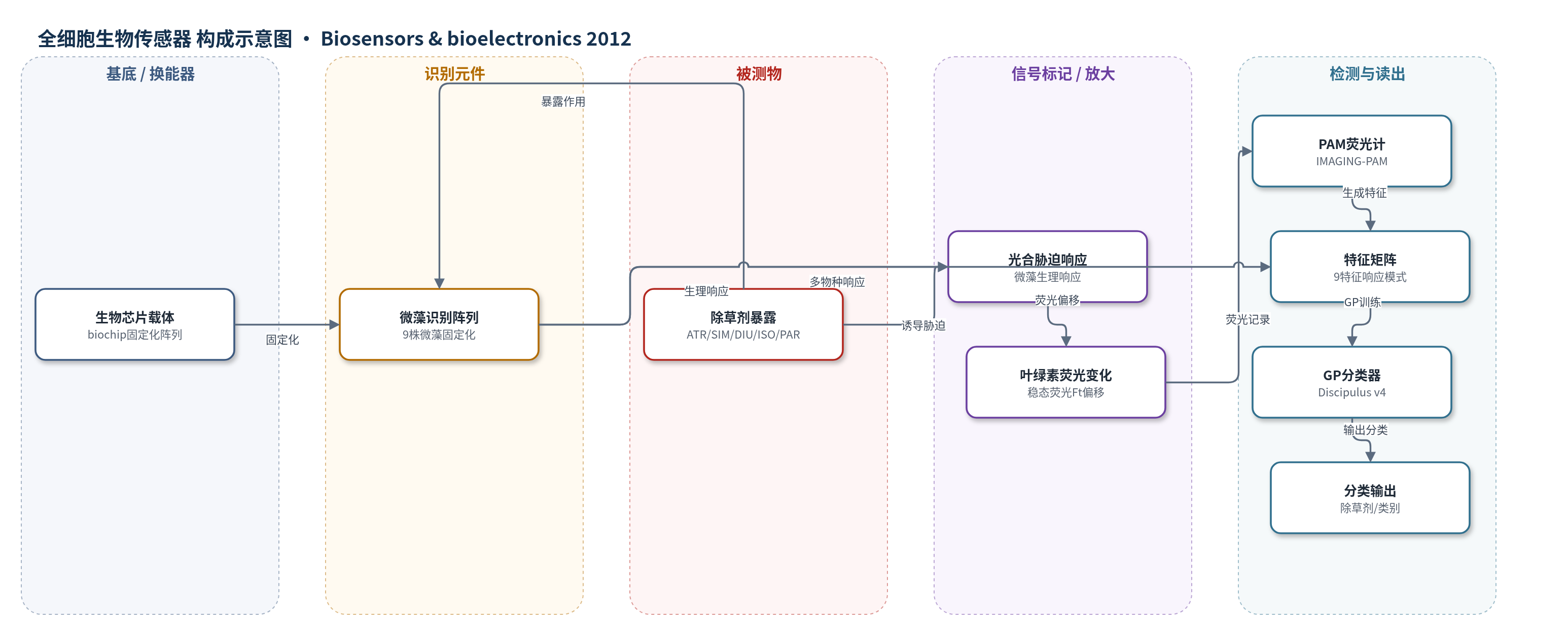
点击图片查看大图 · 依据论文自动绘制
传感器类型
全细胞生物传感器
检测对象
莠去津(atrazine, ATR)、西玛津(simazine, SIM)、莠灭净(diuron, DIU)、异丙甲草胺(isoproturon, ISO)、百草枯(paraquat, PAR);样品基质:除草剂水溶液暴露样品(0.05–500 µg L−1)
检测原理
该传感器为全细胞非特异性检测系统:9株微藻固定化于芯片上,暴露于除草剂后,不同微藻的光合系统受到不同程度胁迫,导致稳态叶绿素荧光Ft相对无药对照发生特征性偏移。PAM成像荧光计每2 min记录一次荧光,20 min内形成由9株微藻响应组成的特征矩阵。该矩阵不是单一浓度响应,而是多物种响应模式。GP以训练集为目标类(class 1)与非目标类(class 0)数据,通过进化生成二分类器,从复杂模式中提取物质特异性信息,从而识别单个除草剂或化学类别。信号放大主要依赖多物种阵列产生的模式差异和机器学习分类,而非化学或酶促放大。
检测灵敏度
原文未报告LOD、线性范围、灵敏度斜率或相关系数。
效应效果
GP生成的7类二分类器(5种除草剂和2个除草剂类别,每类5次重复)均能统计显著区分目标与非目标数据(p<0.05)。在GP应用数据和参考数据中,目标类正确阳性率多数达80%以上,非目标类假阳性率多为0–40%;多数分类器假阳性率低于20%,真阴性率(specificity)多≥80%。GP应用数据中40%分类器正确分类率≥95%,参考数据中为23.3%。训练需数分钟至数小时,未知样本可由生成的计算机程序实时分类。作者认为增加训练数据集和生物多样性可进一步提高灵敏度与特异性,并建议建立优先污染物分类器库用于环境监测。
传感器的构成
- 换能器/读出设备:脉冲幅度调制成像叶绿素荧光计(IMAGING-PAM,H. Walz GmbH),用于激发并记录微藻叶绿素荧光。
- 固定化阵列:生物芯片(biochip)上并行固定化9株微藻,形成多物种全细胞识别阵列。
- 识别元件:9株微藻(Chlamydomonas sp.、Chlorella vulgaris、Cryptomonas sp.、Eudorina elegans、Haematococcus pluvialis、Pseudokirchneriella subcapitata、Scherffelia dubia、Staurodesmus convergens、Synechocystis sp.、Tetraselmis cordiformis),作为非特异性生物识别元件。
- 信号产生层:微藻光合系统受除草剂胁迫后稳态叶绿素荧光(Ft)相对无药对照发生偏移,产生响应信号。
- 数据/分类层:GP软件(Discipulus Professional v4.0)将9株微藻响应作为特征矩阵,生成二分类器以识别除草剂或除草剂类别。
中文摘要
全细胞生物传感器对污染物通常缺乏特异性,但可用于环境监测。为充分利用其多响应特性,需要稳健的分类方法从传感器信号中识别被测物。本文评估遗传编程(GP)用于基于多物种微藻全细胞生物传感器响应模式识别除草剂及除草剂类别。作者重新分析先前报道的芯片化微藻阵列生物传感器数据,该传感器固定化9株微藻,通过脉冲幅度调制成像叶绿素荧光计记录除草剂暴露20 min内每2 min的稳态叶绿素荧光变化。以9株微藻响应为特征,利用商业GP软件Discipulus生成针对5种除草剂(莠去津、西玛津、莠灭净、异丙甲草胺、百草枯)和2个化学类别(三嗪类、苯基脲类)的二分类器。结果表明,GP生成的分类器可统计显著区分目标与非目标数据,多数分类器对测试集的正确阳性率约80–95%,多数假阳性率低于20%。研究首次将GP与生物传感器结合,证明其能从复杂响应模式中提取物质特异性信息,用于未知样品中污染物分类。
英文摘要
Whole-cell biosensors are mostly non-specific with respect to their detection capabilities for toxicants, and therefore offering an interesting perspective in environmental monitoring. However, to fully employ this feature, a robust classification method needs to be implemented into these sensor systems to allow further identification of detected substances. Substance-specific information can be extracted from signals derived from biosensors harbouring one or multiple biological components. Here, a major task is the identification of substance-specific information among considerable amounts of biosensor data. For this purpose, several approaches make use of statistical methods or machine learning algorithms. Genetic Programming (GP), a heuristic machine learning technique offers several advantages compared to other machine learning approaches and consequently may be a promising tool for biosensor data classification. In the present study, we have evaluated the use of GP for the classification of herbicides and herbicide classes (chemical classes) by analysis of substance-specific patterns derived from a whole-cell multi-species biosensor. We re-analysed data from a previously described array-based biosensor system employing diverse microalgae (Podola and Melkonian, 2005), aiming on the identification of five individual herbicides as well as two herbicide classes. GP analyses were performed using the commercially available GP software 'Discipulus', resulting in classifiers (computer programs) for the binary classification of each individual herbicide or herbicide class. GP-generated classifiers both for individual herbicides and herbicide classes were able to perform a statistically significant identification of herbicides or herbicide classes, respectively. The majority of classifiers were able to perform correct classifications (sensitivity) of about 80-95% of test data sets, whereas the false positive rate (specificity) was lower than 20% for most classifiers. Results suggest that a higher number of data sets may lead to a better classification performance. In the present paper, GP-based classification was combined with a biosensor for the first time. Our results demonstrate GP was able to identify substance-specific information within complex biosensor response patterns and furthermore use this information for successful toxicant classification in unknown samples. This suggests further research to assess perspectives and limitations of this approach in the field of biosensors.