组成图示
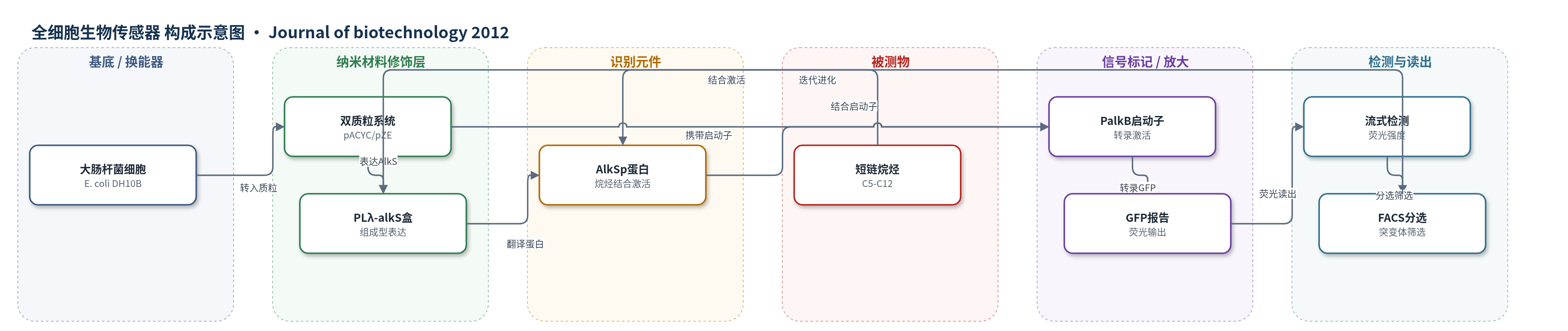
点击图片查看大图 · 依据论文自动绘制
传感器类型
全细胞生物传感器
检测对象
线性烷烃(戊烷 pentane/C5、己烷 hexane/C6、庚烷 heptane/C7、辛烷 octane/C8、壬烷 nonane/C9、癸烷 decane/C10、十一烷 undecane/C11、十二烷 dodecane/C12);样品基质:M9 培养基/水相培养液(8.33% v/v 烷烃诱导剂,密封管)
检测原理
短链烷烃扩散进入大肠杆菌细胞,与组成型表达的 AlkSp 结合,使转录调控蛋白发生构象激活;激活的 AlkSp 结合 PalkB 启动子,驱动下游 GFP 报告基因转录与翻译。GFP 积累产生荧光,荧光强度随烷烃生物利用度/浓度升高而增强。由于 GFP 表达具有细胞内转录放大,低浓度诱导剂可产生可检测信号。通过 error-prone PCR 和 FACS 对 alkS 定向进化,S470T 等突变改变 AlkS 烷烃结合口袋,提高对 C5–C9 短链烷烃的激活效率,使荧光输出较野生型最高提高约5倍。
检测灵敏度
原文未报告 LOD、线性范围、灵敏度斜率或 R^2。
效应效果
该全细胞荧光传感器在 M9 培养基中以 8.33% v/v 烷烃诱导,水为阴性对照。第一代突变体 m3、m4 对己烷荧光输出较野生型约提高2倍;第二代 m4-5 对 C5–C9 短链烷烃荧光提高3–5倍,m4-4 对十二烷出现新响应。作者指出低突变率 error-prone PCR 有利于保留蛋白结构,高突变率会降低响应。表征采用生物学重复,误差棒为标准差,但未报告 RSD、稳定性、实际样品回收率或与 ELISA/HPLC/qPCR 的定量对比。作者主张其可用于环境烃污染检测、低成本烷烃诱导表达和特定烷烃传感。
传感器的构成
- 宿主细胞/换能基质:大肠杆菌 DH10B(E. coli DH10B),作为全细胞表达、烷烃感应与 GFP 荧光放大平台。
- 遗传回路载体:双质粒系统 pACYC-PLλ-alkS 与 pZE-PalkB-GFP,分别携带 AlkS 调控模块和 PalkB-GFP 报告模块。
- 组成型表达元件:λ 噬菌体 PLλ 启动子(PLλ),驱动 alkS 基因组成型表达,避免碳分解抑制和反馈抑制。
- 识别元件:AlkSp 转录调控蛋白(AlkS),来源于 Pseudomonas putida GPo1,结合烷烃后被激活。
- 响应启动子:PalkB 启动子(PalkB),受激活的 AlkSp 结合并激活,控制下游报告基因转录。
- 信号报告元件:绿色荧光蛋白(GFP),在 PalkB 启动子驱动下表达并产生可检测荧光。
- 读出/筛选系统:流式细胞分选仪(BD FACS Aria)与流式细胞仪(BD Fortessa),用于荧光检测、突变体分选和响应谱分析。
中文摘要
合成烷烃诱导型生物传感器可用于环境烃污染检测,也可作为低成本诱导剂的新型诱导表达系统。本研究利用假单胞菌 Pseudomonas putida 烷烃代谢调控机制,在大肠杆菌 Escherichia coli 中组装并进化了一种具有荧光输出信号的烷烃响应生物传感器。在该系统中,转录调控蛋白 AlkSp 在烷烃存在时被激活,并结合 PalkB 启动子,刺激绿色荧光蛋白 GFP 报告基因的转录。通过两轮连续定向进化,即易错 PCR 和荧光激活细胞分选,作者分离到多个 alkS 突变体,使系统对己烷、戊烷等短链烷烃的荧光输出信号最高提高5倍。对选定突变体的进一步表征显示,其对戊烷至十二烷等多种线性烷烃的响应谱发生改变。序列分析表明 S470T 突变可能是增强 AlkS 蛋白对短链烷烃响应效率的关键候选突变。该工作首次实现了烷烃合成生物传感器系统的定向进化。
英文摘要
Synthetic alkane-inducible biosensors have applications as detectors for environmental hydrocarbon contamination and as novel inducible expression systems with low-cost inducers. Here, we have assembled and evolved an alkane-responsive biosensor with a fluorescence output signal in Escherichia coli by utilizing regulatory machinery from Pseudomonas putida's alkane metabolism. Within our system, the transcriptional regulator, AlkSp, is activated by the presence of alkanes and binds to the P(alkB) promoter, stimulating transcription of a Green Fluorescent Protein reporter. Through two successive rounds of directed evolution via error prone PCR and fluorescence activated cell sorting, we isolated alkS mutants enabling up to a 5 fold increase in fluorescence output signal in response to short-chain alkanes such as hexane and pentane. Further characterization of selected mutants demonstrated altered responsiveness to a wide range of linear alkanes (pentane to dodecane). Sequence analysis highlighted the S470T mutation as a likely candidate responsible for increased effectiveness of the AlkS protein for short-chain alkanes. This work represents the first evolution of a synthetic biosensor system for alkanes.