组成图示
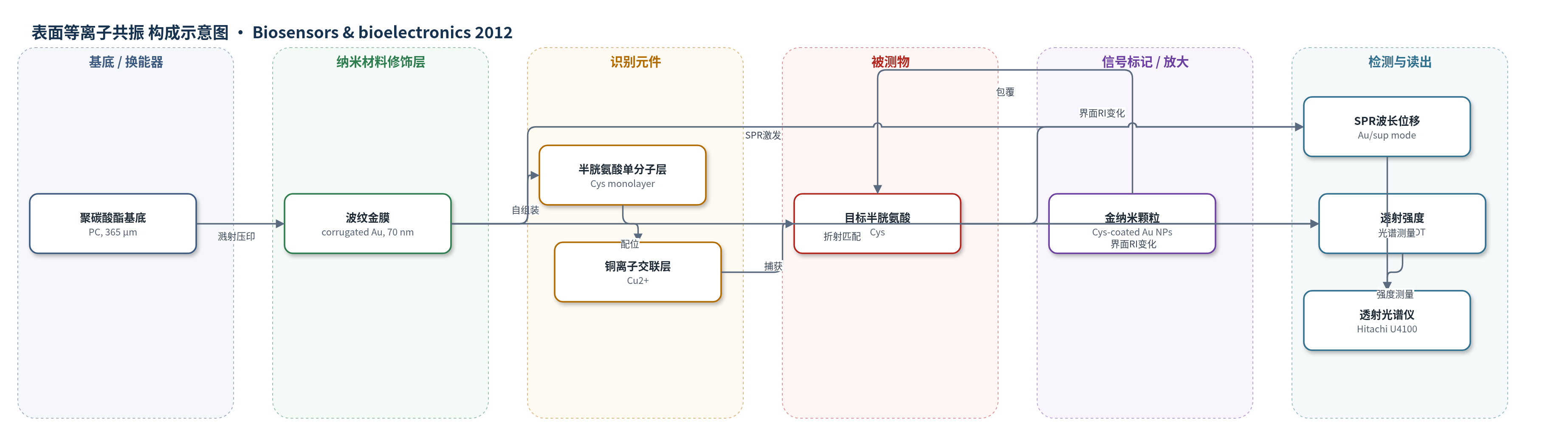
点击图片查看大图 · 依据论文自动绘制
传感器类型
表面等离子共振(SPR)生物传感器
检测对象
半胱氨酸(cysteine, Cys),样品基质:水溶液(Cys 包覆 Au NPs 目标溶液);另演示乙醇(EtOH)水溶液折射率检测
检测原理
波纹金膜在入射光下激发一维周期性 SPR,Au/sup 模式共振波长随上方介质折射率升高而红移;当上方介质折射率接近 PC 基底时,Au/sup 模式能量经波纹尖端高效耦合到 Au/PC 模式,使 EOT 透射强度增强,形成折射匹配信号。生物检测时,Cys 先自组装到 Au 表面,Cu2+ 再与 Cys 末端配位形成交联层;目标 Cys 以 Cys 包覆 Au NPs 形式加入,其 Cys 与 Cu2+ 结合,使界面质量与局部折射率增加。Cys 浓度越高,结合量越大,Au/sup SPR 波长位移越大;1 μM 目标溶液可产生约 1 nm 位移。
检测灵敏度
线性范围: 1 μM–1 mM(Cys 目标溶液,呈线性);灵敏度: 812.17 nm/RIU(5 MPa)、753.15 nm/RIU(8 MPa)、748.81 nm/RIU(10 MPa);r = 0.99;强度灵敏度: 6.25 a.u./RIU(r=0.96)、8.96 a.u./RIU(r=0.99)、5.21 a.u./RIU(r=0.97);Cys: 1 μM 时 SPR 波长位移约 1 nm
效应效果
原文未报告选择性、抗干扰、RSD 或实际样品回收率。化学传感方面,波纹金膜对乙醇水溶液折射率变化响应明显,DIW 到 99% EtOH 时 Au/sup 波长红移约 20 nm;由 SPR 波长和 Au/PC 透射强度双准则计算 RI,平均误差约 10^-3 RIU,双准则平均后误差降至约 10^-4 RIU,最大偏差小于 10^-3 RIU。生物传感方面,Cys 检测呈线性,1 μM 时 SPR 波长位移约 1 nm,显示微摩尔级检测能力。作者强调该传感器制备简单、柔性可卷对卷加工、双准则互验、响应快速,适合一次性化学与生物传感。
传感器的构成
- 基底:聚碳酸酯(PC)柔性基底,厚度365 μm,提供支撑并参与 Au/PC SPR 模式与折射匹配
- 换能金属层:波纹金膜(corrugated Au film),70 nm Au 经纳米压印形成周期800 nm 一维波纹,激发 SPR 并产生 EOT
- 识别固定层:半胱氨酸(Cys)自组装单分子层,修饰波纹 Au 表面,提供巯基结合位点
- 交联识别层:铜离子(Cu2+),结合 Cys 末端,作为交联剂捕获目标 Cys
- 信号标记层:半胱氨酸包覆金纳米颗粒(Cys-coated Au NPs),与 Cu2+ 结合,改变界面折射率并增强 SPR 响应
中文摘要
本研究采用直接金属纳米压印法,一步制备出金属波纹结构,用作高灵敏度等离激元传感器。该波纹金膜可同时响应表面等离子共振(SPR)波长位移和折射匹配效应。与已报道的 SPR 传感器相比,波纹金膜具有约 800 nm/RIU 的高灵敏度,甚至更高。由于独特的折射匹配效应,通过测量金/基底 SPR 模式的透射强度即可实现折射率传感,且无需光谱仪。最后,作者证明波纹金膜能够检测生物分子,表明该结构可用作高灵敏度生物传感器。该柔性芯片还具备简单制备、双准则监测和快速响应等优点,适合一次性化学与生物传感应用。
英文摘要
In this study, we prepared metallic corrugated structures for use as highly sensitive plasmonic sensors. Relying on the direct nanoimprint-in-metal method, fabrication of this metallic corrugated structure was readily achieved in a single step. The metallic corrugated structures were capable of sensing both surface plasmon resonance (SPR) wavelengths and index-matching effects. The corrugated Au films exhibited high sensitivity (ca. 800 nm/RIU), comparable with or even higher than those of other reported SPR-based sensors. Because of the unique index-matching effect, refractometric sensing could also be performed by measuring the transmission intensity of the Au/substrate SPR mode-conveniently, without a spectrometer. In the last, we demonstrated the corrugated Au film was capable of sensing biomolecules, revealing the ability of the structure to be a highly sensitive biosensor.