组成图示
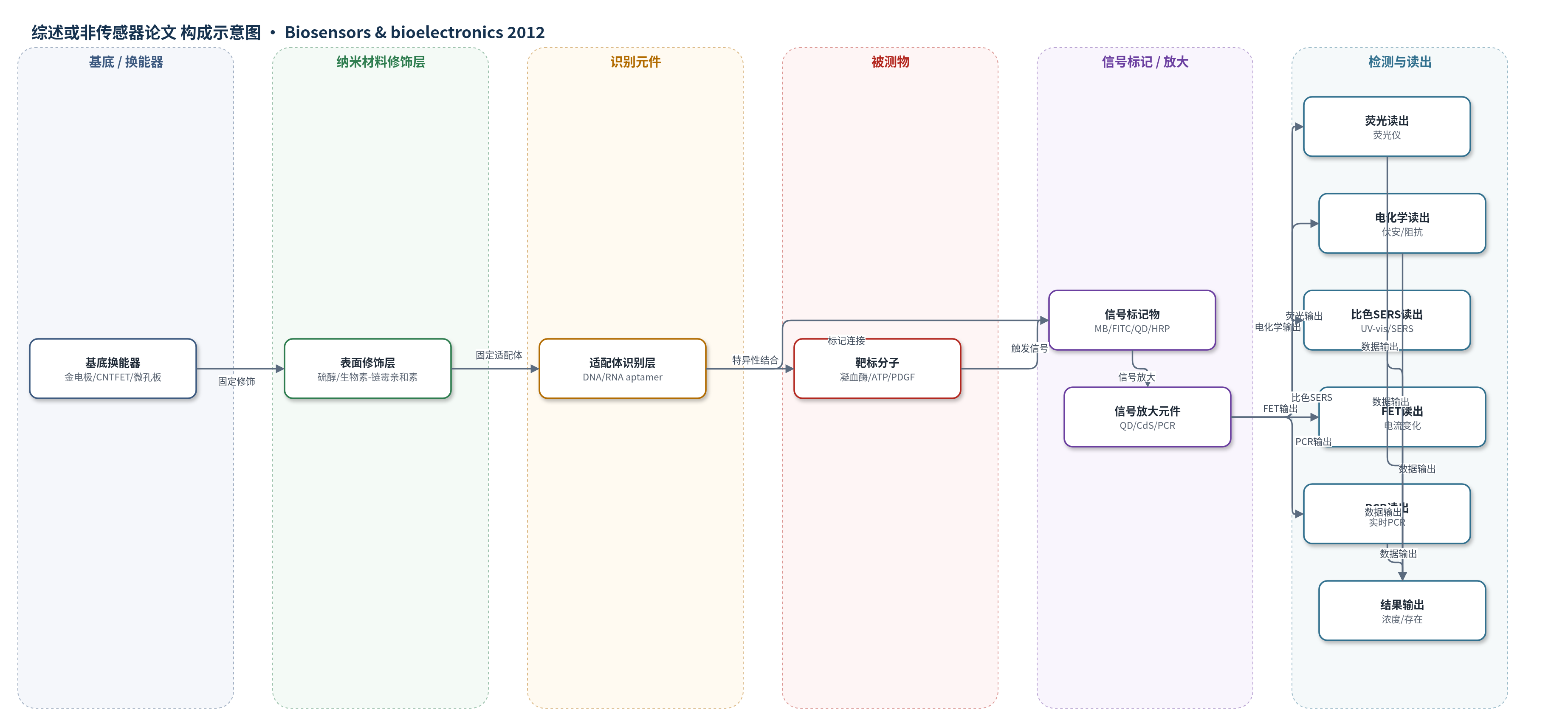
点击图片查看大图 · 依据论文自动绘制
传感器类型
综述或非传感器论文
检测对象
ATP(ATP)、凝血酶(thrombin)、血小板源性生长因子(PDGF)、可卡因(cocaine)、蓖麻毒素(ricin)、汞离子(Hg2+)、免疫球蛋白E(IgE)、纤维蛋白原(fibrinogen)、血管加压素(vasopressin)、前列腺特异性膜抗原(PSMA)、细胞色素c(cytochrome-c)、C反应蛋白(CRP)等;样品基质包括缓冲液、血清、血液/尿液、食品和水样、细胞/培养液。
检测原理
适配体作为识别元件与靶标特异性结合后,可发生构象变化、片段组装、位移或电荷屏蔽,从而改变信号标记物与换能界面之间的距离或电子转移效率。荧光平台中,分子信标、激基复合物或荧光团–淬灭剂距离变化引起荧光增强或猝灭;电化学平台中,G-四链体形成使MB靠近电极产生signal-on,或构象改变使MB远离电极产生signal-off,也可通过阻抗/电位变化读出;纳米材料平台中,AuNP聚集/分散改变比色或等离子体散射,QD/CdS提供信号放大;FET平台中,适配体–靶标复合物屏蔽通道电荷改变电流;PCR/PLA平台中,结合事件触发条码DNA连接与指数扩增。信号强度、颜色、电流或扩增量随靶标浓度变化。
检测灵敏度
综述未报告统一灵敏度;文中列举代表性数值:LOD: 25 μM (ATP)、1 nM (thrombin)、0.11 nM (PDGF)、1.8 nM/1.0 nM (thrombin)、6.4 fmol (thrombin)、0.1 nM (thrombin)、6.4 nM (thrombin)、1 nM (PDGF)、28 fmol (thrombin)、0.02 mg/L (CRP)、0.6 nM (Hg2+)、10 nM (thrombin)、400 fM (VEGF)、5.2 μU/mL (vasopressin)、100 nM (cocaine)、0.1 ng/mL (fibrinogen)、10–10,000 cells (PSMA);线性范围: 1 × 10⁻⁴ M to 1 × 10⁻⁹ M (Hg2+)。
效应效果
综述指出适配体比抗体更稳定,可反复变性复性,表面固定后可多次使用且灵敏度下降小,非特异吸附较低。ALISA/ELAA可作为ELISA替代,ELAA检测凝血酶LOD为1.8 nM,ELISA–ELAA为1 nM;脂质体ALISA可追踪6.4 fmol凝血酶。电化学方法仪器简单、成本低、抗污染和非特异结合,阻抗法可实时监测结合动力学并降低背景噪声。AuNP比色法检测Hg2+在1×10⁻⁴ M至1×10⁻⁹ M线性,LOD 0.6 nM;PLA可在大量非靶细胞中检测10–10,000个PSMA阳性细胞。作者认为适配体平台适合诊断、多靶标检测和纳米诊疗,未来需进一步提高LOD并整合多种适配体策略。
传感器的构成
- 基底/换能器:金电极(Au electrode)、微孔板(microtiter plate)、玻璃基底(glass substrate)、CNTFET/SWNT-FET、CPPy纳米管、SERS Au/Ag/Au纳米管阵列、纳米间隙电容电极,提供固定平台或电学/光学换能。
- 表面修饰/固定层:硫醇(thiol)、生物素–链霉亲和素(biotin–streptavidin)、CPPy、AuNP、石墨烯(graphene)、硅纳米颗粒(silica nanoparticle),用于固定适配体或增强界面信号。
- 识别元件:单链DNA/RNA适配体(aptamer),经SELEX筛选,特异性结合靶标并发生构象变化、位移或聚集/分散。
- 信号标记/放大元件:FITC、FAM、DABCYL、TMR、亚甲基蓝(MB)、量子点(QD)、辣根过氧化物酶(HRP)、CdS纳米颗粒、FITC标记靶标,将结合事件转为荧光、电化学、比色或PCR信号。
- 读出系统:荧光仪、电化学伏安/阻抗/电位仪、SERS拉曼光谱仪、FET电流读出、UV-vis比色、实时PCR,输出与靶标浓度相关的信号。
中文摘要
适配体是通过系统进化指数富集(SELEX)筛选得到的单链DNA或RNA寡核苷酸,能依靠氢键、静电作用和疏水作用而非Watson–Crick碱基配对,对多种靶标分子实现高亲和力和高特异性识别。适配体分子量低、可化学修饰,且在反复变性与复性后仍保持稳定,因此可作为抗体的替代识别元件用于多种诊断检测。本文综述了适配体在荧光、电化学、纳米标签和纳米结构等检测平台中的应用。尽管不同适配体检测策略的信号转换方式不同,其核心设计思路均是将适配体与靶标结合事件转化为可测信号。随着适配体–靶标结合信号转换新方法的发展,适配体有望在生物传感和诊断领域获得更广泛应用。
英文摘要
Aptamers are single stranded DNA or RNA oligonucleotides that have high affinity and specificity towards a wide range of target molecules. Aptamers have low molecular weight, amenable to chemical modifications and exhibit stability undeterred by repetitive denaturation and renaturation. Owing to these indispensable advantages, aptamers have been implemented as molecular recognition element as alternative to antibodies in various assays for diagnostics. By amalgamating with a number of methods that can provide information on the aptamer-target complex formation, aptamers have become the elemental tool for numerous biosensor developments. In this review, administration of aptamers in applications involving assays of fluorescence, electrochemistry, nano-label and nano-constructs are discussed. Although detection strategies are different for various aptamer-based assays, the core of the design strategies is similar towards reporting the presence of specific target binding to the corresponding aptamers. It is prognosticated that aptamers will find even broader applications with the development of new methods of transducing aptamer target binding.