组成图示
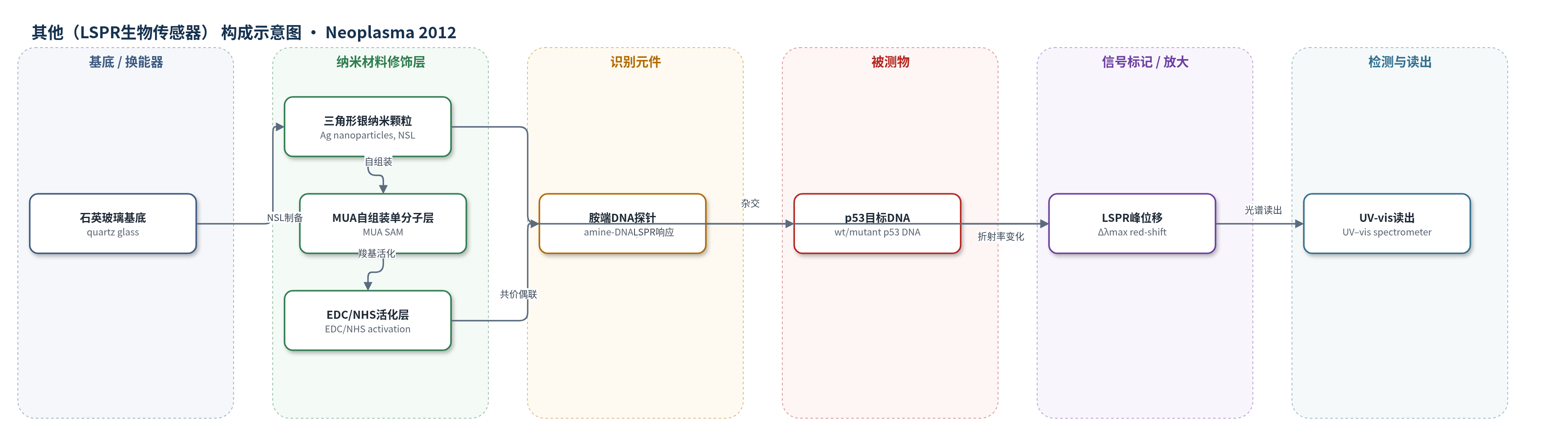
点击图片查看大图 · 依据论文自动绘制
传感器类型
其他(LSPR生物传感器)
检测对象
p53 基因突变序列(p53 mutation sequence,野生型/突变型 DNA,含 codon 175 G→A 单碱基突变);样品基质:合成寡核苷酸、人外周血基因组 DNA 的 PCR 产物
检测原理
该传感器以共价固定于 MUA 自组装单分子层修饰的三角形银纳米颗粒表面的胺端 DNA 探针作为识别元件。目标 p53 DNA 与探针杂交后,纳米颗粒周围局部介电环境改变,局部折射率升高;根据 Mie 理论,银纳米颗粒的 LSPR 消光峰 λmax 发生红移。完全互补序列结合更强,引起更大 Δλmax;单碱基错配序列因碱基配对不完整,界面折射率变化较小,Δλmax 明显降低。因此可通过比较野生型与突变型 DNA 的峰位移差异区分单碱基突变。信号随目标 DNA 浓度升高而增大,在 10 nM–10 μM 范围内可检测,无需荧光或酶标记放大。
检测灵敏度
LOD: 10 nM;动态范围: 10 nM–10 μM
效应效果
该传感器对非互补序列(10 μM)无显著 LSPR 峰位移,空白 PCR 溶液仅产生 Δλmax +0.41 nm,低于实验误差(Δλmax=0.54±0.12 nm,n=3),表明非特异结合被有效抑制。5 个不同芯片检测 1 μM 野生型 PCR 产物,平均 Δλmax 为 13.94 nm,SD=1.40 nm,CV%=10.0%,重现性良好。对 1 μM 野生型与突变型 PCR 产物,Δλmax 分别为 +14.55 nm 和 +4.83 nm,可区分单碱基突变。检测结果与直接 DNA 测序高度一致,总检测时间约 2 h,无需电泳和标记,作者认为其适合临床快速、低成本基因突变检测。
传感器的构成
- 基底/换能器:石英玻璃基底(quartz glass substrate),承载银纳米颗粒并作为光学基底
- 纳米材料修饰层:三角形银纳米颗粒(Ag nanoparticles),由纳米球光刻(NSL)制备,提供 LSPR 光学响应
- 自组装单分子层:11-巯基十一烷酸(MUA)在银表面形成 SAM,提供羧基并稳定纳米颗粒、抑制非特异结合
- 活化层:EDC/NHS 活化 MUA 羧基,形成可共价偶联 DNA 探针的活性酯
- 识别元件:胺端 DNA 探针(amine-terminated DNA probe,3'-H2N-(CH2)6-CAACACTCCGCGACGGGGGTGGTAC-5'),识别 p53 L2 锌结合域序列
- 信号读出:UV-vis 分光光度计(UV–vis spectrometer,Model 9055)与光纤,测量 LSPR 消光峰波长位移
中文摘要
目前关于基于局域表面等离子共振(LSPR)的纳米生物传感器用于基因突变检测的报道较少。本研究旨在开发一种新型 LSPR 生物传感器用于检测 p53 基因突变。采用纳米球光刻法制备银纳米颗粒,设计 DNA 探针识别目标序列,并通过胺基配体共价偶联法固定于芯片表面。将合成寡核苷酸或从血液样本基因组 DNA 中 PCR 扩增的产物与固定探针杂交,通过测量 LSPR 消光光谱峰位移检测野生型和突变型 p53。该传感器对目标序列的检出限为 10 nM,动态范围为 10 nM–10 μM。野生型与错配 p53 DNA 的测量信号差异显著,可有效区分单碱基突变。结论表明,该传感器有望成为快速、无标记、灵敏且低成本检测 p53 突变的方法,为临床遗传突变检测提供有吸引力的替代方案。
英文摘要
Few studies to date have reported on the development and application of a nanobiosensor based on localized surface plasmon resonance (LSPR) for detecting gene mutations. This study aimed to develop a novel LSPR biosensor used for detecting p53 mutation. Nanosphere lithography was used to fabricate the silver nanoparticles. The DNA probe was designed to recognize the target sequence and immobilized on the chip surface by a covalent-coupling method using amine-group ligands. Synthetic oligonucleotides or PCR products were amplified from genomic DNA taken from blood samples and hybridized with the immobilized probe. Wild-type and mutant p53 was detected by measuring shifts in peak of LSPR extinction spectra. The low detection limit of the sensor for target sequence was 10 nM, and detection occurred over a wide dynamic range (10 nM - 10 μM). Importantly, the differences in measuring signal between wild-type and mismatched p53 DNA was significant, allowing for this sensor to effectively discriminate against single base mutations. In conclusion, we developed a biosensor with potential as a rapid, label-free, sensitive, and low-cost method for detecting p53 mutation. Our results suggest that such an LSPR-based biosensor provides an attractive alternative for clinical detection of genetic mutation.