组成图示
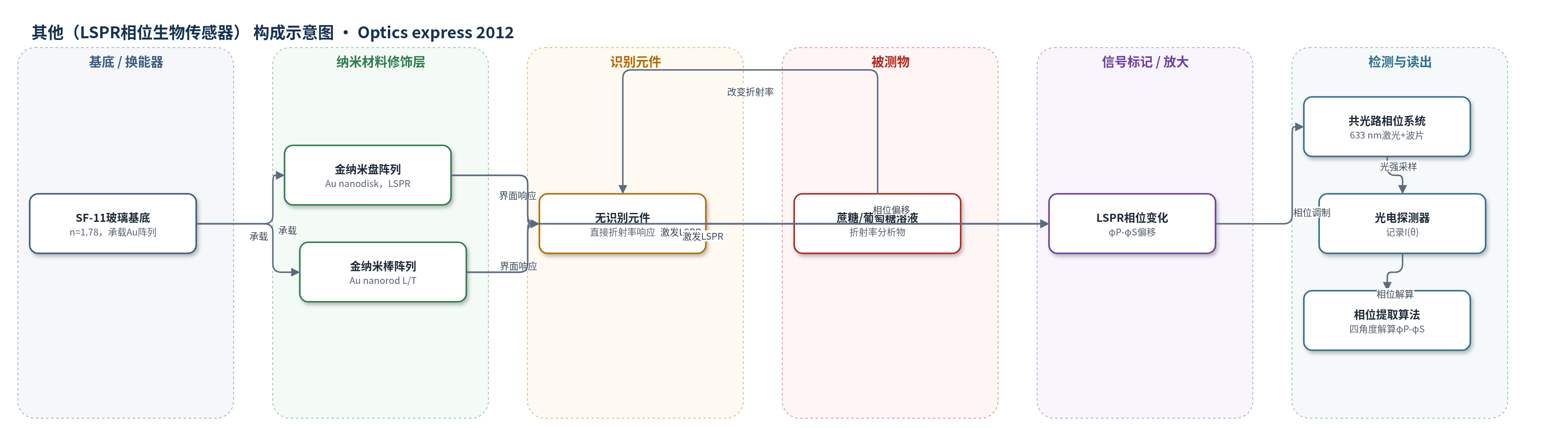
点击图片查看大图 · 依据论文自动绘制
传感器类型
其他(LSPR相位生物传感器)
检测对象
蔗糖(sucrose)水溶液、葡萄糖(glucose)水溶液;样品基质为水溶液(折射率标准液)
检测原理
金(Au)纳米盘或纳米棒在633 nm光激发下产生局域表面等离子体共振(LSPR),其共振条件对周围介质折射率高度敏感。当蔗糖或葡萄糖浓度改变时,纳米结构附近折射率发生变化,使LSPR共振位置及反射/透射光的偏振相位发生移动。系统用半波片将入射光分解为等幅s和p偏振分量,经纳米结构后,s/p相位差φP-φS随折射率改变而改变;再经四分之一波片和旋转线偏振器,在0、π/4、π/2、3π/4角度记录光强,并用算法提取相位差。由于相位在共振附近变化比消光峰波长移动更陡,且p偏振倏逝波激发可增强耦合,因此获得比消光光谱更高的灵敏度。
检测灵敏度
灵敏度: 10.95 rad/RIU(nanorod L, 50° TIR);4.06 rad/RIU(nanodisk, 65°);2.34 rad/RIU(nanorod T, 50°);1.03 rad/RIU(coupler-free nanorod);155.32 rad/RIU(Au film SPR);6.05 rad/RIU(nanorod L, 65°);0.7 rad/RIU(blank substrate, 65°);消光灵敏度: 172.34 nm/RIU(nanodisk)、60.27 nm/RIU(nanorod T)、194.18 nm/RIU(nanorod L);传感分辨率: 1.83×10⁻⁶ RIU(TIR nanorod L)、1.94×10⁻⁵ RIU(coupler-free)、1.74×10⁻⁴ RIU(nanodisk extinction)、4.98×10⁻⁴ RIU(nanorod T extinction)、1.54×10⁻⁴ RIU(nanorod L extinction);R^2 adjusted: 0.838–0.876(nanodisk)、0.906–0.962(nanorod T)、0.853–0.939(nanorod L)、0.898(SPP)
效应效果
在TIR构型下,金纳米棒(L)的相位传感分辨率为1.83×10⁻⁶ RIU,比同一纳米结构消光光谱高35.29–84.15倍,也比当前文献中最灵敏LSPR传感器(不超过2×10⁻⁵ RIU)高10.93倍。无耦合器构型下分辨率为1.94×10⁻⁵ RIU,比消光光谱高7.94倍。每种纳米结构进行5次测量以确认实验。与空白基底相比,纳米棒(L)灵敏度提高8.64倍,说明相位偏移主要来自LSPR而非全内反射。作者认为该相位探测方法可弥补LSPR灵敏度不足,适用于无标记生物传感、单颗粒检测、分子标尺和生物成像。
传感器的构成
- 基底/棱镜:SF-11玻璃(折射率1.78),作为纳米结构载体并支持全内反射(TIR)与无耦合器透射探测
- 纳米材料修饰层:金(Au)纳米盘阵列(直径140–164 nm、厚70 nm、周期约650 nm),通过电子束光刻与电子束蒸发制备,产生LSPR
- 纳米材料修饰层:金(Au)纳米棒阵列(长512 nm、宽215 nm、厚61 nm),包括长轴平行/垂直s偏振电场的L/T构型,产生横向/纵向LSPR模式
- 识别元件:未使用抗体、适配体、酶或DNA探针,传感基于周围介质折射率直接变化
- 信号标记物:未使用荧光、酶或纳米标记物,信号来自LSPR相位变化
- 读出系统:共光路相位探测系统(633 nm激光二极管、线偏振器、半波片、四分之一波片、旋转线偏振器、光电探测器),提取s/p相位差φP-φS
中文摘要
局域表面等离子体共振(LSPR)在生物传感、生物成像和纳米光子学中具有重要应用。与表面等离子体极化激元(SPP)不同,现有 LSPR 生物传感研究主要局限于消光光谱探测,因而限制了其在生物传感和生物成像中的性能。本文揭示,LSPR 的光学相位在共振处会发生比消光光谱更尖锐的变化,从而允许通过相位探测获得超高灵敏度。研究发现,在相同金属纳米结构中,LSPR 光学相位的传感分辨率比消光光谱高约两个数量级。作者首次证明了利用 LSPR 光学相位转换进行生物传感的可行性,其灵敏度不仅优于同一金属纳米结构的消光光谱探测,也优于当前文献中报道的 LSPR 传感器。总之,通过相位探测开发利用 LSPR,可弥补传统 LSPR 传感灵敏度不足的问题,并为理解和利用金属纳米结构中 LSPR 的丰富物理机制提供新途径。
英文摘要
Localized surface plasmon resonance (LSPR) has shown its remarkable applications in biosensing, bioimaging, and nanophotonics. Unlike surface plasmon polariton (SPP), the current studies regarding LSPR as biosensor were restricted in probing the extinction spectra, and thus limit the performance in biosensing and bioimaging. Here, we reveal that optical phase of LSPR provides an acute change at resonance beyond extinction spectra, which permits an ultra-high sensitivity in phase interrogation. We found that optical phases of LSPR show two orders of magnitude higher sensing resolution than extinction spectra among the same nanostructures. For the first time, we demonstrated the feasibility of probing optical phase transduction in LSPR for biosensing, and the sensitivity is superior to not only the extinction spectra among the same metallic nanostructures, but also the LSPR sensors among the current literatures. In summary, the exploitation of LSPR by phase interrogation essentially complements the sensitivity insufficiency of LSPR, and provides new access to understanding and using the rich physics of LSPR.