组成图示
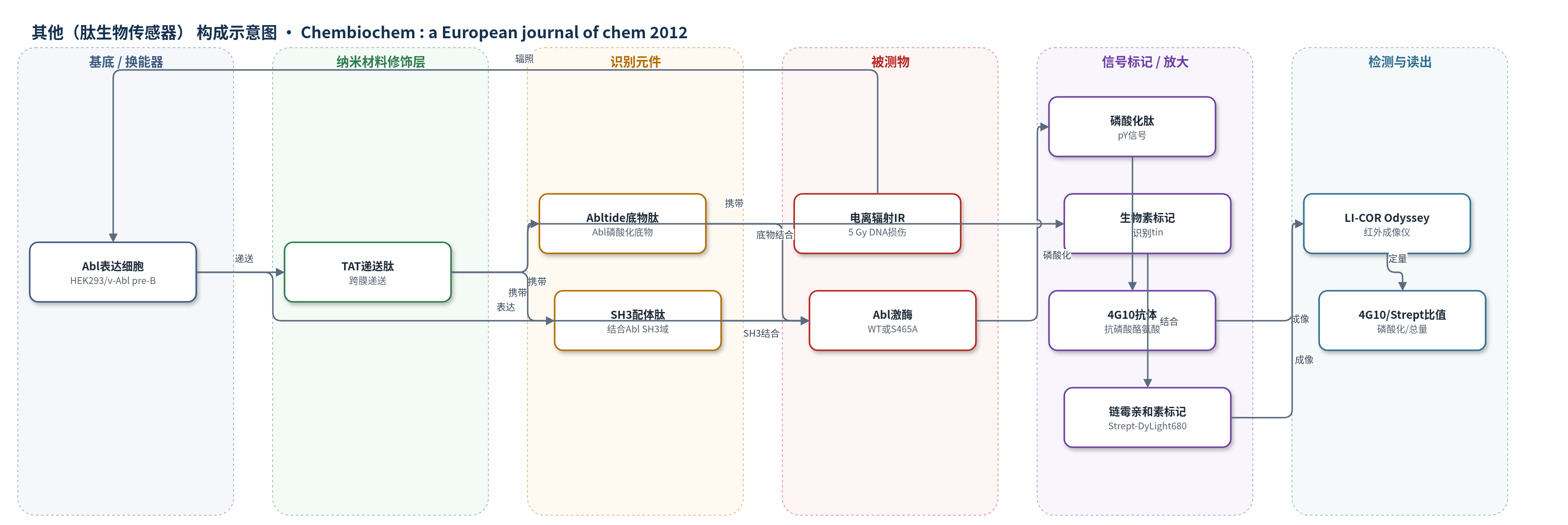
点击图片查看大图 · 依据论文自动绘制
传感器类型
其他(肽生物传感器)
检测对象
Abl 激酶活性(Abl kinase activity);样品基质:HEK 293 细胞与 v-Abl pre-B 细胞裂解液/核质组分
检测原理
TAT 细胞穿透肽将含 Abltide 底物序列和 SH3 配体序列的肽传感器递送至细胞内。电离辐射造成 DNA 双链断裂后,ATM 与 DNAPK 被招募并激活,进而磷酸化并激活核质中的 Abl 激酶。激活的 Abl 以 Abltide 序列为底物进行磷酸化,SH3 配体通过结合 Abl SH3 域增强底物定位与特异性。磷酸化事件使传感器肽带上磷酸酪氨酸,裂解细胞后以抗磷酸酪氨酸抗体 4G10 检测磷酸化肽,同时以链霉亲和素-DyLight 680 检测生物素标记的总肽量。4G10 与链霉亲和素信号比值随 Abl 激酶活性升高而增大,从而在完整细胞中反映 IR 诱导的早期激酶激活。
检测灵敏度
原文未报告 LOD、线性范围、灵敏度斜率或相关系数。
效应效果
在 Abl-WT-EGFP HEK 293 细胞中,IR 后 10 min 内传感器磷酸化信号较未辐照对照升高约 4 倍(p=0.002);Abl-S465A-EGFP 突变体仍显著升高(10 min p=0.0005),提示存在 S465 以外激活机制。DNAPK 抑制剂 NU7026 可将 S465A 突变体的 IR 诱导磷酸化降至接近背景;ATM 缺失 pre-B 细胞中,DNAPK 抑制剂使信号降至与 imatinib 相当。亚细胞分级显示传感器 5–10 min 内进入核质,核组分 10 min 磷酸化升高约 3 倍(p<0.05)。未报告 RSD、回收率或长期稳定性。作者认为该肽传感器可简单、功能性地监测完整细胞内早期 Abl 激酶激活,补充体外激酶实验与磷酸化位点抗体检测。
传感器的构成
- 识别/底物模块:Abltide 肽序列,作为 Abl 激酶特异性磷酸化底物
- 特异性增强模块:Abl SH3 域结合配体肽,通过结合 Abl SH3 域提高底物模拟与特异性
- 连接模块:3-(2-硝苄基)-3-氨基丙酰光裂解连接子,用于质谱检测时的可裂解连接
- 标记模块:γ-氨基生物素化赖氨酸(Kbiotin),用于链霉亲和素检测传感器总量
- 递送模块:TAT 细胞穿透肽(CPP),协助传感器跨质膜进入细胞
- 读出模块:抗磷酸酪氨酸抗体 4G10 与链霉亲和素-DyLight 680,经 LI-COR Odyssey 红外成像定量
中文摘要
广泛表达的 Abl 蛋白是一种非受体酪氨酸激酶,可在核质间穿梭并参与多种细胞信号通路。核内 Abl 在 DNA 损伤后被激活,调控 DNA 修复、细胞周期检查点和凋亡。既往研究已证实,电离辐射(IR)可激活 ATM,并通过磷酸化激酶结构域 Ser465(S465)激活核内 Abl。本研究使用一种特异性报告 Abl 激酶活性的肽生物传感器,发现不能通过经典位点被 ATM 激活的 Abl-S465A 突变体在 IR 后仍被快速激活。作者进一步证明,DNA 依赖性蛋白激酶(DNAPK)可能通过 S465 以外位点的磷酸化,在 IR 早期激活 Abl 的第二条通路。结果表明,核质中的 Abl 激酶在 IR 后 5 min 内即可被 ATM 和 DNAPK 激活;虽然二者之一为必需,但任一激酶均足以激活 Abl。这些结果支持 ATM 与 DNAPK 通路在 DNA 损伤早期共同招募 Abl,以调控核内事件并可能向胞质蛋白传递信号。
英文摘要
The ubiquitously expressed Abl protein is a non-receptor tyrosine kinase that undergoes nuclear-cytoplasmic shuttling and is involved in many signaling pathways in the cell. Nuclear Abl is activated by DNA damage to regulate DNA repair, cell-cycle checkpoints and apoptosis. Previous studies have established that ataxia telangiectasia mutated (ATM) activates nuclear Abl by phosphorylating serine 465 (S465) in the kinase domain in response to ionizing radiation (IR). Using a peptide biosensor that specifically reports on the Abl kinase activity, we found that an Abl-S465A mutant, which is not capable of being activated by ATM through the canonical site, was still activated rapidly after IR. We established that DNA-dependent protein kinase (DNAPK) is likely to be responsible for a second pathway to activate Abl early on in the response to IR through phosphorylation at a site other than S465. Our findings show that nuclear and cytoplasmic Abl kinase is activated early on (within 5 min) in response to IR by both ATM and DNAPK, and that although one or the other of these kinases is required, either one is sufficient to activate Abl. These results support the concept of early Abl recruitment by both the ATM and the DNAPK pathways to regulate nuclear events triggered by DNA damage and potentially communicate them to proteins in the cytoplasm.