组成图示
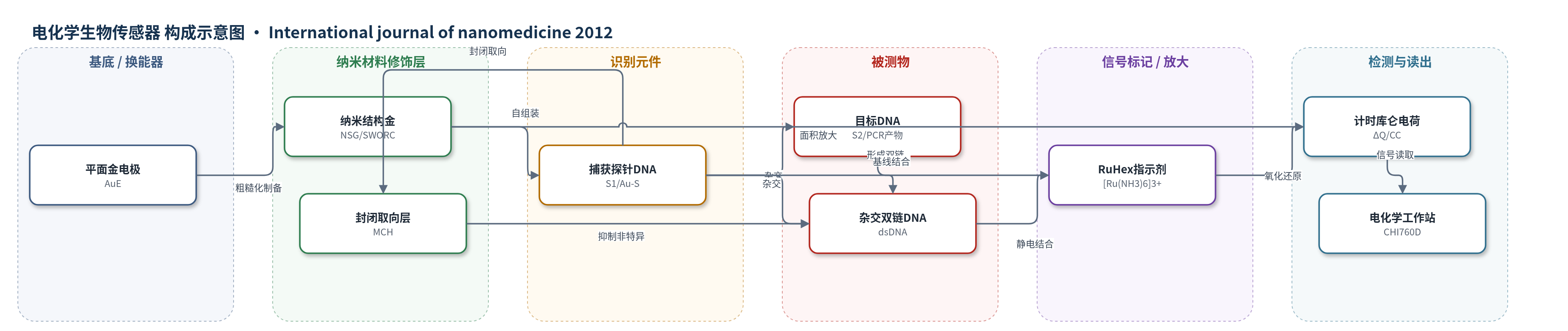
点击图片查看大图 · 依据论文自动绘制
传感器类型
电化学生物传感器
检测对象
survivin基因相关DNA序列(survivin gene DNA,合成靶标DNA及PCR扩增产物);样品基质:合成DNA溶液、PCR实际样品(骨肉瘤患者/正常人)
检测原理
该传感器以纳米结构金电极为换能器,其大真实表面积提高探针负载量。巯基捕获探针通过金–硫键自组装于电极表面,MCH封闭使探针取向整齐。目标DNA与探针杂交形成双链DNA,使电极表面负电荷磷酸基数量增加。六氨合钌(III)(RuHex)作为电活性指示剂,通过静电作用结合DNA磷酸基,其氧化还原电荷与电极表面DNA量成正比。杂交后双链DNA增多,结合RuHex量增加,计时库仑法测得的电荷增量ΔQ随目标DNA浓度升高而增大;单碱基错配或非互补序列杂交不完全,信号显著降低。该方法主要依靠NSG面积放大和RuHex指示剂实现fM级检测。
检测灵敏度
LOD: 5.6 fM (signal to noise = 3);线性范围: 50 fM–250 fM;灵敏度斜率: 2.6148 µC/pM;相关系数: R = 0.9979
效应效果
该传感器对完全互补序列、单碱基错配序列和非互补序列具有良好选择性,错配与非互补信号明显低于互补序列。对0.15 pM目标DNA的重现性RSD为7.32%(n=3)。实际PCR样品中,探针修饰电极、空白、阳性骨肉瘤样品、阴性样品和同浓度目标DNA的RuHex电荷均值分别为3.765 µC(RSD 7.36%)、4.151 µC(RSD 7.59%)、5.879 µC(RSD 5.96%)、3.886 µC(RSD 6.15%)和7.52 µC(RSD 5.35%),与凝胶电泳结果一致。作者认为该法可克服现有方法耗时、精度差和昂贵等不足,适用于骨肉瘤survivin基因的fM水平快速检测。
传感器的构成
- 基底/换能器电极:平面金电极(AuE)经重复方波氧化还原循环(SWORC)制备纳米结构金(NSG)电极,增大真实表面积并提高导电性
- 识别元件:巯基修饰捕获探针DNA(S1)通过Au–S键自组装于NSG表面,特异性识别目标DNA
- 封闭/取向层:巯基己醇(MCH)共吸附处理,使ssDNA取向整齐并封闭非特异吸附位点
- 被测物/杂交层:目标DNA(S2)或PCR扩增产物与探针杂交形成dsDNA,增加电极表面DNA量
- 信号标记物:六氨合钌(III) [Ru(NH3)6]3+(RuHex)静电结合DNA磷酸基,作为电活性指示剂
- 信号读出:三电极体系与CHI760D电化学工作站,采用计时库仑法(CC)/循环伏安法(CV)读取RuHex电荷变化
中文摘要
本文报道了一种基于纳米结构金电极的计时库仑 DNA 生物传感器,用于检测与骨肉瘤相关的 survivin 基因。该传感器以六氨合钌(III) [Ru(NH3)6]3+(RuHex)为电化学指示剂,通过重复方波氧化还原循环(SWORC)在平面金电极表面制备纳米结构金(NSG)电极。研究考察了不同频率对 NSG 电极真实表面积的影响,在 8000 Hz 最优频率下,其真实表面积约为裸平面金电极的 42.5 倍。巯基修饰的捕获探针 DNA 通过金–硫键自组装于 NSG 表面,并与目标 DNA 杂交;杂交前后,RuHex 通过静电作用结合 DNA 磷酸基,其氧化还原电荷随电极表面 DNA 量变化。计时库仑法显示杂交后 RuHex 电荷显著增加。该传感器可在 50 fM–250 fM 范围内定量检测目标 DNA,检出限为 5.6 fM(信噪比=3),具有良好灵敏度和选择性,并成功用于 PCR 实际样品检测。
英文摘要
In this paper, a sensitive chronocoulometric deoxyribonucleic acid (DNA) biosensor based on a nanostructure gold electrode was fabricated for detection of the femtomolar level survivin gene which was correlated with osteosarcoma by using hexaamine-ruthenium III complexes, [Ru(NH(3))(6)](3+), as the electrochemical indicator. The effect of different frequencies on the real surface area of the nanostructure gold electrode obtained by repetitive square-wave oxidation reduction cycle was investigated. At the optimal frequency of 8000 Hz, the real surface of the developed nanostructure gold electrode was about 42.5 times compared with that of the bare planar gold electrode. The capture probe DNA was immobilized on the nanostructure gold electrode and hybridized with target DNA. Electrochemical signals of hexaamine-ruthenium III bound to the anionic phosphate of DNA strands via electrostatic interactions were measured by chronocoulometry before and after hybridization. The increase of the charges of hexaamine-ruthenium III was observed upon hybridization of the probe with target DNA. Results indicate that this DNA biosensor could detect the femtomole (fM) concentration of the DNA target quantitatively in the range of 50 fM to 250 fM; the detection limit of this DNA biosensor was 5.6 fM (signal to noise = 3). This new biosensor exhibits excellent sensitivity and selectivity and has been used for an assay of polymerase chain reaction (PCR) with a satisfactory result.