组成图示
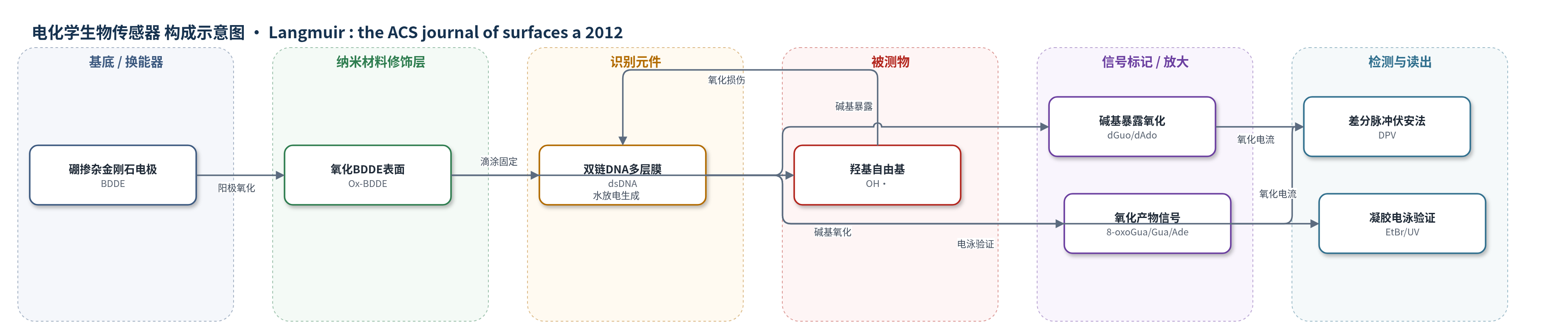
点击图片查看大图 · 依据论文自动绘制
传感器类型
电化学生物传感器
检测对象
羟基自由基(OH•)、双链 DNA 氧化损伤(dsDNA oxidative damage);样品基质:0.1 M 醋酸缓冲液(pH 4.5)中 BDDE 表面原位生成
检测原理
该传感器以 BDDE 为换能器,先在阳极条件下形成 Ox-BDDE,再固定 dsDNA 多层膜。在 +2.0、+2.5 或 +3.0 V 下,Ox-BDDE 表面发生水放电,原位生成高活性 OH•;OH• 扩散距离仅数纳米,主要攻击邻近 dsDNA 的糖基和碱基,导致氢键断裂、双螺旋展开、单链/双链断裂、游离碱基释放及 8-oxoGua 生成。DNA 结构破坏使原本埋藏在双螺旋内部的 dGuo、dAdo 等碱基更易接触电极表面,氧化峰电流增大;高电位长时间作用还出现 dCyt/dThy、8-oxoGua、Gua 和 Ade 氧化峰。DPV 通过监测这些氧化峰电流变化反映 OH• 浓度和作用时间,凝胶电泳与 EtBr 荧光进一步验证 DNA 片段化和碱基损伤。
检测灵敏度
原文未报告 LOD、线性范围、灵敏度斜率或相关系数。
效应效果
BDDE 具有惰性、弱吸附和宽正电位窗口,Ox-BDDE 可在高正电位下稳定生成 OH•,DPV 脉冲技术提高信噪比和选择性。实验通过 +2.0、+2.5 和 +3.0 V 作用 15 min 至 3 h 控制 OH• 浓度;+3.0 V 作用 2 h 后出现 8-oxoGua(Epa +0.42 V)、Gua(约 +1.0 V)和 Ade(约 +1.3 V)氧化峰,dGuo 和 dAdo 峰电流显著增大,dCyt/dThy 峰约 +1.55 V。非变性琼脂糖凝胶电泳显示 DNA 迁移增强和 EtBr 荧光降低,与伏安结果一致。作者认为该传感器可廉价、直接、快速地检测 DNA 氧化损伤,有助于阐明自由基和危害化合物损伤 DNA 的机制。
传感器的构成
- 基底/换能器电极:硼掺杂金刚石电极(BDDE),HF-CVD 制备的多晶硼掺杂金刚石薄膜,硼含量约 8000 ppm,面积 5.7×6.1 mm2,厚度约 1 μm,作为工作电极和原位 OH• 发生/检测换能器。
- 表面预处理层:阳极氧化 BDDE(Ox-BDDE),在 0.1 M 醋酸缓冲液 pH 4.5 中 +3.0 V 处理 15 min,形成氧化表面并用于水放电生成 OH•。
- 识别元件层:双链 DNA(dsDNA)厚多层膜,牛胸腺 dsDNA 钠盐(10000–15000 bp),以 10 mg/mL 溶液滴加 6 次 40 μL,N2 干燥、水化 30 min 并 +0.30 V 稳定 30 min。
- 支持电解质:0.1 M 醋酸缓冲液(pH 4.5),提供离子导电环境并增强 dsDNA 碱基氧化峰。
- 内源信号标记:dsDNA 碱基及其氧化产物(dGuo、dAdo、dCyt/dThy、8-oxoGua、Gua、Ade),通过差分脉冲伏安法(DPV)氧化峰电流变化输出信号。
中文摘要
本文在硼掺杂金刚石电极(BDDE)上直接证明了电化学原位生成的羟基自由基(OH•)可造成双链 DNA(dsDNA)氧化损伤。该 DNA-电化学生物传感器以固定在电极表面的 dsDNA 作为分子识别元件,用于原位测量与 dsDNA 的特异性结合过程,是研究化合物与 DNA 双分子相互作用机制的互补工具,并可筛选和评估自由基及健康危害化合物对 DNA 的影响。活性氧(ROS)在 dsDNA 氧化损伤中起重要作用,该损伤与突变、致癌、自身免疫炎症和神经退行性疾病密切相关。羟基自由基被认为是导致细胞内 dsDNA 内源氧化的主要 ROS,可引起双链断裂、单链断裂、游离碱基和 8-氧代鸟嘌呤(8-oxoGua)生成。作者利用 dsDNA-电化学生物传感器研究固定在 BDDE 表面的 dsDNA 与原位电化学生成 OH• 的相互作用。对电极表面 dsDNA 膜进行非变性琼脂糖凝胶电泳,清晰显示与电化学生成 OH• 作用后发生原位 dsDNA 氧化损伤,证明了该传感器在评估 dsDNA 与羟基自由基相互作用中的重要性。
英文摘要
In situ DNA oxidative damage by electrochemically generated hydroxyl free radicals has been directly demonstrated on a boron-doped diamond electrode. The DNA-electrochemical biosensor incorporates immobilized double-stranded DNA (dsDNA) as molecular recognition element on the electrode surface, and measures in situ specific binding processes with dsDNA, as it is a complementary tool for the study of bimolecular interaction mechanisms of compounds binding to DNA and enabling the screening and evaluation of the effect caused to DNA by radicals and health hazardous compounds. Oxidants, particularly reactive oxygen species (ROS), play an important role in dsDNA oxidative damage which is strongly related to mutagenesis, carcinogenesis, autoimmune inflammatory, and neurodegenerative diseases. The hydroxyl radical is considered the main contributing ROS to endogenous oxidation of cellular dsDNA causing double-stranded and single-stranded breaks, free bases, and 8-oxoguanine occurrence. The dsDNA-electrochemical biosensor was used to study the interaction between dsDNA immobilized on a boron-doped diamond electrode surface and in situ electrochemically generate hydroxyl radicals. Non-denaturing agarose gel-electrophoresis of the dsDNA films on the electrode surface after interaction with the electrochemically generated hydroxyl radicals clearly showed the occurrence of in situ dsDNA oxidative damage. The importance of the dsDNA-electrochemical biosensor in the evaluation of the dsDNA-hydroxyl radical interactions is clearly demonstrated.