组成图示
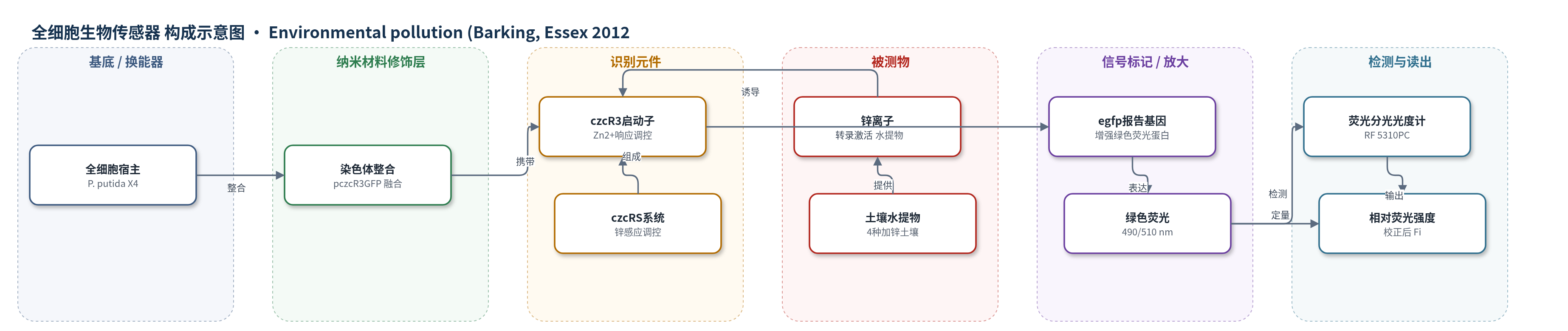
点击图片查看大图 · 依据论文自动绘制
传感器类型
全细胞生物传感器
检测对象
锌(Zn/Zn2+,水可提取锌);样品基质:土壤-水提物(soil-water extracts,四种加锌土壤)
检测原理
该传感器以 P. putida X4 全细胞为换能器。水相中的 Zn2+ 诱导 czcRS 锌抗性系统,使 czcR3 启动子发生锌诱导性转录激活,驱动下游无启动子 egfp 基因转录和翻译,产生增强型绿色荧光蛋白(GFP)。GFP 荧光强度随 Zn2+ 浓度升高而增强,在 5–55 μmol L−1 范围内呈剂量响应,高浓度时信号下降。检测时以 490 nm 激发、510 nm 发射读取荧光,并用 OD600 和土壤基质背景校正,得到相对荧光强度 Fi;通过锌标准曲线(九次多项式拟合,R^2=0.99)定量水可提取锌。其放大机制主要依赖基因表达的生物放大,而非化学标记或酶催化沉积。
检测灵敏度
LOD: 5 μmol L−1;检测范围: 5–55 μmol L−1;R^2 = 0.99
效应效果
该传感器对 Zn2+ 具有较高选择性,czcR3 启动子不被 Co2+、Cu2+、Cd2+、Pb2+ 和 Ni2+ 诱导。检测范围 5–55 μmol L−1,覆盖中国饮用水限值 1.0 mg L−1(15.4 μmol L−1)。报告基因整合于染色体,非选择性条件下稳定。在四种加锌土壤水提物中,荧光法测得锌浓度约为 AAS 的 90%;红土、棕土和红壤(cinnamon soil)平均为 92.2%,黑土为 87.0%。4 周培养显示水可提取锌随时间降低,连续提取表明锌由可溶/交换态向有机结合态和无机沉淀态转化。作者认为其可便捷评估环境土壤锌毒性与生物可利用性。
传感器的构成
- 细胞基底/换能器:Pseudomonas putida X4 全细胞,作为锌感应与信号转导载体
- 遗传修饰层:czcR3 启动子-egfp 融合构建体 pczcR3GFP,整合于染色体
- 识别/调控元件:czcRS 系统(czcR3 启动子),特异性响应 Zn2+
- 信号标记物:egfp 基因,表达增强型绿色荧光蛋白(GFP)
- 反应介质:Tris 缓冲培养基(含 0.1% 葡萄糖),用于诱导与荧光检测
- 样品基质:土壤-水提物(soil-water extract),提供水可提取 Zn2+
- 读出条件:荧光分光光度计(RF 5310PC),激发 490±5 nm、发射 510±5 nm
中文摘要
本研究通过 lacZ 基因融合研究了假单胞菌 Pseudomonas putida X4 中不同 czcRS 操纵子的诱导性与特异性。β-半乳糖苷酶活性结果表明,czcR3 启动子可定量响应锌。作者将无启动子增强型绿色荧光蛋白(egfp)基因与 czcR3 启动子融合并整合到 P. putida X4 染色体中,构建了锌特异性全细胞荧光生物传感器 P. putida X4(pczcR3GFP)。在添加锌的四种不同土壤的水提物中,该报告菌株可检测到样品中约 90% 的锌含量。生物可利用性评估与连续提取分析均表明,土壤中锌的固定/赋存形态高度依赖土壤理化性质,且锌的活性随培养时间延长而降低。结果表明,该生物传感器可作为环境锌毒性及生物可利用性便捷评估的替代系统。
英文摘要
The inducibility and specificity of different czcRS operons in Pseudomonas putida X4 were studied by lacZ gene fusions. The data of β-glycosidase activity confirmed that the czcR3 promoter responded quantitatively to zinc. A zinc-specific biosensor, P. putida X4 (pczcR3GFP), was constructed by fusing a promoterless enhanced green fluorescent protein (egfp) gene with the czcR3 promoter in the chromosome of P. putida X4. In water extracts of four different soils amended with zinc, the reporter strain detected about 90% of the zinc content of the samples. Both the bioavailability assessment and the sequential extraction analysis demonstrated that the immobilization of zinc was highly dependent on the physico-chemical properties of soils. The results also showed that the lability of zinc decreased over time. It is concluded that the biosensor constitutes an alternative system for the convenient evaluation of zinc toxicity in the environment.