组成图示
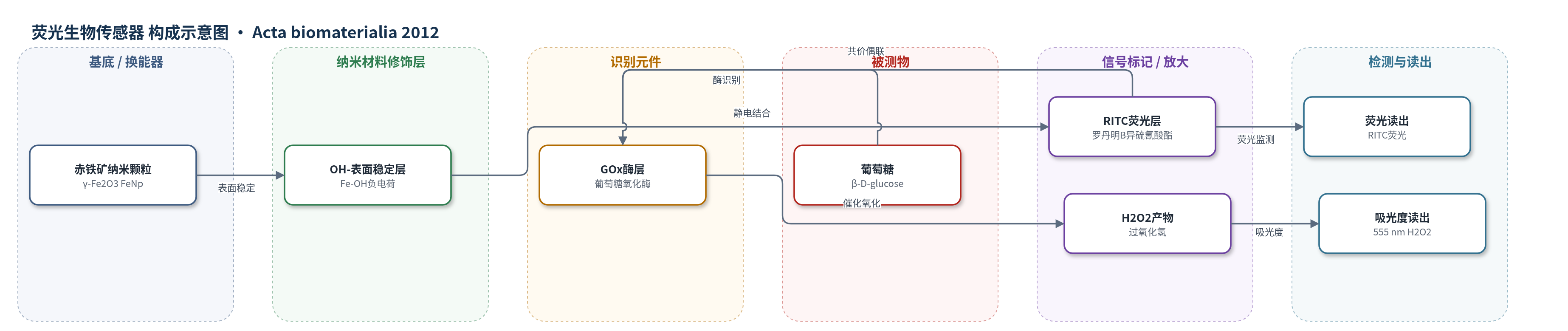
点击图片查看大图 · 依据论文自动绘制
传感器类型
荧光生物传感器
检测对象
葡萄糖(glucose,β-D-glucose);样品基质:水溶液/HEPES缓冲液(pH 7.5),潜在食品化学样品
检测原理
该体系以γ-Fe2O3赤铁矿纳米颗粒为磁性载体,表面OH−使其带负电并稳定胶体。RITC因带正电静电结合到颗粒表面,形成荧光层,并通过异硫氰酸酯与GOx表面伯胺共价连接,构成识别/催化层。当样品中存在β-D-葡萄糖时,GOx催化其氧化为D-葡萄糖内酯并生成H2O2;H2O2生成速率与葡萄糖浓度相关,可通过过氧化物酶偶联显色在555 nm连续监测吸光度变化,从而间接定量葡萄糖。RITC荧光主要用于监测纳米催化剂的存在和量,而非直接随葡萄糖浓度变化。外磁场可将纳米催化剂从溶液中分离并回收复用。该设计未采用HCR、RCA或CRISPR-Cas等额外信号放大策略,主要依赖酶催化反应和荧光/比色读出。
检测灵敏度
葡萄糖:原文未报告LOD、线性范围、灵敏度斜率或R^2。相关校准:RITC线性范围0.1 nM–1 μM,LOD 0.1 nM;GOx/FAD线性范围10 nM–1 μM,r > 0.99,灵敏度0.83 (±0.02) fAU nM−1,LOD 1.5 nM (S/N=3)。
效应效果
该纳米颗粒无需额外表面修饰即可在水中保持6个月胶体稳定性;RITC结合量为99.75 μmol/g FeNp,壳层厚约2–4 nm,固定GOx后增至5–9 nm。FAD荧光法测得GOx负载10.6±2.0 nmol/14.6 mg,相当于每颗粒10±2个酶分子,GOx约11.7 wt%,RITC约2.5 wt%。固定后GOx对葡萄糖氧化的速率常数为32.7 s−1,洗涤三次后活性恒定,泄漏GOx<1%,可经外磁场分离并多次复用而不明显损失活性。最大磁化强度由约71.4 A m2 kg−1降至60.2 A m2 kg−1,有机相约15 wt%。反应速率不依赖搅拌,说明不受扩散控制。论文未报告实际样品加标回收率、RSD或与ELISA/HPLC/qPCR对比,主要强调其在食品化学、低乙醇葡萄酒和葡萄糖酸生产中的应用潜力。
传感器的构成
- 磁性载体/换能基底:γ-Fe2O3赤铁矿纳米颗粒(FeNp,20–40 nm),提供超顺磁性、胶体分散和外部磁场分离能力
- 表面稳定层:OH−/Fe–OH基团,形成负电荷屏障,防止聚集并介导静电结合
- 荧光标记/间隔臂:罗丹明B异硫氰酸酯(RITC),静电结合于表面,提供荧光信号和异硫氰酸酯共价连接位点
- 识别/催化元件:葡萄糖氧化酶(GOx),通过异硫氰酸酯与酶表面伯胺共价结合,催化β-D-葡萄糖氧化
- 信号读出:荧光光谱监测RITC荧光;过氧化物酶偶联比色法在555 nm监测H2O2生成
中文摘要
本文报道了一种由表面羟基稳定的超顺磁赤铁矿(γ-Fe2O3)纳米颗粒(20–40 nm)构建的通用磁荧光纳米载体。该纳米颗粒通过硼氢化钠还原氯化铁并在100 ℃下热处理获得,无需额外表面修饰即可长期保持胶体稳定性;其表面OH−基团形成电荷屏障,防止聚集并允许带相反电荷有机物可逆结合。带正电的罗丹明B异硫氰酸酯(RITC)通过静电作用结合到纳米颗粒表面,形成荧光磁性纳米载体,同时其异硫氰酸酯基团可作为间隔臂共价固定酶等生物分子。作者进一步将葡萄糖氧化酶(GOx)共价固定于FeNp-RITC上,获得首个磁驱动荧光纳米催化剂。高分辨透射电镜显示GOx在颗粒表面形成3–5 nm厚层,荧光测定FAD表明每个纳米颗粒约结合10个酶分子。该纳米催化剂对葡萄糖氧化的速率常数为32.7 s−1,可通过荧光监测其存在,并可用外磁场分离、重复使用而不损失催化效率,适用于生化、生物技术和食品化学中的葡萄糖相关检测。
英文摘要
Superparamagnetic nanoparticles (20-40 nm) of maghemite, γ-Fe(2)O(3), with well-defined stoichiometric structure, are synthesized by the borohydride reduction of ferric chloride at an elevated temperature (100°C) followed by thermal treatment of the reaction product. Prepared maghemite nanoparticles reveal excellent colloidal stability for a long time without the necessity for any additional surface modification. These colloidal features are due to surface stabilizing OH(-) groups, which act as charge barriers preventing a particle aggregation and enabling a reversible binding of various oppositely charged organic substances. Such binding with rhodamine B isothiocyanate results in the fluorescent magnetic nanocarrier providing, at the same time, a spacer arm for covalent immobilization of other biosubstances including enzymes. In this work, we exploit this general applicability of the developed nanocarrier for covalent immobilization of glucose oxidase. This is the first reported example of magnetically drivable fluorescent nanocatalyst. The immobilized enzyme creates a 3-5 nm thick layer on the nanoparticle surface as proved by high-resolution transmission electron microscopy. This layer corresponds to 10 enzyme molecules, which are bound to the nanoparticle surface as found by the fluorimetric determination of flavin adenine dinucleotide. The developed magnetic fluorescent nanocatalyst, showing a rate constant of 32.7s(-1) toward glucose oxidation, can be used as a biosensor in various biochemical, biotechnological, and food chemistry applications. The presence of the nanocatalyst can be simply monitored by its fluorescence; moreover, it can be easily separated from the solution by an external magnetic field and repeatedly used without a loss of catalytic efficiency.