组成图示
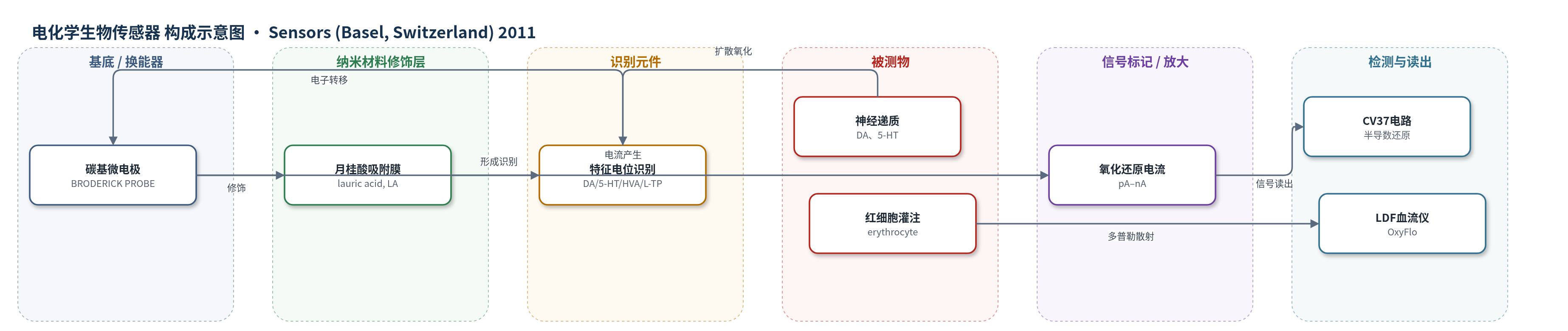
点击图片查看大图 · 依据论文自动绘制
传感器类型
电化学生物传感器
检测对象
多巴胺(dopamine, DA)、5-羟色胺(serotonin, 5-HT)、高香草酸(homovanillic acid, HVA)、L-色氨酸(L-tryptophan, L-TP)及红细胞灌注/脑血流(erythrocyte perfusion/cerebral blood flow, CBF);样品基质:活体大鼠背侧纹状体(dorsal striatum, DStr)脑组织微环境
检测原理
月桂酸/脂质在碳基BRODERICK PROBE®微电极表面形成定向吸附膜,降低表面张力并改善电子转移动力学。活体DStr中的DA、5-HT、HVA和L-TP扩散至电极界面,在CV37施加的电位扫描(−0.2至+0.9 V,10 mV/s)下于特征氧化半波电位发生氧化电子转移,产生法拉第电流。根据Cottrell方程,电流与扩散层内被测物浓度成正比,因此浓度升高使对应电位峰电流增大。半导数电路消除非法拉第充电电流,使多种神经递质按特征电位选择性成像。LDF以低功率激光经光纤照射DStr,移动红细胞散射光产生多普勒频移,背向散射光被收集;微血管灌注MP=NE×VE,输出信号与红细胞灌注成正比。
检测灵敏度
未报告LOD、线性范围、灵敏度斜率或相关系数。
效应效果
该NMI生物传感器可在线选择性成像DA、5-HT、HVA和L-TP,抗坏血酸与DA/5-HT分离,特征半波电位窗口±0.015 V;半导数电路消除非法拉第充电电流,响应毫秒级,多神经递质成像分钟级,空间分辨率纳米级,电流pA–nA。作者称可长期成像数月而不形成胶质增生,抗细菌生长,无需笨重头架。MCAO使DA信号约增加10倍;依诺肝素降低DA并增强5-HT,5-HT较基线增强约10倍。1.5 h和3 h再灌注后梗死面积显著减小(p<0.05),双LDF显示对侧半球代偿性血流变化。作者认为适用于卒中/脑损伤药物机制与临床转化研究。
传感器的构成
- 换能器电极:碳基BRODERICK PROBE®微电极/指示电极,作为电子转移与电流检测基底
- 修饰层:月桂酸(lauric acid, LA)/脂肪酸脂质定向吸附膜,降低表面张力并促进分子迁移与电子转移
- 识别元件:无外加抗体/适配体,依赖DA(0.14 V)、5-HT(0.31 V)、HVA(0.46 V)、L-TP(0.68 V)特征氧化半波电位选择性识别
- 参比/辅助电极:Ag/AgCl微参比电极与不锈钢微辅助电极,置于硬脑膜接触,构成电位扫描回路
- 信号读出:CV37检测器与半导数电子还原电路,将电位扫描转换为pA–nA电流
- 血流换能器:双激光多普勒血流仪(LDF)光纤激光传感器,监测DStr红细胞灌注
中文摘要
本文提出基于吸附电化学的神经分子成像(NMI)与双激光多普勒血流仪(LDF)联用,用于研究抗血小板/抗血栓药物依诺肝素(enoxaparin)对急性缺血性卒中(AIS)脑神经化学的影响。NMI采用微型生物传感器,可对神经递质和神经肽进行毫秒级响应成像;半导数电子还原电路可在数分钟内选择性、分别成像多种神经递质。NMI生物传感器空间分辨率为纳米级,电化学诱导电流处于皮安至纳安范围。LDF通过低功率激光和光纤光导在线照射活体脑组织,监测背侧纹状体等神经解剖底物的脑血流。BRODERICK PROBE®生物传感器具有生物相容性,并基于实验获得的特征半波电位和氧化电子转移,在动物和人体机体、血液、脑组织中精确成像神经递质。研究将月桂酸型BRODERICK PROBE®生物传感器和LDF激光传感器植入活体动物基底节背侧纹状体多巴胺能运动神经元,通过大脑中动脉闭塞(MCAO)诱导AIS,观察依诺肝素及再灌注期间脑神经化学与脑血流变化。该研究为卒中运动功能障碍和卒中后抑郁提供了临床相关证据,也是首次在卒中药物作用过程中在线成像脑神经递质。
英文摘要
Neuromolecular Imaging (NMI) based on adsorptive electrochemistry, combined with Dual Laser Doppler Flowmetry (LDF) is presented herein to investigate the brain neurochemistry affected by enoxaparin (Lovenox(®)), an antiplatelet/antithrombotic medication for stroke victims. NMI with miniature biosensors enables neurotransmitter and neuropeptide (NT) imaging; each NT is imaged with a response time in milliseconds. A semiderivative electronic reduction circuit images several NT's selectively and separately within a response time of minutes. Spatial resolution of NMI biosensors is in the range of nanomicrons and electrochemically-induced current ranges are in pico- and nano-amperes. Simultaneously with NMI, the LDF technology presented herein operates on line by illuminating the living brain, in this example, in dorso-striatal neuroanatomic substrates via a laser sensor with low power laser light containing optical fiber light guides. NMI biotechnology with BRODERICK PROBE(®) biosensors has a distinct advantage over conventional electrochemical methodologies both in novelty of biosensor formulations and on-line imaging capabilities in the biosensor field. NMI with unique biocompatible biosensors precisely images NT in the body, blood and brain of animals and humans using characteristic experimentally derived half-wave potentials driven by oxidative electron transfer. Enoxaparin is a first line clinical treatment prescribed to halt the progression of acute ischemic stroke (AIS). In the present studies, BRODERICK PROBE(®) laurate biosensors and LDF laser sensors are placed in dorsal striatum (DStr) dopaminergic motor neurons in basal ganglia of brain in living animals; basal ganglia influence movement disorders such as those correlated with AIS. The purpose of these studies is to understand what is happening in brain neurochemistry and cerebral blood perfusion after causal AIS by middle cerebral artery occlusion in vivo as well as to understand consequent enoxaparin and reperfusion effects actually while enoxaparin is inhibiting blood clots to alleviate AIS symptomatology. This research is directly correlated with the medical and clinical needs of stroke victims. The data are clinically relevant, not only to movement dysfunction but also to the depressive mood that stroke patients often endure. These are the first studies to image brain neurotransmitters while any stroke medications, such as anti-platelet/anti-thrombotic and/or anti-glycoprotein are working in organ systems to alleviate the debilitating consequences of brain trauma and stroke/brain attacks.