组成图示
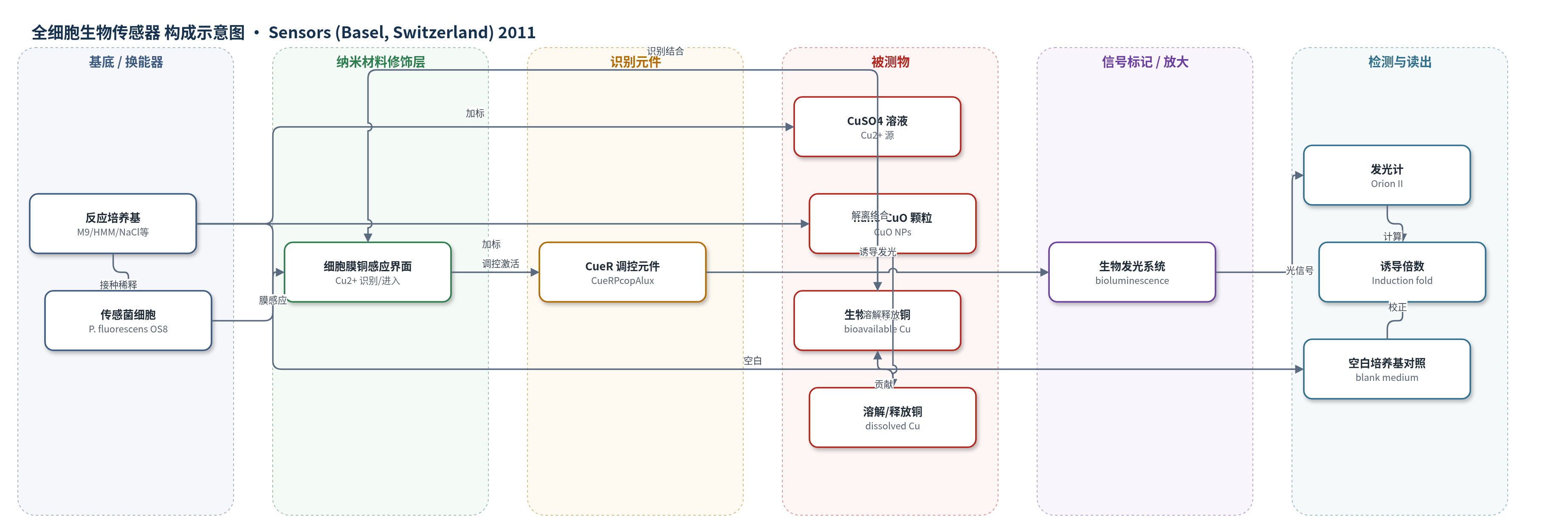
点击图片查看大图 · 依据论文自动绘制
传感器类型
全细胞生物传感器
检测对象
铜(copper, Cu),以 CuSO4 和 CuO 纳米颗粒(nano-CuO)形式;样品基质为17种生态毒理及微生物测试培养基(如 M9、HMM、LB、YPD、ME、0.9% NaCl、2% NaCl、AFW1、AFW2、Osterhout、algal medium 等)。
检测原理
该铜生物传感器以重组荧光假单胞菌 Pseudomonas fluorescens OS8::KnCueRPcopAlux 为传感单元。样品中的 CuSO4 解离出 Cu2+,nano-CuO 则通过溶解/释放 Cu2+ 以及颗粒相关生物可利用途径贡献可感应铜。生物可利用 Cu2+ 被细菌识别并进入细胞,激活铜响应调控元件 CueRPcopAlux,诱导生物发光报告系统表达,使发光强度随生物可利用铜浓度升高而增加。实验以空白培养基为对照,计算诱导倍数或相对诱导百分比,并用 Orion II 发光计读出。对 CuSO4,信号主要反映自由/可络合铜;对 nano-CuO,信号还可反映 ISE 无法检测的颗粒相关生物可利用铜,因此可作为快速生态毒理筛查。
检测灵敏度
Cu-ISE LOD (DI water): 0.021 ± 0.005 mg Cu/L;Cu-biosensor LOD: 20% induction;CuSO4: Cu-ISE LOD 0.008 ± 0.002 mg/L (AFW1), 2.7 ± 0.17 mg/L (LB);Cu-biosensor LOD 0.00002 ± 0.000005 mg/L (AFW1), 3.1 ± 0.21 mg/L (LB);nano-CuO: Cu-ISE LOD 0.015 ± 0.003 mg Cu/L (DI water), 0.009 ± 0.009 mg/L (0.9% NaCl);Cu-biosensor LOD 0.006 ± 0.0006 mg/L (0.9% NaCl);相关系数: r = 0.854, p < 0.01 (CuSO4), r = 0.869 (nano-CuO), r = 0.837 (CuSO4 vs nano-CuO free Cu)。
效应效果
CuSO4 体系中,自由铜与生物可利用铜显著相关(r=0.854,p<0.01),生物传感器 LOD 通常低于 Cu-ISE;11个 CuSO4 EC50 按自由铜归一化后,差异由4个数量级降至1.8个数量级,说明培养基络合能力是毒性差异主因。nano-CuO 体系中,两者相关(r=0.869),但生物传感器 LOD 最多比 Cu-ISE 低5倍,提示部分颗粒相关铜对活菌生物可利用而 ISE 不可检。有机物增加使 CuSO4 的 Cu-ISE LOD 升高(0.9% NaCl 加 0.5% AA 升高87倍,M9/HMM 加 0.5% AA 约30倍)。未报告 RSD 和回收率。作者认为该细菌铜生物传感器可作快速生态毒理筛查。
传感器的构成
- 传感基底/换能器:活细菌细胞(Pseudomonas fluorescens OS8::KnCueRPcopAlux),作为生物识别与信号转导单元。
- 识别元件:CueRPcopAlux 铜响应调控元件,响应生物可利用 Cu2+ 并启动报告基因表达。
- 信号标记物:生物发光报告系统(bioluminescence),铜诱导下产生可测发光信号。
- 反应介质:LB 培养基(含 100 µg/L kanamycin)用于预培养;M9、HMM、0.9% NaCl、2% NaCl、AFW1、AFW2、Osterhout、algal medium、ME、YPD 等作为反应基质。
- 被测物/样品:CuSO4·5H2O 溶液或 nano-CuO 悬浮液(标称 30 nm,水动力直径约 195±2 nm)加入测试培养基。
- 读出装置:Orion II luminometer(Berthold Detection Systems)测量 96 孔板中生物发光强度。
- 对照体系:空白培养基(medium blank)用于计算诱导倍数/百分比。
中文摘要
在复杂环境及生物测试基质中分析生物可利用铜具有挑战性。本研究利用基于重组荧光假单胞菌(Pseudomonas fluorescens)的铜生物传感器,评估硫酸铜(CuSO4)和氧化铜纳米颗粒(nano-CuO)在17种生态毒理及微生物培养基中的生物可利用性,并同步用铜离子选择性电极(Cu-ISE)测定自由铜。对 CuSO4,随培养基中有机物和磷酸盐浓度升高,自由铜和生物可利用铜均显著降低;自由铜与生物可利用铜呈良好相关(r=0.854,p<0.01),表明自由铜可作为 CuSO4 毒性的合理预测指标。将11个不同生物在不同培养基中的 CuSO4 EC50 按自由铜归一化后,差异由4个数量级降至1.8个数量级,说明毒性差异主要源于培养基性质而非生物固有敏感性。对 nano-CuO,自由铜和生物可利用铜与有机物浓度无显著相关,其形态受铜离子络合及不同条件下差异溶解共同影响;部分无法被 Cu-ISE 检测的 nano-CuO 对细菌生物传感器具有生物可利用性。结果表明,细菌铜生物传感器可单独或与其他形态分析技术结合,用作快速生态毒理筛查方法。
英文摘要
The analysis of (bio)available copper in complex environmental settings, including biological test media, is a challenging task. In this study, we demonstrated the potential of a recombinant Pseudomonas fluorescens-based biosensor for bioavailability analysis of CuSO4 and CuO nanoparticles (nano-CuO) in seventeen different ecotoxicological and microbiologial test media. In parallel, free Cu in these test media was analysed using Cu-ion selective electrode (Cu-ISE). In the case of CuSO4, both free and bioavailable Cu decreased greatly with increasing concentration of organics and phosphates in the tested media. A good correlation between free and bioavailable Cu was observed (r = 0.854, p < 0.01) indicating that the free Cu content in biological test media may be a reasonably good predictor for the toxicity of CuSO4. As a proof, it was demonstrated that when eleven EC50 values for CuSO4 from different organisms in different test media were normalized for the free Cu in these media, the difference in these EC50 values was decreased from 4 to 1.8 orders of magnitude. Thus, toxicity of CuSO4 to these organisms was attributed to the properties of the test media rather than to inherent differences in sensitivity between the test organisms. Differently from CuSO4, the amount of free and bioavailable Cu in nano-CuO spiked media was not significantly correlated with the concentration of organics in the test media. Thus, the speciation of nano-CuO in toxicological test systems was not only determined by the complexation of Cu ions but also by differential dissolution of nano-CuO in different test conditions leading to a new speciation equilibrium. In addition, a substantial fraction of nano-CuO that was not detectable by Cu-ISE (i.e., not present as free Cu-ions) was bioavailable to Cu-biosensor bacteria. Thus, in environmental hazard analysis of (nano) particulate materials, biosensor analysis may be more informative than other analytical techniques. Our results demonstrate that bacterial Cu-biosensors either in combination with other analytical/speciation techniques or on their own, may serve as a rapid (eco)toxicological screening method.