组成图示
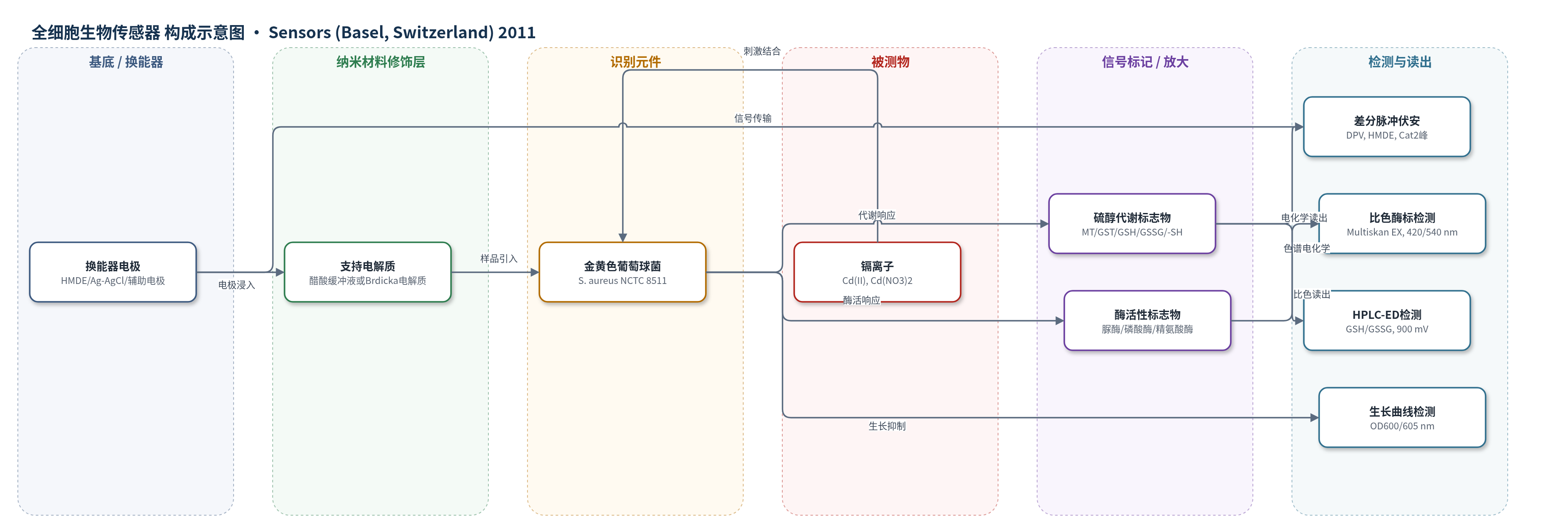
点击图片查看大图 · 依据论文自动绘制
传感器类型
全细胞生物传感器
检测对象
镉(II)离子(Cadmium(II) ions, Cd(II));样品基质:金黄色葡萄球菌培养液(肉蛋白胨、NaCl、牛提取物、酵母提取物)及经微波消解的细菌裂解/矿化样品。
检测原理
Cd(II)与金黄色葡萄球菌细胞壁/膜结合并进入细胞后,触发细菌抗性与解毒响应:CadA/CadCA外排、Smt金属硫蛋白(MT)结合、谷胱甘肽氧化及巯基代谢改变。随着Cd(II)浓度升高,MT、GST、-SH和GSSG增加,GSH/GSSG下降,脲酶、磷酸酶、精氨酸二水解酶及糖类代谢发生特征性变化,生长受到抑制。信号换能采用多通道读出:Cd(II)在HMDE上经吸附溶出伏安形成汞齐并再氧化,峰高随浓度增加;MT通过Brdicka反应催化Co(III)还原,在-1.55 V产生Cat2峰,峰高随MT含量增加;GSH/GSSG经HPLC-ED在900 mV氧化检测;酶和糖类代谢用比色底物在420/540 nm检测;生长用OD600/605监测。全细胞代谢级联和Brdicka催化反应提供信号放大。
检测灵敏度
LOD: 0.01 nM (pH 5);LOQ: 0.03 nM (pH 5);线性范围: 0.25 nM–100 nM;灵敏度斜率: 39.723 (pH 5);R^2 = 0.996。
效应效果
Cd(II)差分脉冲伏安在pH 5时RSD为3.2%,pH 4和pH 6分别为4.6%和5.1%;100%培养基使Cd(II)峰高降低超过70%,峰电位正移10 mV,斜率随培养基含量每1%下降2 nA,多项式模型R2>0.99。微波消解回收率为98.5–100.5%,两种消解方案斜率分别为5.8和4.4,差异超过20%。生长曲线在0–30 µg/mL呈线性(y=-2.0537x+70.016,R2=0.9641),50 µg/mL显著抑制;GSH、GSSG、MT、GST和-SH响应R2分别为0.987、0.990、0.987、0.988和0.987,GST与-SH相关R2=0.992。甘露糖、麦芽糖、甘露醇和脲酶变化明显,乳糖和N-乙酰-D-葡萄糖胺无显著变化。作者认为该全细胞体系可结合光谱与电化学用于环境重金属在线监测。
传感器的构成
- 识别元件:金黄色葡萄球菌(Staphylococcus aureus, NCTC 8511)活菌,作为生物识别与响应元件,接触Cd(II)后改变生长和代谢。
- 培养基质:肉蛋白胨、NaCl、牛提取物、酵母提取物培养基(pH 7.4),提供细菌生长、代谢和Cd(II)暴露环境。
- 被测物/刺激源:Cd(NO3)2提供的Cd(II)离子,浓度0–50 µg/mL,作为传感目标物。
- 信号标记/代谢标志物:金属硫蛋白(MT)、谷胱甘肽S-转移酶(GST)、巯基(-SH)、GSH/GSSG、脲酶、磷酸酶、精氨酸二水解酶及糖类代谢产物,作为Cd(II)响应信号。
- 换能器电极:悬挂汞滴电极(HMDE)作工作电极,Ag/AgCl/3M KCl作参比电极,玻璃碳或铂作辅助电极,用于Cd(II)和MT的电化学检测。
- 支持电解质:0.2 M醋酸缓冲液(pH 4/5/6)用于Cd(II)吸附溶出伏安;1 mM Co(NH3)6Cl3和1 M氨缓冲液(pH 9.6)用于Brdicka反应检测MT。
- 样品前处理层:磷酸盐缓冲液洗涤、液氮冷冻、超声/均质裂解、微波消解(HNO3/H2O2),释放细胞内结合Cd(II)和MT。
- 检测仪器:Metrohm 747 VA/757 VA差分脉冲伏安仪、Multiskan EX比色/酶标仪、BS-200自动生化分析仪、HPLC-ED(CoulArray)等,完成信号读出。
中文摘要
镉是环境中常见且危害人体健康的污染物,其检测具有重要意义。本研究以常见潜在致病菌金黄色葡萄球菌(Staphylococcus aureus)为生物识别元件,探索可用于镉(II)离子传感的代谢标志物。作者考察了0、1.25、2.5、5、10、15、25和50 µg/mL Cd(II)对细菌生长和能量代谢的影响。结果显示,硫醇化合物代谢发生显著变化:金属硫蛋白(MT)含量为0.79–26.82 mmol/mg蛋白,谷胱甘肽S-转移酶(GST)活性为190–5827 µmol/(min·mg蛋白),巯基(-SH)含量为9.6–274.3 µmol半胱氨酸/mg蛋白;还原型与氧化型谷胱甘肽(GSH/GSSG)比值明显下降,提示氧化应激。此外,与细菌抗性相关的脲酶活性发生显著变化,Cd(II)还影响精氨酸、β-葡萄糖苷酶、磷酸酶、N-乙酰β-D-葡萄糖胺、蔗糖、海藻糖、甘露醇、麦芽糖、乳糖、果糖及总蛋白等代谢途径。研究完成了Cd(II)处理下金黄色葡萄球菌的代谢组学谱图,为评估镉在细胞内的积累提供数据。结果表明,微生物可作为基于生物组分的现代生物传感器系统,用于重金属污染监测。
英文摘要
Cadmium, as a hazardous pollutant commonly present in the living environment, represents an important risk to human health due to its undesirable effects (oxidative stress, changes in activities of many enzymes, interactions with biomolecules including DNA and RNA) and consequent potential risk, making its detection very important. New and unique technological and biotechnological approaches for solving this problems are intensely sought. In this study, we used the commonly occurring potential pathogenic microorganism Staphylococcus aureus for the determination of markers which could be used for sensing of cadmium(II) ions. We were focused on monitoring the effects of different cadmium(II) ion concentrations (0, 1.25, 2.5, 5, 10, 15, 25 and 50 μg mL(-1)) on the growth and energetic metabolism of Staphylococcus aureus. Highly significant changes have been detected in the metabolism of thiol compounds-specifically the protein metallothionein (0.79-26.82 mmol/mg of protein), the enzyme glutathione S-transferase (190-5,827 μmol/min/mg of protein), and sulfhydryl groups (9.6-274.3 μmol cysteine/mg of protein). The ratio of reduced and oxidized glutathione indicated marked oxidative stress. In addition, dramatic changes in urease activity, which is connected with resistance of bacteria, were determined. Further, the effects of cadmium(II) ions on the metabolic pathways of arginine, β-glucosidase, phosphatase, N-acetyl β-d-glucosamine, sucrose, trehalose, mannitol, maltose, lactose, fructose and total proteins were demonstrated. A metabolomic profile of Staphylococcus aureus under cadmium(II) ion treatment conditions was completed seeking data about the possibility of cadmium(II) ion accumulation in cells. The results demonstrate potential in the application of microorganisms as modern biosensor systems based on biological components.