组成图示
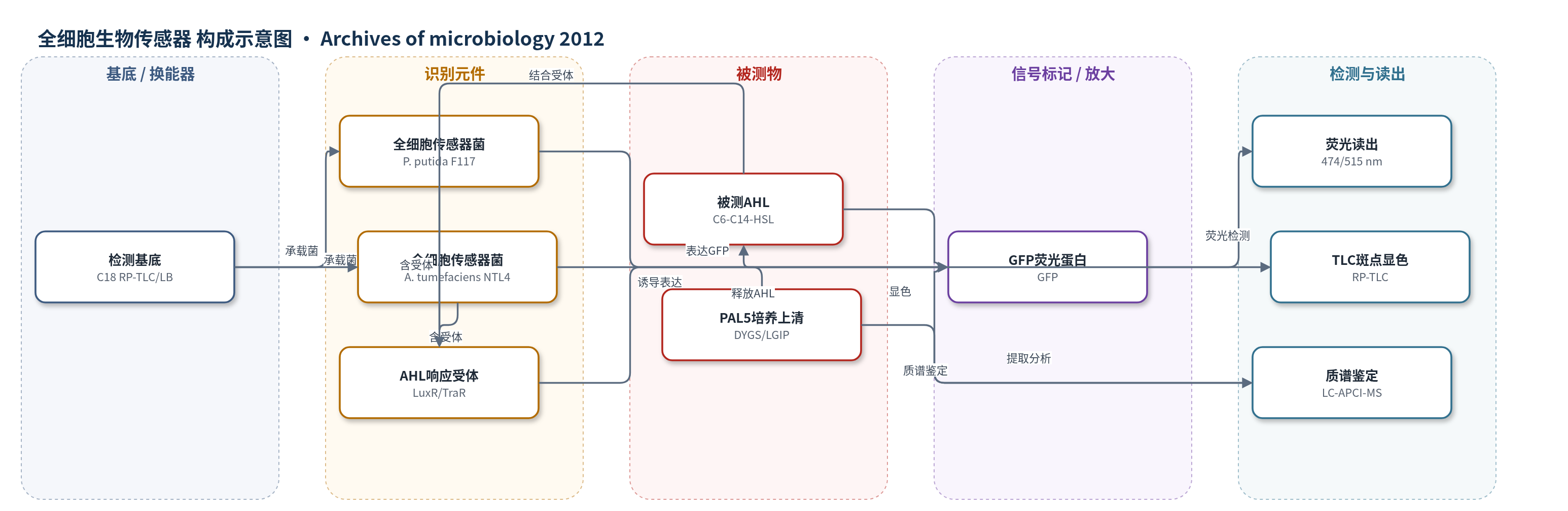
点击图片查看大图 · 依据论文自动绘制
传感器类型
全细胞生物传感器
检测对象
N-酰基高丝氨酸内酯(N-acyl homoserine lactones, AHLs,含 C6-HSL、C8-HSL、C10-HSL、C12-HSL、C14-HSL、3-oxo-C10-HSL、3-oxo-C12-HSL、3-oxo-C14-HSL);样品基质:Gluconacetobacter diazotrophicus PAL5 的 DYGS 复杂培养基/LGIP 合成培养基培养上清及乙酸乙酯浓缩提取物
检测原理
PAL5 培养上清或乙酸乙酯提取物中的 AHL 扩散至全细胞生物传感器菌。AHL 与菌内 LuxR 型受体结合,使受体构象改变并激活 AHL 响应启动子,诱导绿色荧光蛋白(GFP)转录表达。GFP 荧光强度随 AHL 浓度升高而增强,经 OD600 归一化后以相对荧光单位(RFU)或特异荧光单位(SFU)定量。TLC 生物测定中,A. tumefaciens NTL4 与短链 AHL 共显色形成斑点。LC-APCI-MS 则通过 [M+H]+ 精确质量确认分子结构。该体系依靠全细胞转录放大,而非化学标记或酶催化沉积。
检测灵敏度
原文未报告 LOD、线性范围、灵敏度斜率或相关系数。
效应效果
检测采用 A. tumefaciens NTL4 与 P. putida F117 两种全细胞生物传感器互补:前者对短链 AHL 敏感,后者响应长链 AHL,弥补 TLC 对长链 AHL 灵敏度低的不足。未接种培养基无斑点,背景荧光扣除,选择性较好。DYGS 与 LGIP 的 AHL 谱一致;DYGS 上清对两种 P. putida F117 的 GFP 诱导比 LGIP 高 3.5–4 倍,但按 OD600 归一化后短链 AHL 无显著差异,长链 AHL 在合成培养基中降低约 30%。定量至少三次,未报告 RSD、LOD 或回收率。作者认为该结果首次描述 PAL5 的 AHL 信号谱,有助于微生物-植物互作研究。
传感器的构成
- 基底/换能器:全细胞生物传感器菌(P. putida F117、A. tumefaciens NTL4)及 C18 RP-TLC/LB 培养基,承载识别与信号表达
- 识别元件:A. tumefaciens NTL4 (pCF218 pCF372) 中的 AHL 响应 LuxR 型受体与启动子,识别短链 AHL
- 识别元件:P. putida F117 (pKR-C12) 中的长链 AHL 响应受体,识别 C10-C14-HSL
- 识别元件:P. putida F117 (pAS-C8) 中的短链 AHL 响应受体,识别 C6/C8-HSL
- 信号标记物:绿色荧光蛋白(GFP),由 AHL 诱导表达,提供荧光信号
- 信号读出:荧光显微镜/Perkin-Elmer LS 55 荧光分光光度计(474 nm 激发、515 nm 发射)检测 GFP 荧光;TLC 斑点显色
中文摘要
甘蔗内生固氮菌 Gluconacetobacter diazotrophicus PAL5 具有生物固氮、分泌植物激素、溶解矿物养分及拮抗植物病原菌等促生功能。其基因组序列显示存在群体感应(QS)系统。QS 通过产生信号分子或自诱导物协调微生物群体生理,革兰氏阴性菌中最受关注的自诱导物为 N-酰基高丝氨酸内酯(AHLs)。本研究利用生物传感器菌株证明,在复杂培养基 DYGS 和合成培养基 LGIP 中培养的 PAL5 均产生 AHL 样分子。LC-APCI-MS 分析鉴定出 8 种信号分子,包括 C6-HSL、C8-HSL、C10-HSL、C12-HSL、C14-HSL 以及酰链含羰基取代的 3-oxo-C10-HSL、3-oxo-C12-HSL 和 3-oxo-C14-HSL。两种培养条件下 AHL 谱无差异;短链 AHL 水平未受影响,但合成培养基中长链 AHL 产量降低约 30%。
英文摘要
The endophytic diazotrophic Gluconacetobacter diazotrophicus PAL5 was originally isolated from sugarcane (Saccharum officinarum). The biological nitrogen fixation, phytohormones secretion, solubilization of mineral nutrients and phytopathogen antagonism allow its classification as a plant growth-promoting bacterium. The recent genomic sequence of PAL5 unveiled the presence of a quorum sensing (QS) system. QS are regulatory mechanisms that, through the production of signal molecules or autoinducers, permit a microbial population the regulation of the physiology in a coordinated manner. The most studied autoinducers in gram-negative bacteria are the N-acyl homoserine lactones (AHLs). The usage of biosensor strains evidenced the presence of AHL-like molecules in cultures of G. diazotrophicus PAL5 grown in complex and synthetic media. Analysis of AHLs performed by LC-APCI-MS permitted the identification of eight different signal molecules, including C6-, C8-, C10-, C12- and C14-HSL. Mass spectra confirmed that this diazotrophic strain also synthesizes autoinducers with carbonyl substitutions in the acyl chain. No differences in the profile of AHLs could be determined under both culture conditions. However, although the level of short-chain AHLs was not affected, a decrease of 30% in the production of long-chain AHLs could be measured in synthetic medium.