组成图示
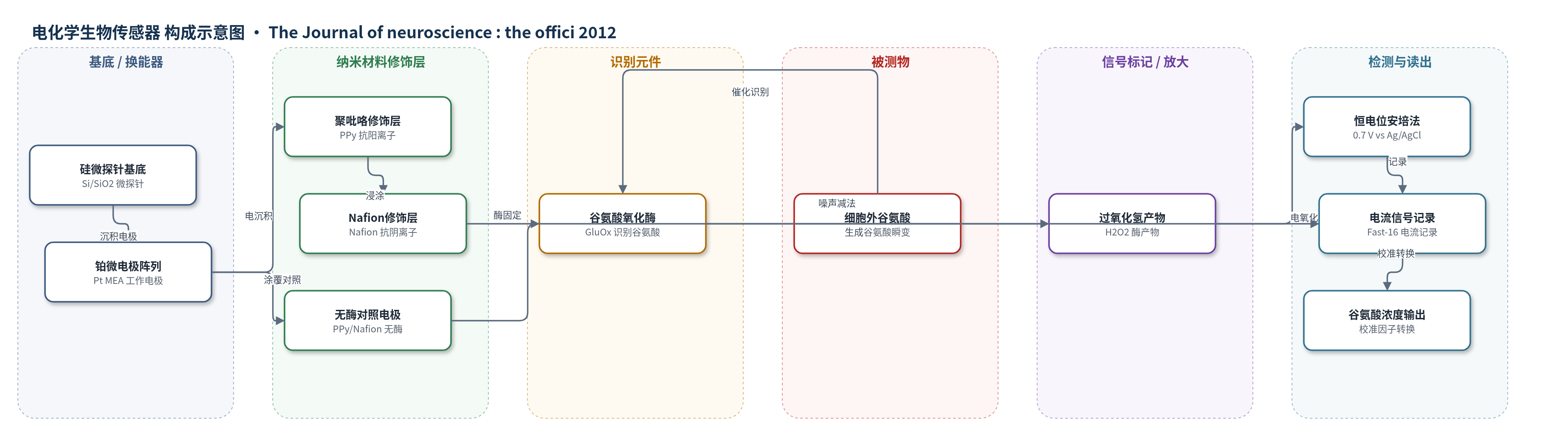
点击图片查看大图 · 依据论文自动绘制
传感器类型
电化学生物传感器
检测对象
细胞外谷氨酸(glutamate, Glu);样品基质:自由行为大鼠基底外侧杏仁核(BLA)活体脑组织细胞外液
检测原理
传感器以铂微电极阵列为工作电极,表面依次修饰聚吡咯(PPy)和Nafion以排斥多巴胺等阳离子及抗坏血酸等阴离子干扰,并固定L-谷氨酸氧化酶(GluOx)。当BLA细胞外谷氨酸扩散至电极表面时,GluOx催化其氧化脱氨,生成过氧化氢(H2O2)。在+0.7 V(vs Ag/AgCl)恒电位下,H2O2在Pt表面发生电氧化,产生与H2O2浓度成正比的安培电流;由于酶反应速率受谷氨酸浓度调控,电流随细胞外谷氨酸浓度升高而增大。无酶对照电极记录非酶H2O2氧化及背景电流,并从酶电极信号中减去,以降低噪声并提高瞬变信噪比。最终经体外校准因子将电流转换为谷氨酸浓度,实现近实时、空间离散的谷氨酸瞬变检测。
检测灵敏度
体外校准范围: 5–60 μM;平均校准因子(灵敏度): 149.6 μM/nA;响应时间: ~1 s;传感器上升时间: ~0.8 s
效应效果
选择性:250 μM抗坏血酸和5–10 μM多巴胺未产生高于噪声的电流;无酶对照电极对谷氨酸无响应,H2O2灵敏度差异约10%且不显著(t(15)=1.68, p=0.11)。响应时间约1 s,上升时间约0.8 s;体内瞬变持续约2–5 s,上升0.9 s、半宽0.8 s、衰减0.6 s。任务参与时频率显著升高(F(2,20)=16.12, p=0.0004),频率与按压速率相关(R^2=0.57, p=0.05),幅度相关(R^2=0.85, p=0.003)。TTX降低自发瞬变(t(4)=4.23, p=0.02),OFC muscimol降低任务相关频率(交互F(2,6)=6.05, p=0.03)。适用于自由行为动物脑内快速谷氨酸监测。
传感器的构成
- 基底/换能器电极:硅微探针(Si substrate,150–200 μm厚)与铂(Pt)微电极阵列(MEA),Pt 1000 Å 沉积于 Cr 200 Å 粘附层,电极位点约40×100 μm,用于电氧化H2O2并输出电流
- 绝缘/钝化层:热氧化SiO2及SiO2/Si3N4层(各5000 Å),电隔离基底与金属连接,并暴露Pt电极位点
- 抗阳离子修饰层:聚吡咯(PPy)电沉积层,排斥多巴胺(DA)等阳离子干扰
- 抗阴离子修饰层:Nafion薄膜,静电排斥抗坏血酸(AA)等阴离子干扰
- 识别/固定层:L-谷氨酸氧化酶(GluOx)以BSA和戊二醛(GA)化学交联固定于电极位点,催化谷氨酸氧化脱氨生成H2O2
- 参比电极:Ag/AgCl参比电极(玻璃封装或200 μm线,3 M NaCl),用于施加0.7 V恒电位
- 信号读出/对照:多通道快速电位计(Fast-16, Quanteon)记录电流;无酶PPy/Nafion对照电极用于减去非酶H2O2氧化电流并降低噪声
中文摘要
快速、有信息量的决策对于生存至关重要。基底外侧杏仁核(BLA)在奖赏寻求动作中起关键作用,但其神经化学基础尚不清楚。本研究利用生物传感器技术进展,在大鼠执行自定步调杠杆按压序列以获取蔗糖奖赏时,对BLA细胞外主要兴奋性递质谷氨酸进行空间离散、近实时记录。结果检测到与动作执行时间锁定的快速瞬变谷氨酸波动;这些谷氨酸瞬变往往先于杠杆按压动作,并在大鼠从事奖赏寻求动作时频率显著增加。基于 muscimol 和 tetrodotoxin 微灌流,这些瞬变似乎来源于胞体位于眶额皮层(OFC)的神经元末梢。谷氨酸瞬变的幅度和频率随所获奖赏价值波动,并正向预测杠杆按压速率。这些在工具性操作期间获得的新颖快速谷氨酸记录表明,BLA 谷氨酸能信号在工具性奖赏寻求动作中发挥作用。
英文摘要
The ability to make rapid, informed decisions about whether or not to engage in a sequence of actions to earn reward is essential for survival. Modeling in rodents has demonstrated a critical role for the basolateral amygdala (BLA) in such reward-seeking actions, but the precise neurochemical underpinnings are not well understood. Taking advantage of recent advancements in biosensor technologies, we made spatially discrete near-real-time extracellular recordings of the major excitatory transmitter, glutamate, in the BLA of rats performing a self-paced lever-pressing sequence task for sucrose reward. This allowed us to detect rapid transient fluctuations in extracellular BLA glutamate time-locked to action performance. These glutamate transients tended to precede lever-pressing actions and were markedly increased in frequency when rats were engaged in such reward-seeking actions. Based on muscimol and tetrodotoxin microinfusions, these glutamate transients appeared to originate from the terminals of neurons with cell bodies in the orbital frontal cortex. Importantly, glutamate transient amplitude and frequency fluctuated with the value of the earned reward and positively predicted lever-pressing rate. Such novel rapid glutamate recordings during instrumental performance identify a role for glutamatergic signaling within the BLA in instrumental reward-seeking actions.