组成图示
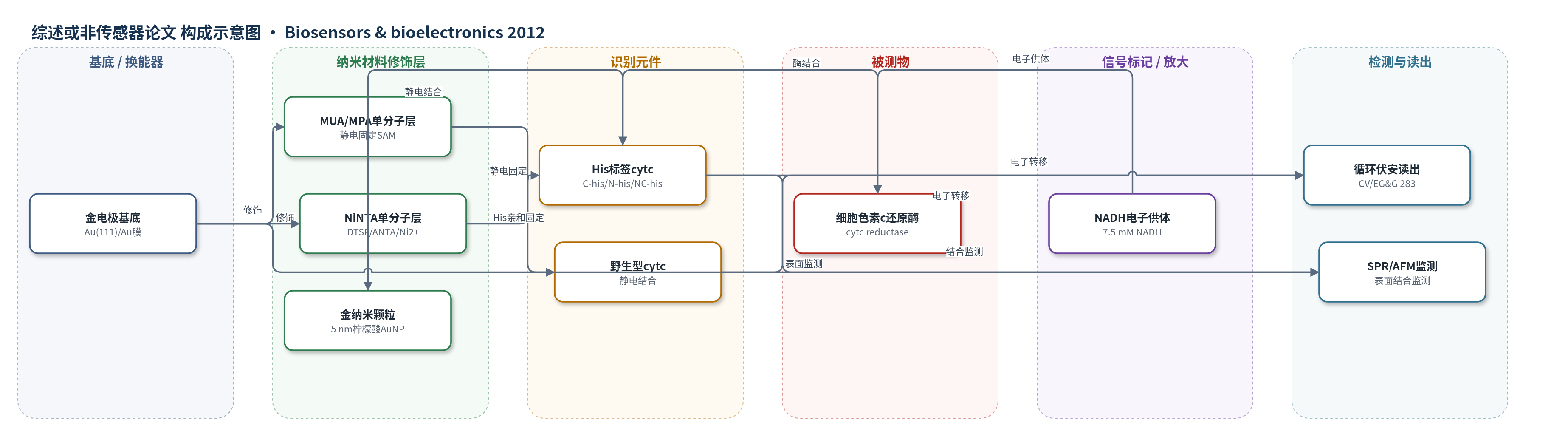
点击图片查看大图 · 依据论文自动绘制
传感器类型
综述或非传感器论文
检测对象
无明确检测对象;研究对象为马心脏细胞色素c(horse heart cytochrome c, cytc)及其与细胞色素c还原酶(cytc reductase)的电酶反应;样品基质为5.78 mM磷酸盐缓冲液(pH 7)
检测原理
该体系并非以某分析物浓度产生定量信号,而是研究固定化cytc的直接电化学与电酶电子传递。金电极表面先形成MUA/MPA或NiNTA自组装单分子层:前者通过羧基静电吸附cytc,后者通过Ni2+与His标签配位实现定向固定。cytc血红素中心与电极之间发生直接电子转移,循环伏安法出现氧化还原峰;固定取向和电极-血红素距离决定峰电位、峰分离和表面覆盖。加入细胞色素c还原酶和NADH后,NADH将电子经还原酶传递给cytc血红素,还原态cytc在电极表面被氧化,形成可循环的电催化电流。电流受酶结合、扩散和空间位阻限制;静电固定使cytc赖氨酸富集结合域朝向电极,导致还原酶无法结合,因而无催化响应。
检测灵敏度
原文未报告LOD、线性范围、灵敏度斜率或相关系数。
效应效果
SPR显示野生型cytc在MUA上静电结合快速稳定,洗涤无显著解吸;His标签cytc在NiNTA表面结合成功且未见明显非特异吸附,N-his约15 min饱和,C-his约25 min饱和,NC-his超过30 min。CV表明Wt/MUA表面覆盖Bn=66%,C-his/MPA为27%;NiNTA固定中C-his信号最强(E0=54 mV,ΔE=44 mV,Γm=0.20 μC/cm2,Bn=12%),N-his和NC-his分别为4%和6%。加入0.8 mg/mL cytc reductase和7.5 mM NADH后,所有His标签cytc均出现明显氧化电流增加,证明保留酶结合与电子中继功能;静电固定cytc无催化响应。5 nm AuNP可静电结合于His标签cytc表面,AFM覆盖约80%。作者认为该双价固定策略有利于定向组装和新型生物传感/生物电子器件。
传感器的构成
- 基底/换能器电极:Au(111)单晶或玻璃上Au膜(15–30 nm),提供电子转移界面与SPR检测表面
- 自组装单分子层(SAM):MUA或MPA,通过羧基静电结合cytc;NiNTA SAM由DTSP、ANTA和Ni2+构建,用于His标签亲和固定
- 识别/电子传递蛋白:重组马心脏细胞色素c(cytc,Wt、C-his、N-his、NC-his),血红素中心参与直接电子转移
- 亲和标签:C端、N端或双端His标签,与NiNTA-Ni2+配位实现定向固定
- 第二固定/界面纳米材料:5 nm柠檬酸金纳米颗粒(AuNP),静电结合于His标签固定cytc表面,实现双价固定
- 酶促电子供体:细胞色素c还原酶(cytc reductase)与NADH,将电子经cytc传递至电极并产生电催化电流
中文摘要
过去十年,微型电极上的蛋白质电化学不仅用于研究氧化还原蛋白的电荷转移性质,也推动了高灵敏度生物传感器和生物电子器件的发展。该领域的主要挑战之一是如何在电子元件与生物活性组分之间实现定向偶联。实现电极与蛋白之间快速、可逆电子转移的前提,是蛋白能以有利取向结合到电极表面。本文研究了静电结合和生物亲和标签结合策略,用于将马心脏细胞色素c(cytochrome c, cytc)定向固定于金电极表面。马心脏cytc在大肠杆菌中表达为未修饰蛋白或遗传修饰的组氨酸(His)标签蛋白,His标签分别引入多肽链的N端、C端或双端。研究目标是获得能够促进蛋白与电极之间强电子耦合、同时保留催化和调节功能的标签化cytc。不同固定策略的组合,例如His标签与静电固定,还为蛋白的双价固定提供了新途径,这对分子生物电子和生物传感应用具有重要意义,尤其适用于将蛋白定向固定于两个交叉电极之间。
英文摘要
During the last decade protein electrochemistry at miniaturized electrodes has become important not only for functional studies of the charge transfer properties of redox proteins but also for fostering the development of sensitive biosensor and bioelectronic devices. One of the major challenges in this field is the directed coupling between electronic and biologically active components. A prerequisite for a fast and reversible electron transfer between electrode and protein is that the protein can be bound to the electrode in a favourable orientation. We examined electrostatic and bioaffinity-tag binding strategies for the directed immobilization of horse heart cytochrome c (cytc) on gold electrode surfaces to achieve this goal. Horse heart cytc was expressed in E. coli either as non-modified or genetically modified, i.e. histidine (his)-tag containing protein. The his-tags were introduced at defined positions at the N- or C-terminus of the polypeptide. It was our aim to generate tagged-versions of cytc that facilitate strong electronic coupling between protein and electrode and, at the same time, retain their catalytic and regulatory properties. The combination of different immobilization strategies, e.g. his-tag and electrostatic immobilization also opens new avenues for bivalent immobilization of proteins. This is of interest for molecular bioelectronic and biosensing applications where the proteins are immobilized between two crossing electrodes.