组成图示
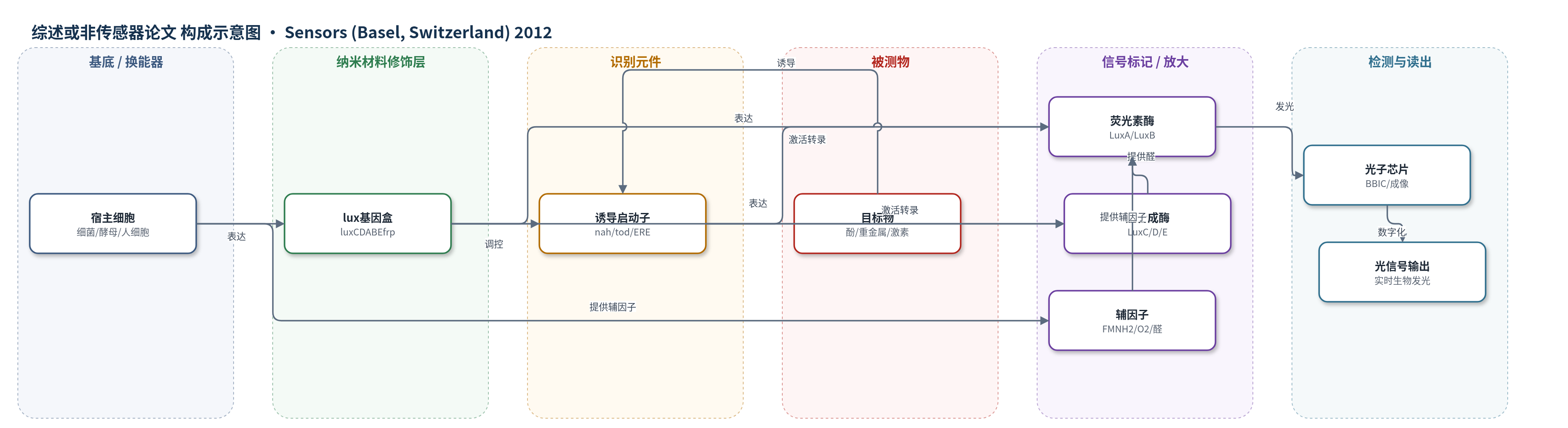
点击图片查看大图 · 依据论文自动绘制
传感器类型
综述或非传感器论文
检测对象
酚(phenol)、BTEX(benzene/toluene/ethylbenzene/xylene)、萘(naphthalene)、重金属(As、Hg、Pb、Cd、Ni、Zn)、雌激素/雄激素化合物(estrogenic/androgenic compounds)、DNA损伤/氧化应激;样品基质:环境水样、土壤、细胞培养液、活体小鼠。
检测原理
lux 全细胞生物报告系统以宿主细胞为传感单元。目标物进入细胞或结合调控元件后,激活相应诱导启动子/受体(如 nah、tod、mopR、recA、雌激素/雄激素反应元件),上调 luxCDABE 转录。LuxC/D/E 利用内源肉豆蔻酸等合成醛底物,frp 将 FMN 还原为 FMNH2;LuxA/LuxB 荧光素酶催化 FMNH2、O2 与醛发生氧化还原反应,发射蓝绿光。发光强度与目标物浓度、细胞数量或毒性/代谢状态相关,因此可实时、非破坏地反映被测物水平。信号由光子检测芯片(BBIC)或生物发光成像系统采集并数字化,无需外源荧光素底物。
检测灵敏度
原文为综述,未报告统一 LOD、线性范围、斜率或 R^2;代表性检测/浓度数值:toluene 30 µg/L;phenol 2.5 ppm;phenol 0.008 mg/L;mercury 0.5 ng/L;naphthalene 12–120 μM;BTEX 0.03–50 mg/L。
效应效果
lux 系统可连续、非破坏监测,信噪比优于传统酶报告;早期 lux 标记菌检测限较此前方法低约三个数量级。BTEX 报告器可在 2 h 内检测 30 µg/L 甲苯,并在无抗生素选择下保持 100 代以上活性;酚报告器对 10 种酚衍生物中仅 3 种响应,显示一定选择性。酵母雌激素检测 1 h 出结果,显著快于比色法 5 d。人细胞自主 lux 发光低于荧光素酶,需 15,000 个细胞(荧光素酶 50 个)和 25,000 个细胞(荧光素酶 2,500 个)用于成像,但可持续更久、变异性更低。BBIC 可检测约 5,000 个发光细胞并区分分析物浓度变化,支持植入式剂量/反应治疗。
传感器的构成
- 宿主细胞层:大肠杆菌、假单胞菌、酿酒酵母或人细胞系等,作为全细胞生物传感器载体与代谢环境
- 基因表达层:luxCDABEfrp 基因盒及表达载体,luxA/luxB 编码荧光素酶,luxC/D/E 编码醛底物合成酶,frp 编码黄素还原酶
- 识别/调控层:诱导型启动子或受体/转录因子(如 lac/ara、nah、tod、mopR、recA、雌激素/雄激素反应元件、LuxR/LuxI),响应目标物并启动 lux 转录
- 内源底物层:肉豆蔻酸(myristic acid)、FMN 和 O2,由细胞代谢提供或回收,支持自主发光
- 信号维持层:frp 黄素还原酶再生 FMNH2,维持持续生物发光
- 读出层:光子检测数字芯片(BBIC)或生物发光成像系统,将光子转换为数字信号并输出
中文摘要
细菌荧光素酶基因盒(lux)在生物发光生物报告系统中具有独特性,因为它能够合成和/或获取发光所需的全部底物。因此,lux 系统可在多种宿主中自主产生发光信号,既可持续发光,也可在特定触发物存在时响应发光。最初,lux 被广泛用作细菌生物报告系统,用于检测环境样品中的特定化学信号;过去30年来,其应用不断扩展,包括在酿酒酵母等真核细胞乃至人细胞系中表达。在这些条件下,lux 系统被开发为生物医学检测工具,用于毒性筛选和小动物模型中肿瘤显像。随着 lux 信号检测技术不断改进,它有望通过直接连接可植入光子检测数字芯片,成为首批完全可植入的体内光学检测系统之一。本综述介绍了使 lux 系统持续自主发光的基本生化背景,并概述了基于 lux 的生物报告器从原核细菌化学检测平台发展到啮齿动物肿瘤发生研究靶标的重要里程碑。此外,还将介绍利用集成电路微光度计在活体宿主内实时成像的 lux 成像未来,并强调其在剂量/反应治疗系统开发中的作用。
英文摘要
The bacterial luciferase gene cassette (lux) is unique among bioluminescent bioreporter systems due to its ability to synthesize and/or scavenge all of the substrate compounds required for its production of light. As a result, the lux system has the unique ability to autonomously produce a luminescent signal, either continuously or in response to the presence of a specific trigger, across a wide array of organismal hosts. While originally employed extensively as a bacterial bioreporter system for the detection of specific chemical signals in environmental samples, the use of lux as a bioreporter technology has continuously expanded over the last 30 years to include expression in eukaryotic cells such as Saccharomyces cerevisiae and even human cell lines as well. Under these conditions, the lux system has been developed for use as a biomedical detection tool for toxicity screening and visualization of tumors in small animal models. As the technologies for lux signal detection continue to improve, it is poised to become one of the first fully implantable detection systems for intra-organismal optical detection through direct marriage to an implantable photon-detecting digital chip. This review presents the basic biochemical background that allows the lux system to continuously autobioluminesce and highlights the important milestones in the use of lux-based bioreporters as they have evolved from chemical detection platforms in prokaryotic bacteria to rodent-based tumorigenesis study targets. In addition, the future of lux imaging using integrated circuit microluminometry to image directly within a living host in real-time will be introduced and its role in the development of dose/response therapeutic systems will be highlighted.