组成图示
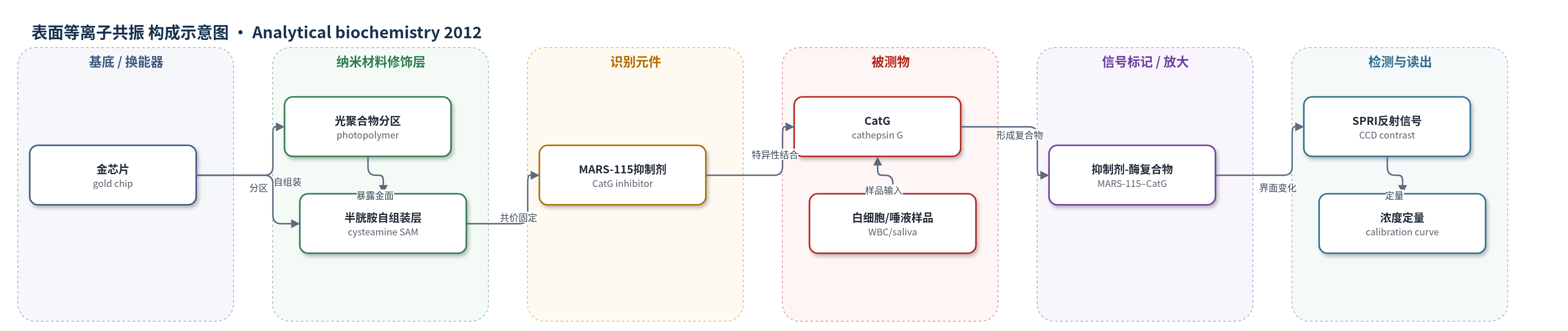
点击图片查看大图 · 依据论文自动绘制
传感器类型
表面等离子共振(SPR)生物传感器
检测对象
组织蛋白酶G(cathepsin G, CatG);样品基质:白细胞(white blood cells, WBC)和唾液(saliva)
检测原理
传感器以金芯片为SPRI换能基底,经半胱胺自组装单层固定MARS-115抑制剂。MARS-115的C端1-氨基烷基膦酸二芳基酯作为亲电弹头,与溶液中CatG活性位点发生不可逆共价结合,从而将酶特异性捕获在芯片表面。结合事件使金表面质量/折射率发生变化,改变表面等离子体共振成像的反射率或对比度。SPRI装置在固定入射角下用CCD相机采集整个芯片图像,Image J对单个斑点区域积分并扣除背景,得到与结合量成正比的SPRI信号。在pH 8.0、10 min孵育条件下,信号随CatG浓度增加而升高,呈Langmuir等温型,动态响应范围为0.25–1.5 ng/ml。
检测灵敏度
LOD: 0.23 ng/ml(3-SD basis);动态响应范围: 0.25–1.5 ng/ml (0.01–0.06 nM)
效应效果
传感器对CatG高度选择性:MARS-115对CatG的kobs/[I]为52,500±2500 M^-1 s^-1、IC50为21±5 nM,对糜蛋白酶、人中性粒细胞弹性蛋白酶和猪胰腺弹性蛋白酶无抑制。CatB以1:1至1:1000过量存在时不干扰,回收率101%–102%。1.00 ng/ml CatG 24次测定SD为0.15 ng/ml,95%置信限0.06 ng/ml。白细胞加标回收率98.4%–100.7%。7例白血病白细胞CatG为0.74–41.65×10^-5 ng/10^3 WBC,健康者低于检出限;唾液CatG随年龄升高,19–24岁1.25–2.17 ng/ml,>75岁3.18–3.51 ng/ml。
传感器的构成
- 基底/换能器:金芯片(gold chip),SPRI光学换能基底
- 分区层:光聚合物(photopolymer)和疏水保护漆(hydrophobic paint),划分9×12测量点
- 自组装连接层:半胱胺(cysteamine, 2-aminoethanethiol)20 mM乙醇溶液处理,形成硫醇自组装单层并提供氨基
- 识别/捕获元件:MARS-115 CatG肽类抑制剂,C端1-氨基烷基膦酸二芳基酯(phosphonic warhead)不可逆结合CatG活性位点
- 偶联试剂:EDC(N-ethyl-N'-(3-dimethylaminopropyl) carbodiimide)和NHS(N-hydroxysuccinimide)活化MARS-115羧基,与半胱胺氨基形成酰胺键
- 信号读出:SPRI装置(HeNe laser、prism、CCD camera)测量反射率/对比度变化,Image J积分斑点信号
中文摘要
本研究开发了一种用于测定具有酶活性的组织蛋白酶G(CatG)的特异性表面等离子共振成像(SPRI)阵列生物传感器。该传感器基于固定于芯片表面的抑制剂与待测溶液中CatG之间的特异性相互作用。作者合成了CatG肽类抑制剂MARS-115,其C端含有1-氨基烷基膦酸二芳基酯结构,N端为带游离羧基的N-琥珀酰亚胺;通过硫醇基团(半胱胺)将其共价固定于金芯片表面。利用原子力显微镜观察芯片制备各步骤中的表面变化,并优化检测条件。结果表明,所合成抑制剂对CatG具有高度特异性,方法的精密度和准确度均适合酶测定。该传感器可用于白细胞和唾液中CatG的测定,有望在白血病和口腔疾病早期病理状态中进行辅助诊断。
英文摘要
A specific surface plasmon resonance imaging (SPRI) array biosensor for the determination of the enzymatically active cathepsin G (CatG) has been developed. For this purpose, a specific interaction between an inhibitor immobilized onto a chip surface and CatG in an analyzed solution was used. The MARS-115 CatG peptidyl inhibitor containing the 1-aminoalkylphosphonate diaryl ester moiety at the C terminus and N-succinamide with a free carboxylic function was synthesized and covalently immobilized onto the gold chip surface via the thiol group (cysteamine). Atomic force microscopy was used for the observation of surface changes during the subsequent steps of chip manufacture. Optimal detection conditions were chosen. High specificity of synthesized inhibitor to CatG was proved. The precision, as well as the accuracy, was found to be well suited to enzyme determination. The sensor application for the determination of CatG in white blood cells and saliva was shown for potential diagnosis of leukemia and oral cavity diseases during the early stages of those pathological states.