组成图示
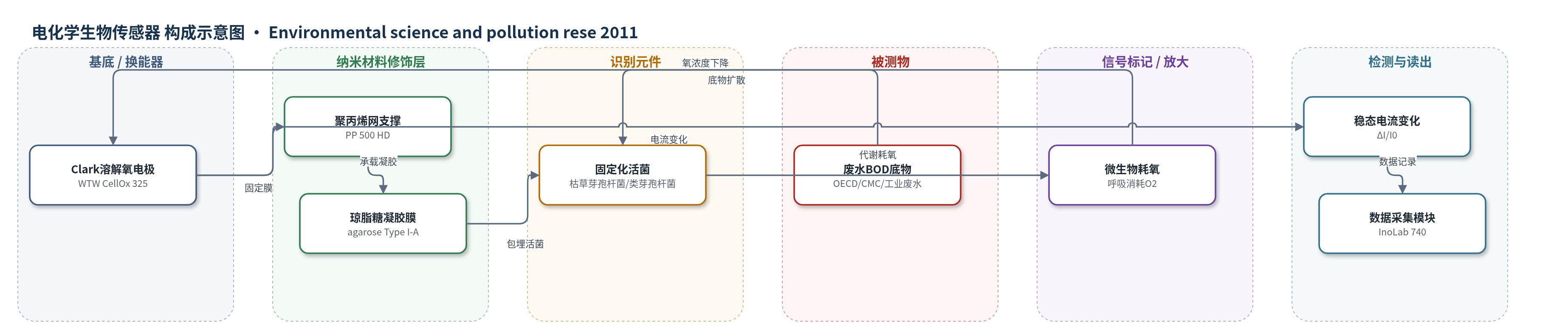
点击图片查看大图 · 依据论文自动绘制
传感器类型
电化学生物传感器
检测对象
生化需氧量(BOD/BOD7);样品基质:纸浆造纸工业废水、OECD合成废水、CMC加标合成废水、纸厂循环水、杨树浆厂出水
检测原理
传感器以固定化活菌为生物识别元件,以Clark型溶解氧电极为电化学换能器。测量时,将微生物膜置于曝气磷酸盐缓冲液中,待初始稳态电流I0稳定后加入含BOD底物的废水。可生物降解有机物(包括纤维素/CMC)扩散进入琼脂糖凝胶膜,被枯草芽孢杆菌或类芽孢杆菌同化代谢,微生物呼吸耗氧速率随之增加,导致电极附近溶解氧浓度下降,形成新的稳态电流Is。信号响应取ΔI=I0−Is,并归一化为NSR=ΔI/I0。NSR随样品BOD7浓度升高而增大,在至55或至50 mg/L范围内近似线性。该法无化学放大,主要依靠微生物代谢耗氧和稳态法提高信噪比。
检测灵敏度
LOD: 5 mg/l BOD7;线性范围: 至55 mg/l BOD7(B. subtilis)、至50 mg/l BOD7(Paenibacillus sp.);灵敏度: 0.01557 1/(mg/l BOD7)(B. subtilis)、0.01669 1/(mg/l BOD7)(Paenibacillus sp.)
效应效果
稳态法响应时间为20–25 min,固定化微生物使用寿命96 d,稳定期自固定后15 d开始。稳定期校准信号标准偏差为±5.57%(B. subtilis)和±8.85%(Paenibacillus sp.)。OECD合成废水重复性为±3.2%和±4.7%(N=5),合成与工业废水重复性分别为±6.8%–10.8%和±4.5%–8.6%;六支平行传感器重现性为±5.3%和±3.7%(N=6),均低于APHA限值15.4%。与常规BOD7相比,CMC加标合成废水中两者分别高估11.5%和3.1%;纸厂废水分别高估26.3%和21.6%;杨树浆厂废水分别低估13.6%和4.7%。Paenibacillus sp.传感器准确度更高,适合快速监测造纸废水纤维素污染,对单宁和木质素检测较弱。
传感器的构成
- 换能器电极:Clark型溶解氧传感器(WTW CellOx 325),电化学检测微生物膜附近溶解氧变化。
- 安装固定件:专用安装环和支架(mounting collar and holder),将微生物膜固定于溶解氧传感器表面。
- 支撑网:聚丙烯网(Scrynel PP 500 HD)圆盘,承载琼脂糖凝胶膜并控制厚度。
- 固定基质:琼脂糖凝胶(agarose, Type I-A, Low EEO, Sigma-Aldrich),包埋活菌形成微生物膜。
- 识别元件:枯草芽孢杆菌(Bacillus subtilis CE 22.1)或类芽孢杆菌(Paenibacillus sp. HTK 158a)活菌,同化可生物降解有机物并耗氧。
- 测量介质:磷酸盐缓冲液(pH 6.86,Na2HPO4/NaH2PO4·H2O),维持微生物活性与氧扩散。
- 信号读出:测量模块(InoLab 740)与MultiLab Pilot软件,记录稳态信号并计算归一化响应。
- 辅助装置:曝气单元和磁力搅拌器(Magnetmix 2070),维持溶液饱和溶解氧。
中文摘要
本研究构建了两种半特异性微生物生物传感器,用于快速分析高纤维素含量纸浆造纸工业废水中的生化需氧量(BOD)。传感器以固定在琼脂糖凝胶中的枯草芽孢杆菌(Bacillus subtilis)和类芽孢杆菌(Paenibacillus sp.)活菌为识别元件,菌株分别来自腐木屑和兔粪,并依据其同化纤维素的能力筛选。传感器采用OECD合成废水进行校准,并对不同废水样品进行检测。稳态法下响应时间为20–25 min,固定化微生物使用寿命为96 d。检出限为5 mg/L BOD7,枯草芽孢杆菌和类芽孢杆菌传感器的线性范围分别可达55和50 mg/L BOD7。两种传感器的重复性和重现性均低于APHA规定的15.4%限值。与常规BOD7相比,两者在纸厂废水中均高估BOD7,在杨树浆厂废水中则低估BOD7。结果表明,半特异性传感器更适合估算纤维素来源的有机污染,对单宁和木质素污染检测较弱,其中类芽孢杆菌传感器准确度和重复性更好。
英文摘要
INTRODUCTION: Two semi-specific microbial biosensors were constructed for the analysis of biochemical oxygen demand (BOD) in high-cellulose-content pulp and paper industry wastewaters. The biosensors were based on living cells of Bacillus subtilis and Paenibacillus sp. immobilized in an agarose gel matrix. Semi-specific microorganisms were isolated from various samples (decaying sawdust and rabbit manure) and were chosen based on their ability to assimilate cellulose.
MATERIALS & METHODS: The biosensors were calibrated with the Organization for Economic Cooperation and Development synthetic wastewater, and measurements with different wastewaters were conducted.
RESULTS: The response time of biosensors using the steady-state method was 20-25 min, and the service life of immobilized microorganisms was 96 days. Detection limit was 5 mg/l of BOD(7) while linear ranges extended up to 55 and 50 mg/l of the BOD(7) for B. subtilis- and Paenibacillus sp.-based biosensors, respectively. Repeatability and reproducibility of both biosensors were within the limits set by APHA-less than 15.4%. In comparison, both biosensors overestimated the BOD(7) values in paper mill wastewaters and underestimated the BOD(7) in aspen pulp mill wastewater.
CONCLUSIONS: The semi-specific biosensors are suitable for the estimation of organic pollution derived from cellulose, while the detection of pollution derived from tannins and lignins was minor. Better results in terms of accuracy and repeatability were gained with Paenibacillus sp. biosensor.