组成图示
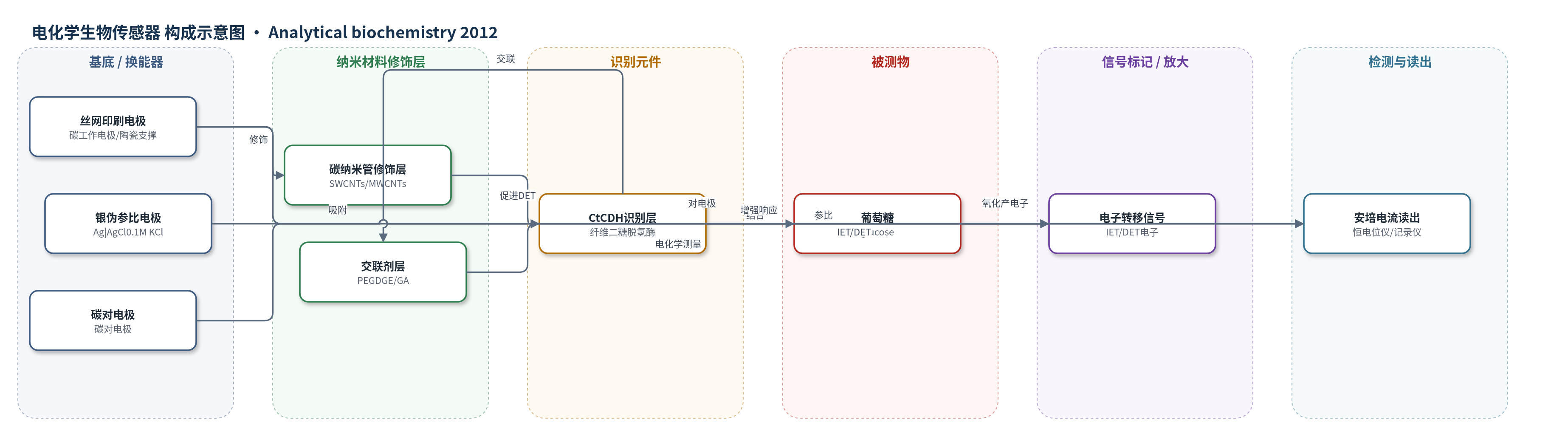
点击图片查看大图 · 依据论文自动绘制
传感器类型
电化学生物传感器
检测对象
葡萄糖(glucose);样品基质:PBS缓冲液(pH 7.4,含0.1 M KCl),面向血液/血糖样品
检测原理
该传感器为无介质第三代安培葡萄糖传感器。CtCDH的脱氢酶域(DHCDH)在pH 7.4附近催化葡萄糖发生2电子2质子氧化,生成葡萄糖内酯并使FAD还原;随后电子经域间电子转移(IET)传递至含血红素b的细胞色素域(CYTCDH),再由表面暴露的血红素通过直接电子转移(DET)到达碳工作电极。在+100 mV(vs Ag|AgCl 0.1 M KCl)下,葡萄糖浓度升高使催化电流增大。SWCNT/MWCNT增大电极真实表面积并改善酶取向与电子传递;PEGDGE或GA交联稳定酶层并提高响应。
检测灵敏度
LOD: 10 μM(原文10 lM/0.01 mM);线性范围: 0.025–30 mM
效应效果
SPCE-SWCNT传感器响应比裸SPCE高3–4.5倍,SPCE-MWCNT高2.5–3.5倍;PEGDGE交联使响应提高3–5倍,GA提高1.5–2倍。传感器间重现性RSD为3.3%–3.9%。连续7 h反复注入50 mM葡萄糖,响应仅下降约10%。对5 mM半乳糖、木糖、岩藻糖、鼠李糖、蔗糖和木糖醇无显著响应;5 mM甘露糖仅产生葡萄糖信号的10%,且血液中甘露糖浓度约为葡萄糖的1/100,仅在极低葡萄糖(<50 μM)时可能干扰。作者认为该传感器适合患者或血液样品中葡萄糖监测。
传感器的构成
- 基底/换能器:商用丝网印刷电极(SPCE),陶瓷支撑上印刷碳工作电极、银伪参比电极和碳对电极,提供电化学检测与微体积样品接触
- 纳米材料修饰层:羧基功能化单壁碳纳米管(SWCNTs)或多壁碳纳米管(MWCNTs)修饰碳工作电极,增大真实表面积并促进直接电子转移(DET)
- 识别元件:Corynascus thermophilus纤维二糖脱氢酶(CtCDH),物理吸附于工作电极表面,催化葡萄糖氧化并通过域间电子转移(IET)和直接电子转移(DET)传递电子
- 交联/稳定层:聚乙二醇(400)二缩水甘油醚(PEGDGE)或戊二醛(GA),交联吸附的CtCDH,提高稳定性与电流响应
中文摘要
本文报道一种可在生理条件下工作的第三代安培葡萄糖生物传感器。该传感器由新近发现的子囊菌Corynascus thermophilus来源的纤维二糖脱氢酶(CtCDH)通过简单物理吸附,或吸附后使用聚乙二醇(400)二缩水甘油醚(PEGDGE)或戊二醛(GA)交联,固定于商用碳基丝网印刷电极(SPCEs)、羧基功能化单壁碳纳米管修饰丝网印刷电极(SPCE-SWCNTs)或多壁碳纳米管修饰丝网印刷电极(SPCE-MWCNTs)上构成。该无介质直接电子转移葡萄糖传感器线性范围为0.025–30 mM,葡萄糖检出限为10 μM。基于SWCNT的传感器比MWCNT和裸SPCE具有更高灵敏度与催化响应;三种电极在酶层经PEGDGE或GA交联后响应均显著提高。通过反复注入50 mM葡萄糖测试7 h工作稳定性,电化学响应仅轻微下降。对血液中可能存在的甘露糖、半乳糖、蔗糖和岩藻糖等潜在干扰糖进行选择性测试,均未观察到显著分析响应。
英文摘要
In this article, we describe a third-generation amperometric glucose biosensor working under physiological conditions. This glucose biosensor consists of a recently discovered cellobiose dehydrogenase from the ascomycete Corynascus thermophilus (CtCDH) immobilized on different commercially available screen-printed electrodes made of carbon (SPCEs), carboxyl-functionalized single-walled carbon nanotubes (SPCE-SWCNTs), or multiwalled carbon nanotubes (SPCE-MWCNTs) by simple physical adsorption or a combination of adsorption followed by cross-linking using poly(ethyleneglycol) (400) diglycidyl ether (PEGDGE) or glutaraldehyde (GA). The CtCDH-based third-generation glucose biosensor has a linear range between 0.025 and 30 mM and a detection limit of 10 μM glucose. Biosensors based on SWCNTs showed a higher sensitivity and catalytic response than the ones functionalized with MWCNTs and the SPCEs. A drastic increase in response was observed for all three electrodes when the adsorbed enzyme was cross-linked with PEGDGE or GA. The operational stability of the biosensor was tested for 7 h by repeated injections of 50 mM glucose, and only a slight decrease in the electrochemical response was found. The selectivity of the CtCDH-based biosensor was tested on other potentially interfering carbohydrates such as mannose, galactose, sucrose, and fucose that might be present in blood. No significant analytical response from any of these compounds was observed.