组成图示
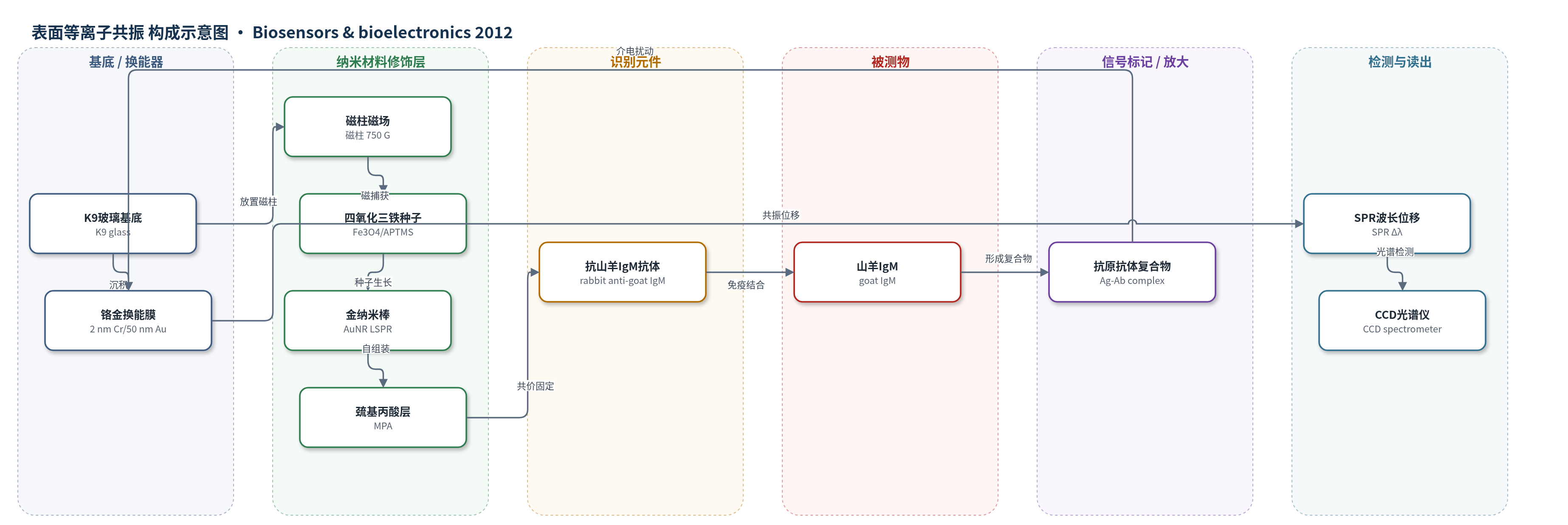
点击图片查看大图 · 依据论文自动绘制
传感器类型
表面等离子共振(SPR)生物传感器
检测对象
山羊IgM(goat IgM);样品基质:PBS缓冲液(0.01 mol/L,pH 7.4)标准溶液;干扰物为人IgG、BSA
检测原理
该传感器为无标记SPR免疫检测。Fe3O4–AuNR纳米复合材料在棱镜下方磁柱产生的磁场中被捕获并固定于Au膜表面,随后通过MPA的巯基自组装和EDC/NHS活化羧基共价固定兔抗山羊IgM抗体。当山羊IgM流过流动池时,与表面抗体特异性结合形成抗原–抗体复合物,使传感器表面局部介电常数增加。Au纳米棒的纵向局域表面等离子共振对周围介电变化敏感,并与Au膜中的传播表面等离子体耦合,导致SPR共振波长发生红移。共振波长位移随山羊IgM浓度升高而增大,经CCD光谱仪实时读出。
检测灵敏度
响应范围: 0.15–40.00 μg mL−1;未使用Fe3O4–AuNR的MPA膜响应范围: 1.25–40.00 μg mL−1;最小共振波长位移: 0.44 nm @0.15 μg mL−1;最大共振波长位移: 5.54 nm @40.00 μg mL−1;MPA膜最大位移: 2.66 nm @40.00 μg mL−1;LOQ: 比MPA膜低8倍
效应效果
该传感器对山羊IgM具有良好选择性:在相同条件下,10 μg/mL人IgG和BSA均未引起可观测的共振波长位移,表明非特异性结合较低。与仅用MPA自组装膜固定抗体的SPR传感器相比,Fe3O4–AuNR纳米复合材料可显著增加抗体负载并放大SPR响应:山羊IgM响应下限由1.25 μg/mL降至0.15 μg/mL,40.00 μg/mL时共振波长位移由2.66 nm增至5.54 nm,定量下限(LOQ)降低8倍。传感膜可通过移去磁柱并用水冲洗约40 min再生,实验步骤简化,适用于山羊IgM的实时、无标记免疫检测。
传感器的构成
- 基底/换能器:K9玻璃片,承载2 nm Cr粘附层和50 nm Au膜,形成SPR换能界面
- 磁场辅助固定层:棱镜下方磁柱(直径25 mm、高12 mm,约750 G磁场),用于磁性捕获Fe3O4–AuNR
- 磁性纳米种子:Fe3O4纳米粒子(约10 nm),经APTMS氨基修饰,提供异相成核位点并赋予磁性
- 金纳米棒修饰层:AuNR(约50×15 nm,AgNO3 0.05 mmol/L制备),通过种子介导生长在Fe3O4表面,提供局域表面等离子共振和光学放大
- 自组装连接层:3-巯基丙酸(MPA),通过巯基结合Au表面,提供羧基用于抗体共价固定
- 识别元件:兔抗山羊IgM抗体(rabbit anti-goat IgM,100 μg/mL),经EDC/NHS活化羧基后共价固定,特异性识别山羊IgM
- 封闭剂:1 mol/L乙醇胺盐酸盐(pH 8.0),封闭未反应羧基,降低非特异性结合
- 信号读出:波长调制SPR系统(卤素钨灯、K9棱镜、Ocean Optics光谱仪、CCD),监测共振波长位移
中文摘要
本文制备了一种新型磁性金纳米棒(Fe3O4–AuNR)纳米复合材料,并将其用作表面等离子共振(SPR)生物传感器的基底以检测山羊IgM。Fe3O4–AuNR通过种子介导生长法合成,并经分子吸收光谱、透射电子显微镜(TEM)、能量色散光谱(EDS)和X射线光电子能谱(XPS)表征。该纳米复合材料兼具磁性与优异光学性质,有利于抗体固定化并提高检测灵敏度。传感膜可方便再生,实验步骤简化。金纳米棒具有横向和纵向两种等离子共振波长,其中纵向等离子波长对周围介质介电性质变化更敏感。基于Fe3O4–AuNR纳米复合材料的SPR生物传感器在抗体–抗原免疫检测中表现出高灵敏度。在最优条件下,该传感器对山羊IgM在0.15–40.00 μg/mL浓度范围内响应良好;而未使用Fe3O4–AuNR的传感器响应范围为1.25–40.00 μg/mL,表明Fe3O4–AuNR显著提高了传感器灵敏度。
英文摘要
A novel nanocomposite Fe(3)O(4)-Au nanorod (AuNR) was prepared and used as the substrate in the surface plasmon resonance (SPR) biosensor to detect goat IgM. Fe(3)O(4)-AuNR nanocomposites were synthesized by a method of seed-mediated growth, and further characterized by molecular absorption spectroscopy, transmission electronic microscopy (TEM), energy-dispersive spectroscopy (EDS) and X-ray photoelectron spectroscopy (XPS). The nanocomposites exhibit both magnetic property and exceptional optical property, which are beneficial to the antibody immobilization and the sensitivity of detection. The sensing membrane can be regenerated easily and the experimental procedure is simplified. Moreover, the Au nanorods show two plasmon resonance wavelengths defined as transverse mode and longitudinal mode, and the longitudinal plasmon wavelengths are more sensitive to the changes in the dielectric properties of the surroundings. Fe(3)O(4)-AuNR nanocomposites got a high sensitivity in detection of antibody-antigen immunoassay. In the optimal conditions, the biosensor based on Fe(3)O(4)-AuNR nanocomposites exhibits a satisfactory response to goat IgM in the concentration range of 0.15-40.00 μg mL(-1). However, the biosensor without Fe(3)O(4)-AuNR nanocomposites shows a response to goat IgM in the concentration range of 1.25-40.00 μg mL(-1). As a result, the sensitivity of the biosensor based on Fe(3)O(4)-AuNR nanocomposites is enhanced significantly.