组成图示
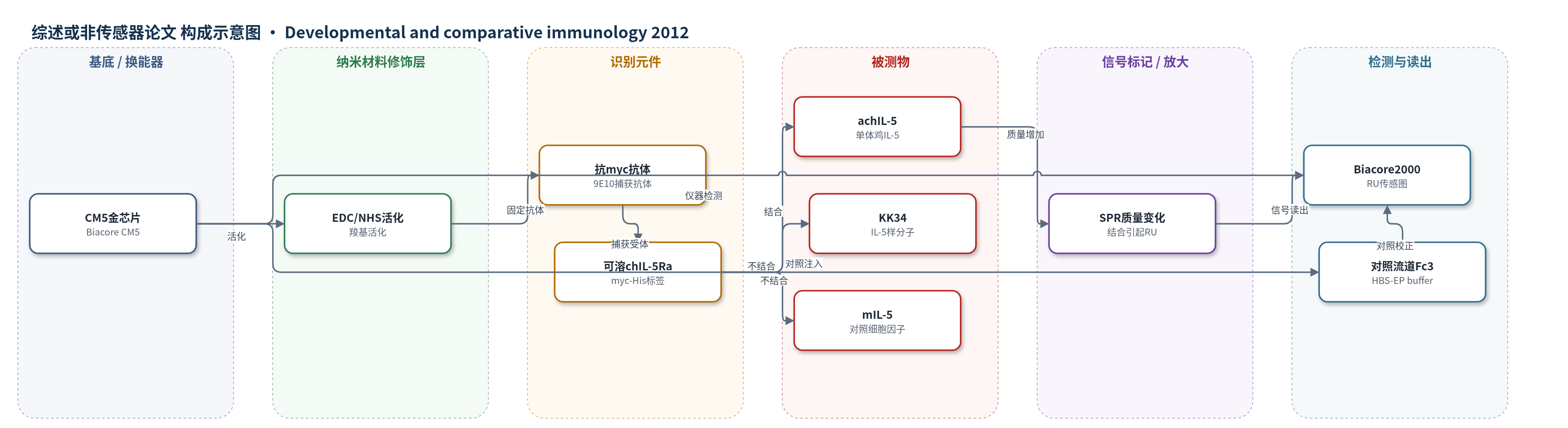
点击图片查看大图 · 依据论文自动绘制
传感器类型
综述或非传感器论文
检测对象
重组人工鸡白细胞介素-5(achIL-5)、鸡 IL-5 样分子 KK34、小鼠白细胞介素-5(mIL-5);样品基质:重组蛋白溶液/HBS-EP buffer
检测原理
该检测采用表面等离子共振(SPR)原理。CM5 金芯片经 EDC/NHS 活化后,固定小鼠抗 c-myc 抗体 9E10,再捕获带 myc-His 标签的可溶性 chIL-5Ra。当重组细胞因子流过芯片时,若与 chIL-5Ra 结合,芯片表面质量增加,导致表面等离子体共振条件改变,Biacore 2000 记录为共振单位(RU)变化。结合信号大小与表面结合量相关;对照流道注入 HBS-EP buffer 并扣除缓冲液基线,以校正非特异结合。实验后以 10 mM glycine-HCl(pH 1.5)再生芯片。achIL-5 与 chIL-5Ra 结合产生 RU 信号,而 KK34 和 mIL-5 不产生特异结合信号。
检测灵敏度
原文未报告 LOD、线性范围、灵敏度斜率或相关系数。
效应效果
SPR 结果显示,chIL-5Ra 对单体 achIL-5 具有特异性结合能力:8 倍浓缩 achIL-5 在约 513 RU 的 chIL-5Ra 捕获表面产生 114 RU 信号;1/16 稀释 achIL-5 仍可使约 367 RU 的 chIL-5Ra 饱和,产生 83 RU 信号。KK34 和 mIL-5 在 chIL-5Ra 表面未显示结合。作为交叉反应对照,约 557 RU 的 mIL-5Ra 捕获表面仅与 mIL-5 结合,achIL-5 和 KK34 的信号与 mock 对照相似。结果表明 chIL-5Ra 不与 KK34 相互作用,也不与哺乳动物 IL-5/IL-5Ra 交叉反应,支持鸡具有 IL-5Ra 同源物但 KK34 不能补充 IL-5/IL-5R 系统。
传感器的构成
- 基底/换能器:CM5 金传感器芯片,提供 SPR 检测表面
- 活化层:EDC/NHS 混合液(400 mM EDC、100 mM NHS),活化芯片表面羧基
- 捕获抗体:小鼠抗 c-myc 抗体 9E10,固定于芯片并捕获 myc-His 标签受体
- 封闭/失活层:1 M 乙醇胺-HCl(pH 8.5),灭活剩余反应基团
- 识别元件:可溶性 chIL-5Ra(myc-His 标签,HBS-EP buffer),结合目标细胞因子
- 分析物:重组 achIL-5、KK34、mIL-5 等细胞因子样品(HBS-EP buffer)
- 再生剂:10 mM glycine-HCl(pH 1.5),洗脱表面结合复合物
- 读出装置:Biacore 2000 SPR 仪器,以共振单位(RU)记录结合信号
中文摘要
白细胞介素-5(IL-5)与其受体(IL-5R)的相互作用对哺乳动物抗蠕虫免疫、过敏反应和B细胞应答的调控具有重要意义。本研究鉴定了编码鸡 IL-5R α 链(chIL-5Ra)的全长 cDNA。推导氨基酸序列与哺乳动物同源物具有41–43%一致性,胞外区含有四个保守半胱氨酸和 WSXWS 基序,胞内区含有 PPXP 基序。定量 RT-PCR 显示 chIL-5Ra mRNA 在骨髓中表达显著升高,在脾脏和肺中相对较高。为分析细胞因子-受体相互作用,利用 293F 细胞表达可溶性 chIL-5Ra 及细胞因子(人工制备的 chIL-5,即 achIL-5,以及另一种 IL-5 样分子 KK34)。Biacore 生物传感器相互作用分析表明,chIL-5Ra 能够结合单体 achIL-5,但不结合 KK34。结果表明鸡具有 IL-5Ra 同源物,但 KK34 不能补充 IL-5/IL-5R 系统。
英文摘要
Interaction between interleukin (IL)-5 and its receptor (IL-5R) is important for the regulation of immunity against worm infections, allergic reactions and B cell response in mammals. In this study, we identified a full-length cDNA encoding chicken IL-5R α-chain (chIL-5Rα). The deduced amino acid sequence showed 41-43% identity to mammalian homologues. It has four well-conserved cysteines and a WSXWS motif in the extracellular region, and a PPXP motif in the cytoplasmic region. Quantitative RT-PCR analysis revealed that chIL-5Rα mRNA expression was markedly high in bone marrow and relatively high in spleen and lung. Recombinant proteins of soluble chIL-5Rα and cytokines (artificially produced chIL-5 (achIL-5) and another IL-5-like molecule KK34) were expressed by 293F cells to examine the cytokine-receptor interactions. Interaction assay using a Biacore biosensor showed that chIL-5Rα has the capability to bind with monomeric achIL-5, but not with KK34. In conclusion, chicken has an IL-5Rα homologue but KK34 does not complement the IL-5/IL-5R system.