组成图示
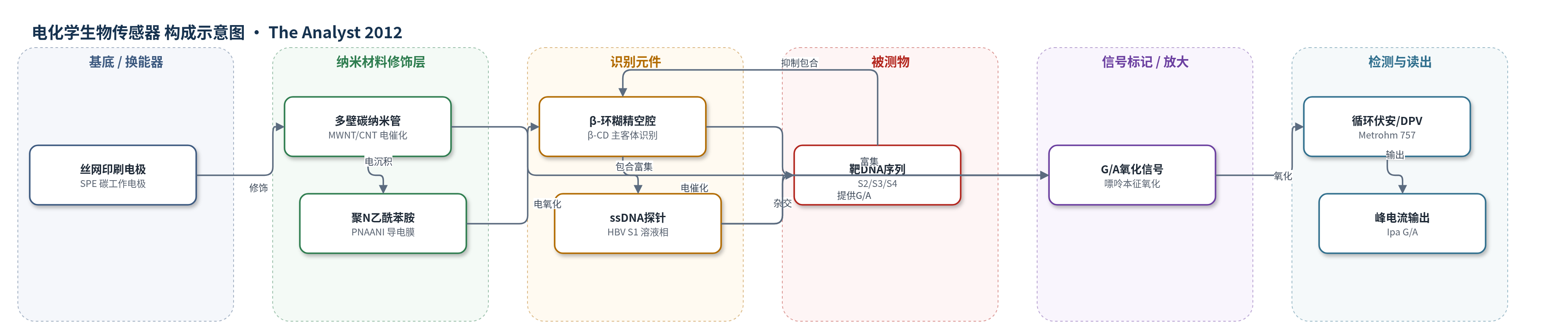
点击图片查看大图 · 依据论文自动绘制
传感器类型
电化学生物传感器
检测对象
乙型肝炎病毒(HBV)相关单链DNA靶序列(target DNA, S2/S3/S4)、单链DNA(ssDNA),样品基质为PBS缓冲液(溶液相杂交)
检测原理
β-环糊精(β-CD)疏水空腔包合单链DNA(ssDNA)中暴露的鸟嘌呤(G)和腺嘌呤(A),形成主客体复合物,使嘌呤碱基在电极表面预富集并降低氧化电位;多壁碳纳米管(MWNT)提供电催化和电子传递,聚(N-乙酰苯胺)(PNAANI)形成导电复合膜。ssDNA探针S1与靶DNA在溶液相杂交形成双链DNA后,G和A通过Watson-Crick碱基配对被掩蔽,不能进入β-CD空腔,可氧化嘌呤减少,G/A氧化峰电流下降。峰高与寡核苷酸中G/A数目及靶DNA浓度相关。通过循环伏安(CV)或差分脉冲伏安(DPV)测量G/A本征氧化峰电流变化,实现无标记均相杂交检测。信号放大来自β-CD包合预富集与CNT电催化协同。
检测灵敏度
LOD: 5.0 pmol mL−1 (S/N = 3);线性范围: 0.01–1.02 nmol mL−1
效应效果
该传感器可区分互补靶序列(S2)、双碱基错配序列(S3)和非互补序列(S4),非互补序列信号接近探针信号的两倍,表明杂交选择性良好。固定浓度ssDNA四次独立测量RSD为4.8%;介质交换实验中CD/PNAANI/CNT电极保留约70%原始峰高,而PNAANI/CNT无峰,说明β-CD对嘌呤碱基结合较强;电极至少可重复使用4次。方法无需外源标记,均相杂交简化步骤,作者认为其低成本、简单、灵敏、准确,适用于DNA检测。
传感器的构成
- 基底/换能器电极:丝网印刷石墨电极(SPE),含碳工作电极、碳对电极和银伪参比电极,提供电化学测量界面
- 纳米材料修饰层:多壁碳纳米管(MWNT/CNT)薄膜,经HNO3活化,提供电催化和界面富集,增强G/A氧化电流
- 导电聚合物修饰层:聚(N-乙酰苯胺)(PNAANI)膜,由N-乙酰苯胺电沉积形成,与CD/CNT构成复合修饰层
- 主客体识别层:β-环糊精(β-CD)空腔,通过电氧化负载于PNAANI/CNT电极,包合并预富集ssDNA中暴露的G/A碱基
- 识别元件:HBV相关单链DNA探针(ssDNA probe, S1),在溶液相中与靶DNA杂交
- 信号标记物:无外源标记,利用ssDNA中鸟嘌呤(G)和腺嘌呤(A)的本征氧化信号作为内源信号
中文摘要
本文报道了一种基于β-环糊精/聚(N-乙酰苯胺)/碳纳米管复合修饰丝网印刷电极(CD/PNAANI/CNT/SPE)的无标记电化学DNA杂交生物传感器。该传感器利用进入β-环糊精空腔的单链DNA中鸟嘌呤(G)和腺嘌呤(A)的本征氧化信号进行杂交检测。由于双链DNA中G和A分别与互补的胞嘧啶和胸腺嘧啶结合,ssDNA的氧化信号显著高于dsDNA。多壁碳纳米管的协同作用显著增强伏安信号,β-环糊精包合效应使G和A的阳极峰电位较裸电极负移。G和A峰高取决于寡核苷酸中相应碱基数目及靶DNA浓度。通过测量嘌呤碱基氧化信号监测互补链杂交,可在0.01–1.02 nmol mL−1范围内检测靶序列,检出限低至5.0 pmol mL−1(S/N=3)。该无标记均相电化学杂交检测为低成本、简单、高灵敏和准确的DNA分析提供了重要途径,并能区分互补、非互补和双碱基错配靶序列。
英文摘要
A novel label-free electrochemical DNA hybridization biosensor using a β-cyclodextrin/poly(N-acetylaniline)/carbon nanotube composite modified screen printed electrode (CD/PNAANI/CNT/SPE) has been developed. The proposed DNA hybridization biosensor relies on the intrinsic oxidation signals of guanine (G) and adenine (A) from single-stranded DNA entered into the cyclodextrin (CD) cavity. Due to the binding of G and A bases to complementary cytosine and thymine bases in dsDNA, the signals obtained for ssDNA were much higher than that of dsDNA. The synergistic effect of the multi-walled carbon nanotubes provides a significantly enhanced voltammetric signal, and the CD encapsulation effect makes anodic peaks of G and A shift to less positive potentials than that at the bare SPE. The peak heights of G and A signals are dependent on both the number of the respective bases in oligonucleotides and the concentration of the target DNA sequences. Hybridization of complementary strands was monitored through the measurements of oxidation signal of purine bases, which enabled the detection of target sequences from 0.01 to 1.02 nmol μl(-1) with the detection limit of target DNA as low as 5.0 pmol μl(-1) (S/N = 3). Implementation of label-free and homogeneous electrochemical hybridization detection constitutes an important step toward low-cost, simple, highly sensitive and accurate DNA assay. Discrimination between complementary, noncomplementary, and two-base mismatch targets was easily accomplished using the proposed electrode.