组成图示
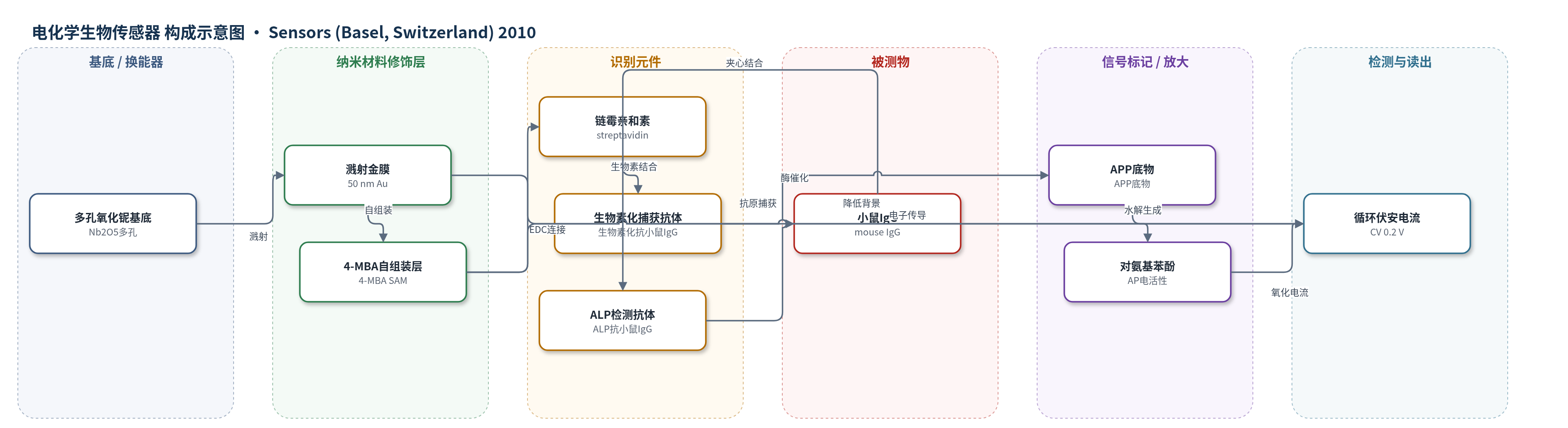
点击图片查看大图 · 依据论文自动绘制
传感器类型
电化学生物传感器
检测对象
小鼠免疫球蛋白G(mouse IgG);样品基质:孵育缓冲液(IB,含BSA)标准品溶液
检测原理
该传感器采用夹心免疫识别:Au@Nb2O5表面经4-MBA自组装、EDC/NHS活化并固定链霉亲和素,再结合生物素化抗小鼠IgG捕获目标mouse IgG,随后ALP偶联抗小鼠IgG结合形成夹心复合物。ALP催化底物APP水解生成电活性对氨基苯酚(AP)。在含APP的缓冲液中,AP在Au@Nb2O5电极表面发生电化学氧化,在约0.2 V(vs. Ag/AgCl)产生阳极峰电流。目标IgG越多,结合的ALP越多,生成的AP越多,氧化电流越大。Au@Nb2O5的高粗糙度和稳定金膜增强电子传递与信号,4-MBA单分子层降低非特异性吸附背景。
检测灵敏度
LOD: 1 pg mL–1
效应效果
该传感器对小鼠IgG具有选择性,山羊IgG阴性对照未出现0.2 V氧化峰;非特异性蛋白吸附低,背景电流小,有利于降低检测限。Au@Nb2O5电极上金膜附着稳定,无需耗时清洗即可重复测量,且溅射金膜表面粗糙度较高。与块金电极相比,在100 μg/mL小鼠IgG下电化学灵敏度提高两倍以上。每个浓度至少测量3个电极并取平均,响应从1 pg/mL可见,至1 mg/mL趋于饱和。作者认为该平台可用于多种临床相关蛋白的高灵敏、可重复检测。
传感器的构成
- 基底/换能器电极:Nb箔经阳极氧化形成多孔Nb2O5,孔径约10 nm、孔长120 nm,提供高粗糙度与稳定附着
- 金属修饰层:磁控溅射50 nm Au薄膜,形成Au@Nb2O5工作电极,提供导电表面与SAM成膜位点
- 自组装单分子层:1 mM 4-巯基苯甲酸(4-MBA)在乙醇中自组装12 h,形成羧基SAM,提供固定位点并降低背景
- 交联连接层:EDC/NHS活化4-MBA羧基并连接链霉亲和素(streptavidin),用于固定生物素化抗体
- 封闭层:1% BSA孵育30 min,减少非特异性蛋白吸附
- 捕获抗体:生物素化山羊抗小鼠IgG(biotinylated goat anti-mouse IgG)结合链霉亲和素,捕获目标mouse IgG
- 检测抗体/信号标记:ALP偶联山羊抗小鼠IgG(ALP-conjugated goat anti-mouse IgG)结合目标,形成夹心并催化底物
- 底物/信号生成:4-氨基苯基磷酸盐(APP)被ALP水解生成电活性对氨基苯酚(AP),在约0.2 V氧化产生电流
中文摘要
本文报道了一种基于阳极多孔氧化铌上溅射薄金膜(Au@Nb2O5)电极的酶放大夹心型电化学免疫传感器。该传感器利用碱性磷酸酶(ALP)催化4-氨基苯基磷酸盐(APP)生成电活性对氨基苯酚(AP),并在Au@Nb2O5表面进行电化学氧化,从而获得强信号放大。与传统块金或氧化铌电极相比,Au@Nb2O5电极具有更高表面粗糙度、更强金膜附着和更低非特异性蛋白吸附,因此无需耗时清洗即可获得可重复的电化学信号。循环伏安结果表明,非特异性结合背景可忽略,氧化峰电流随小鼠IgG浓度增加而增强。该传感器表现出高分辨率和高灵敏度,有望用于高效生物检测器件及临床相关蛋白分析。
英文摘要
We report on the development of an enzyme-amplified sandwich-type immunosensor based on a thin gold film sputtered on an anodic nanoporous niobium oxide (Au@Nb(2)O(5)) electrode. The electrocatalytic activity of enzymatically amplified electroactive species and a stable electrode consisting of Au@Nb(2)O(5) were used to obtain a powerful signal amplification of the electrochemical immunobiosensor. The method using this electrochemical biosensor based on an Au@Nb(2)O(5) electrode provides a much better performance than those based on conventional bulk gold or niobium oxide electrodes. Our novel approach does not require any time-consuming cleaning steps to yield reproducible electrochemical signals. In addition, the strong adhesion of gold films on the niobium oxide electrodes offers a very stable substrate during electrochemical biosensing. Cyclic voltammetry measurements indicate that non-specific binding of proteins to the modified Au@Nb(2)O(5) surface is sufficiently low to be ignored in the case of our novel system. Finally, we demonstrated the ability of the biosensor based on an Au@Nb(2)O(5) offering the enhanced performance with a high resolution and sensitivity. Therefore, it is expected that the biosensor based on an Au@Nb(2)O(5) has great potential for highly efficient biological devices.