组成图示
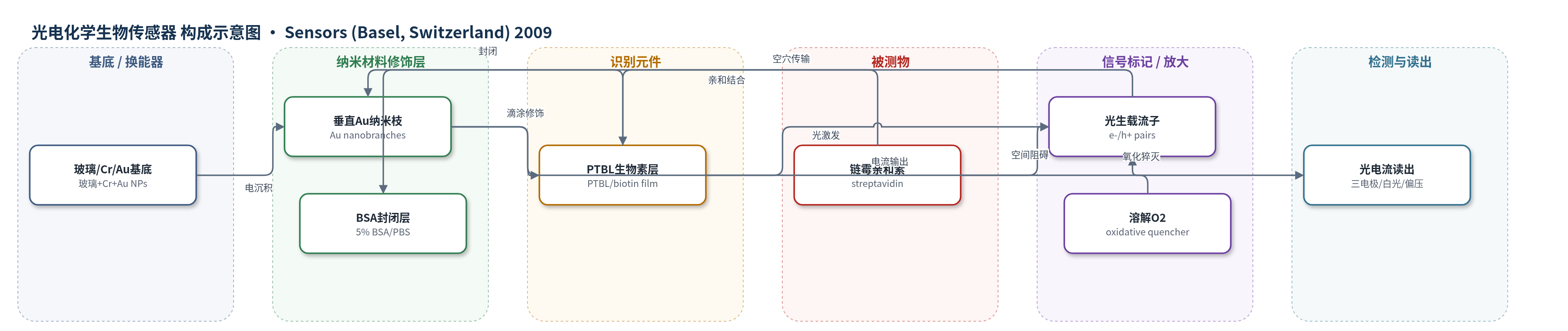
点击图片查看大图 · 依据论文自动绘制
传感器类型
光电化学生物传感器
检测对象
链霉亲和素(streptavidin),样品基质为 PBS 缓冲液
检测原理
PTBL 吸收白光后产生电子-空穴对,形成光电流。垂直取向 Au 纳米枝降低反射、增大界面面积,并作为单晶导电通道促进空穴从 PTBL 价带向 Au 费米能级转移,从而提高光电流。PBS 中溶解 O2 维持光电化学循环。当 streptavidin 与 PTBL 上的生物素特异性结合后,界面形成空间位阻,阻碍光生载流子向电解质传输,使阴极光电流下降;链霉亲和素浓度越高,光电流下降越大,实现无标记定量检测。
检测灵敏度
LOD: about 5 μg/mL;灵敏度斜率: 0.085(Δjph 对 Cstreptavidin)
效应效果
与 PTBL/Au 纳米颗粒电极相比,PTBL/Au 纳米枝电极的光电流下降斜率为 0.085,提高 2.5 倍,信噪比提高 1.6 倍。结合 60 μg/mL streptavidin 后,纳米颗粒电极稳定时间约 6 s,而纳米枝电极响应快且无明显滞后。光开关循环 1000 次后光电流保持稳定;PBS 对照未引起光电流下降,说明信号来自生物素-链霉亲和素特异性结合。该传感器对 streptavidin 的检出限约为 5 μg/mL,作者认为该策略可用于无标记光电化学亲和检测及高性能纳米结构生物传感器。
传感器的构成
- 基底/换能器电极:玻璃基底,溅射 Cr 粘附层(0.5 nm)与 Au 纳米颗粒层(约 3 nm),提供导电基底与成核位点
- 纳米材料修饰层:电化学沉积垂直取向 Au 纳米枝(Au nanobranches,-0.2 V、800 s,直径 50–500 nm、高 100–2000 nm),增强光收集与光生载流子传输
- 光敏/识别层:生物素化聚噻吩衍生物 PTBL 薄膜(约 200 nm,0.25 mg/mL DMF 滴涂),兼具光电响应与生物素识别位点
- 封闭层:5% BSA/0.1 M PBS 封闭 2 h(4 °C),减少链霉亲和素非特异吸附
- 氧化猝灭剂:电解质中溶解 O2,维持光电化学循环
- 信号标记物:无(label-free,streptavidin 结合直接改变光电流)
中文摘要
本文采用简单无模板电化学沉积法制备了四种纳米结构金电极,并将其与生物素化聚噻吩衍生物(PTBL)复合,研究其光电流产生及作为光电化学生物传感器的性能。四种电极中,垂直取向的金纳米枝显著提高了光电转换效率,因为垂直纳米结构不仅有利于光收集,还有利于光生载流子的传输。得益于该优势纳米结构,PTBL/金纳米枝电极在链霉亲和素-生物素亲和反应的光电化学检测中表现出比 PTBL/金纳米颗粒电极更高的灵敏度和更快的响应速度。该工作表明,通过构建垂直取向纳米结构电极,可增强光电化学信号并改善生物识别界面的响应特性,为高性能光电化学生物传感器和光电转换器件的设计提供了思路。
英文摘要
Four nanostructured Au electrodes were prepared by a simple and templateless electrochemical deposition technique. After complexing with a biotinylated polythiophene derivative (PTBL), photocurrent generation and performance of PTBL/Au-nanostructured electrodes as photoelectrochemical biosensors were investigated. Among these four nanostructured Au electrodes, vertically oriented nanobranches on the electrode significantly improved the photoelectric conversion, because the vertically oriented nanostructures not only benefit light harvesting but also the transfer of the photogenerated charge carriers. Owing to this advantaged nanostructure, the PTBL/Au-nanobranch electrode showed higher sensitivity and faster response times in the photoelectrochemical detection of a streptavidin-biotin affinity reaction compared to a PTBL/Au-nanoparticle electrode.