组成图示
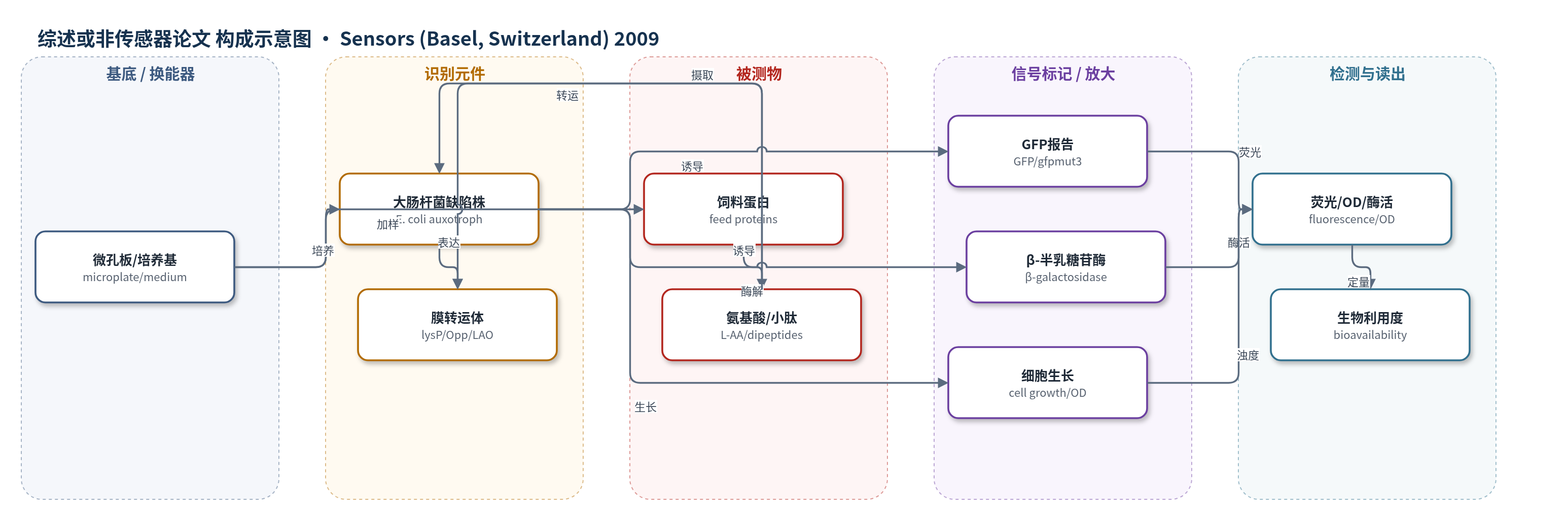
点击图片查看大图 · 依据论文自动绘制
传感器类型
综述或非传感器论文
检测对象
赖氨酸(Lys)、蛋氨酸(Met)、半胱氨酸(Cys)、苏氨酸(Thr)、色氨酸(Trp)、谷氨酰胺(Gln)等生物可利用氨基酸;样品基质为饲料蛋白/动物饲料经蛋白酶预消化后的消化液
检测原理
饲料蛋白先经蛋白酶(如 pronase、peptidase)预消化,模拟胃肠消化,释放 L-氨基酸和二/三肽。大肠杆菌氨基酸营养缺陷型突变株因缺失相应合成基因,其生长或报告基因表达依赖外源氨基酸。细胞膜转运体(lysP、LIV-II、LAO、Opp 等)立体特异性识别并摄取 L-氨基酸或小肽;氨基酸浓度越高,进入细胞的底物越多,细胞增殖越快,或诱导 GFP、β-半乳糖苷酶等报告系统表达越强。最终通过光密度(OD)、荧光或酶活读出,信号随生物可利用氨基酸浓度增加而增强,经标准曲线定量。全细胞生长和报告基因表达提供天然放大,微孔板实现高通量。
检测灵敏度
相关系数: 0.94(赖氨酸生物利用度,E. coli 赖氨酸营养缺陷株与鸡生物测定)
效应效果
该综述强调 E. coli 具有最短倍增时间,7–8 h 可达稳定期,微生物测定仅需 6–8 h,明显短于鸡生物测定的 2–3 周。E. coli 赖氨酸营养缺陷株经 pronase/peptidase 预消化后与已发表鸡生物测定数据相关系数为 0.94;GFP 全细胞传感器在 6 h 内测定高粱、豆粕、棉籽粕、肉骨粉、雏鸡料和仔猪料等生物可利用赖氨酸,除高粱外与鸡生物测定无显著差异。转运体只识别 L-型且要求自由氨基/羧基,赋予选择性。微孔板降低体积、时间和成本,可多缺陷株并行检测多种氨基酸;低代谢能或低氨基酸样品不影响测定,而动物试验受环境、性别、年龄和物种影响。
传感器的构成
- 反应容器/换能载体:微孔板(microtiter plate)或试管,用于培养大肠杆菌并读取光密度/荧光
- 传感细胞:大肠杆菌氨基酸营养缺陷型突变株(E. coli auxotroph,如 ΔlysA、lysA::Tn5、metC-/thr-、trpEA2-),作为识别与生长响应元件
- 识别元件:细胞膜氨基酸/肽转运体(lysP、LIV-II、LAO、Opp 等),立体特异性摄取 L-氨基酸或二/三肽
- 信号标记物:绿色荧光蛋白(GFP, gfpmut3)、β-半乳糖苷酶(β-galactosidase)或生物发光报告系统,将氨基酸利用转化为荧光/酶活/发光
- 样品预处理酶:蛋白酶(pronase、peptidase、pepsin、trypsin、chymotrypsin),模拟胃肠消化释放可吸收氨基酸/肽
- 读出方式:光密度(OD)、荧光、β-半乳糖苷酶活性,用于定量氨基酸生物利用度
中文摘要
动物日粮中必需氨基酸的数量与平衡对营养至关重要。缺乏会导致体重增长不佳,过量补充则增加成本并提高动物氮排放。虽然体内动物试验是测定氨基酸生物利用度的标准方法,但成本高、耗时长。大肠杆菌(Escherichia coli, E. coli)生物测定在准确性、成本和耗时方面是可行替代。E. coli 是胃肠道常驻菌,虽在结肠更丰富,但小肠也可分离到较高数量,而小肠是氨基酸和肽主要吸收部位。饲料蛋白消化后释放的氨基酸和小肽可被小肠和 E. coli 共同利用。两者氨基酸转运体均具立体特异性,只转运生物 L-型;自由氨基和羧基对氨基酸及二肽转运关键;二、三、四肽可进入肠细胞,且只有二、三、四肽支持 E. coli 生长。这些相似性加上成熟的细菌遗传学,使 E. coli 成为评估饲料中营养可用氨基酸的理想生物测定微生物。
英文摘要
In animal diets optimal amino acid quantities and balance among amino acids is of great nutritional importance. Essential amino acid deficiencies have negative impacts on animal physiology, most often expressed in sub-optimal body weight gains. Over supplementation of diets with amino acids is costly and can increase the nitrogen emissions from animals. Although in vivo animal assays for quantification of amino acid bioavailability are well established, Escherichia coli-based bioassays are viable potential alternatives in terms of accuracy, cost, and time input. E. coli inhabits the gastrointestinal tract and although more abundant in colon, a relatively high titer of E. coli can also be isolated from the small intestine, where primary absorption of amino acids and peptides occur. After feed proteins are digested, liberated amino acids and small peptides are assimilated by both the small intestine and E. coli. The similar pattern of uptake is a necessary prerequisite to establish E. coli cells as accurate amino acid biosensors. In fact, amino acid transporters in both intestinal and E. coli cells are stereospecific, delivering only the respective biological l-forms. The presence of free amino- and carboxyl groups is critical for amino acid and dipeptide transport in both biological subjects. Di-, tri- and tetrapeptides can enter enterocytes; likewise only di-, tri- and tetrapeptides support E. coli growth. These similarities in addition to the well known bacterial genetics make E. coli an optimal bioassay microorganism for the assessment of nutritionally available amino acids in feeds.