组成图示
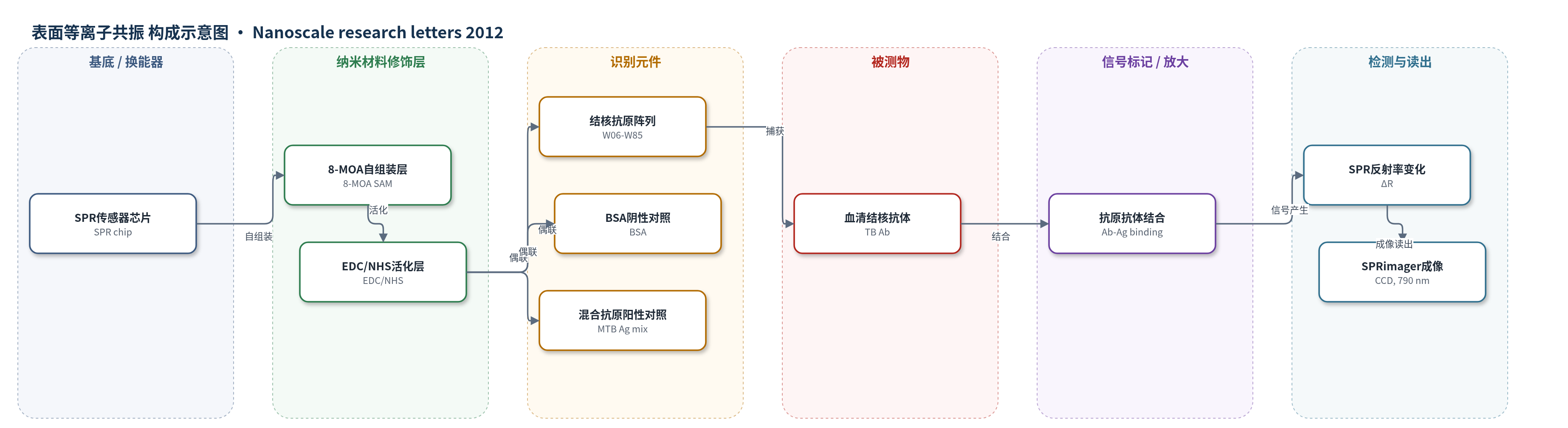
点击图片查看大图 · 依据论文自动绘制
传感器类型
表面等离子共振(SPR)生物传感器
检测对象
结核分枝杆菌抗体(Mycobacterium tuberculosis antibodies, anti-MTB Ab / TB Ab;用于识别 MTB 感染),样品基质:人血清(serum)
检测原理
传感器芯片表面先形成 8-巯基辛酸(8-MOA)自组装单分子层,经 EDC/NHS 活化后,将 9 种结核分枝杆菌抗原共价固定于微阵列点,形成多抗原识别界面。待测血清稀释后流过芯片,血清中抗结核抗体与对应抗原特异性结合,使芯片表面质量与局部折射率增加,改变表面等离子体共振条件。在固定角度下,SPR 反射率发生可测变化,以 ΔR 表示;抗体结合量越高,ΔR 越大。系统以健康组均值加 2 倍标准差(阈值 0.58)作为阳性判断标准,实现无标记、实时、多靶点检测。
检测灵敏度
原文未报告 LOD、线性范围、灵敏度斜率或相关系数。
效应效果
在 57 份血清(29 例结核患者、28 例健康人)中,单抗原 SPR 特异性为 93%–100%,灵敏度为 14%–79%;ELISA 特异性为 79%–100%,灵敏度为 10%–62%。多抗原 SPR 组合的灵敏度、特异性、阳性预测值(PPV)和阴性预测值(NPV)分别为 100%、89%、91% 和 100%,优于多抗原 ELISA 的 90%、57%、68% 和 84%。阴性对照反射率通常低于 0.02,患者 W14 点反射率可高于 0.6,健康人为 0.2–0.5。结果经三次独立实验平均,p<0.05,显示无标记、实时、多靶点检测潜力。
传感器的构成
- 基底/换能器:SPR 传感器芯片(SPR sensor chip),承载 25 点蛋白微阵列并产生 SPR 反射信号。
- 修饰层:8-巯基辛酸(8-MOA)自组装单分子层,提供羧基用于抗原偶联。
- 活化层:EDC/NHS 处理,活化 8-MOA 羧基形成可偶联基团。
- 识别元件:9 种结核分枝杆菌抗原(W06、W10、W14、W19、W28、W38、W64、W70、W85)固定于阵列点,捕获血清结核抗体。
- 对照元件:BSA 阴性对照点与混合 MTB 抗原阳性对照点,用于背景与阳性验证。
- 封闭剂:1 M 乙醇胺(ethanolamine)封闭未反应位点,降低非特异结合。
- 信号读出:GWC SPRimager 系统(CCD 相机,790 nm),以 ΔR 反射率变化实时监测抗体结合。
中文摘要
结核分枝杆菌(Mycobacterium tuberculosis, MTB)感染是造成全球数百万人死亡的重要慢性传染病。传统涂片镜检敏感性不足,培养法需 6–8 周才能出结果,难以满足快速诊断、预后评估和复发监测需求。本文构建了一种新型阵列格式表面等离子共振(surface plasmon resonance, SPR)生物传感器,将 9 种结核抗原固定于传感器芯片上,实现血清中多种结核抗体的同时检测。与酶联免疫吸附试验(ELISA)相比,该阵列 SPR 系统具有无标记、实时检测的优势,并表现出较高的敏感性和特异性,显示其在结核感染快速诊断和生物传感器阵列开发中的应用潜力。
英文摘要
Tubercle bacillus [TB] is one of the most important chronic infectious diseases that cause millions of deaths annually. While conventional smear microscopy and culture methods are widely used for diagnosis of TB, the former is insensitive, and the latter takes up to 6 to 8 weeks to provide a result, limiting the value of these methods in aiding diagnosis and intermediate decisions on treatment. Therefore, a rapid detection method is essential for the diagnosis, prognosis assessment, and recurrence monitoring. A new surface plasmon resonance [SPR] biosensor based on an array format, which allowed immobilizing nine TB antigens onto the sensor chip, was constructed. Simultaneous determination of multiple TB antibodies in serum had been accomplished with this array-based SPR system. The results were compared with enzyme-linked immunosorbent assay, a conventional immunological method. Array-based SPR showed more advantages in providing label-free and real-time detection. Additionally, the high sensitivity and specificity for the detection of TB infection showed its potential for future development of biosensor arrays for TB diagnosis.