组成图示
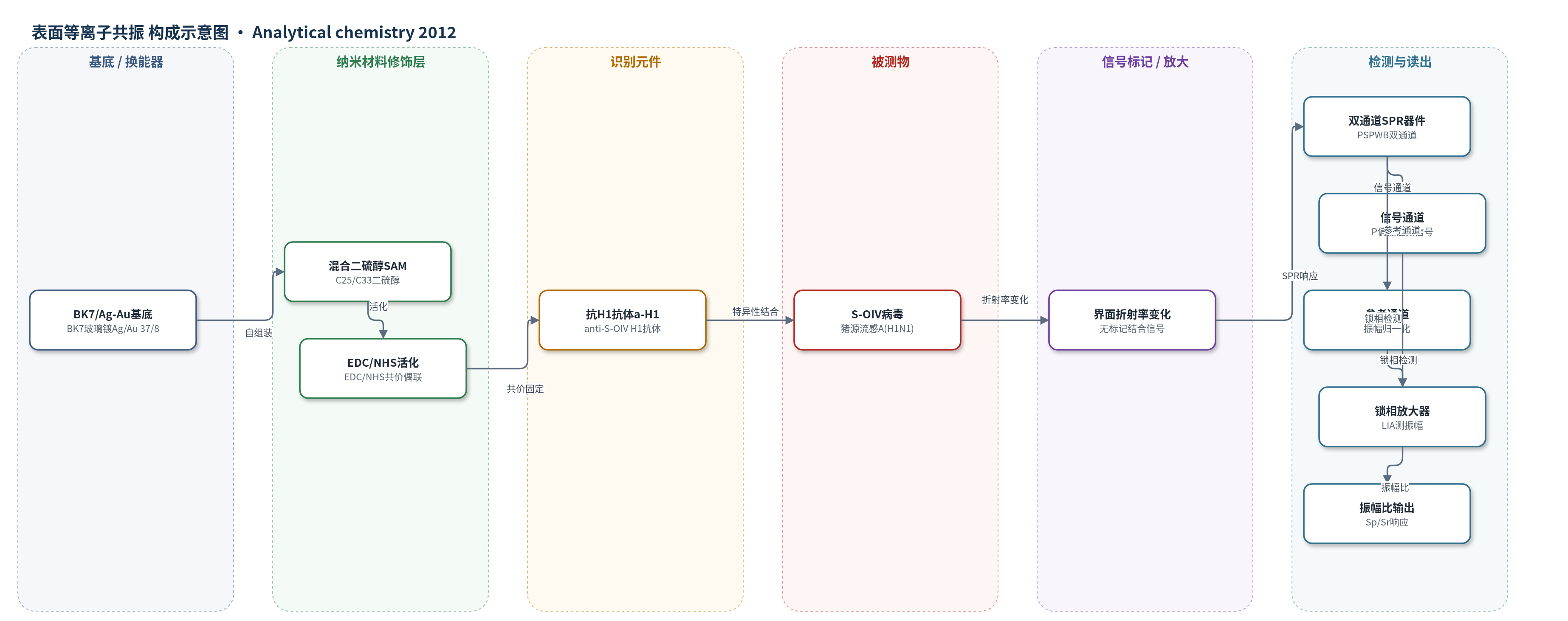
点击图片查看大图 · 依据论文自动绘制
传感器类型
表面等离子共振(SPR)生物传感器
检测对象
猪源流感A(H1N1)病毒(swine-origin influenza A (H1N1) virus, S-OIV);样品基质:PBS、正常人鼻黏膜模拟液(mimic solution)
检测原理
双通道PSPWB以BK7/Ag-Au SPR芯片为换能器,P偏振光在金属/介质界面激发表面等离子波,对界面有效折射率变化敏感。芯片表面经二硫醇SAM、EDC/NHS活化后共价固定抗S-OIV H1抗体(a-H1)。当PBS或鼻黏膜模拟液中的S-OIV与a-H1特异性结合时,界面局部质量/折射率增加,使SPR反射条件改变,信号通道P偏振混频振幅随之变化。参考通道同步测量背景并用于振幅比归一化,抑制激光强度与环境漂移。病毒浓度越高,结合量越大,SPR响应越强,经四参数逻辑拟合得到浓度-响应关系,实现无标记、实时、约20 min内检测。
检测灵敏度
LOD: 30 PFU/mL;线性范围: 18–1.8×10^6 PFU/mL;R^2 = 0.9735
效应效果
双通道PSPWB在20 min内系统稳定性RSD为0.02%,显著优于单通道的0.31%。在PBS中,S-OIV浓度18–1.8×10^6 PFU/mL范围内与SPR信号呈四参数逻辑关系(R^2=0.9735),理论LOD为30 PFU/mL。在含正常人鼻黏膜的模拟液中可检测1.8×10^2 PFU/mL。与商用RIDT相比,本方法在PBS中LOD低约2个数量级(RIDT为1.8×10^4 PFU/mL,模拟液为1.8×10^5 PFU/mL);与qPCR相比,PBS中LOD高约1个数量级(qPCR为3.5 PFU/mL),但检测时间仅<20 min,且不受PCR抑制物影响更明显,具有快速、无PCR扩增的临床诊断潜力。
传感器的构成
- 基底/换能器:BK7玻璃片镀Ag/Au叠层(37/8 nm),提供SPR换能界面
- 自组装单分子层:混合二硫醇SAM(C25H44O6S2与C33H58O11S2,90:10),形成结合基质并优化抗体单层
- 活化层:EDC/NHS混合溶液,活化SAM羧基以形成氨基反应位点
- 识别元件:抗S-OIV H1抗体(a-H1),共价固定于芯片表面,特异性捕获病毒H1抗原
- 封闭剂:乙醇胺-HCl(ETH,pH 8.5),封闭未反应活性位点
- 信号标记物:无标记S-OIV病毒颗粒,结合后改变界面有效折射率
- 读出系统:双通道PSPWB(He-Ne激光、EOM、双通道SPR器件、锁相放大器),输出信号/参考通道振幅比
中文摘要
本研究将所开发的双通道配对表面等离子波生物传感器(PSPWB)用于猪源流感A(H1N1)病毒(S-OIV)的快速高灵敏检测。该传感器采用信号通道与参考通道振幅比进行归一化,显著提高了系统稳定性。在磷酸盐缓冲液(PBS)中,以S-OIV临床分离株浓度为18–1.8×10^6 PFU/mL进行表面等离子共振(SPR)信号拟合,得到双通道PSPWB的理论检出限(LOD)为30 PFU/mL。该灵敏度比商用快速流感诊断试纸最差情况高约2个数量级,但比本实验中PBS中S-OIV的实时定量PCR(qPCR,LOD为3.5 PFU/mL)低约1个数量级。在含PBS稀释正常人鼻黏膜的模拟液中,该体系成功检测到1.8×10^2 PFU/mL的S-OIV,且检测时间少于20 min。结果表明,双通道PSPWB有望成为无需PCR扩增、适用于临床样本中病毒病原体快速、敏感、准确检测的替代诊断方法。
英文摘要
In this study, we applied the developed paired surface plasma waves biosensor (PSPWB) in a dual-channel biosensor for rapid and sensitive detection of swine-origin influenza A (H1N1) virus (S-OIV). In conjunction with the amplitude ratio of the signal and the reference channel, the stability of the PSPWB system is significantly improved experimentally. The theoretical limit of detection (LOD) of the dual-channel PSPWB for S-OIV is 30 PFU/mL (PFU, plaque-forming unit), which was calculated from the fitting curve of the surface plasmon resonance signal with a S-OIV clinical isolate concentration in phosphate-buffered saline (PBS) over a range of 18-1.8 × 10(6) PFU/mL. The LOD is 2 orders of magnitude more sensitive than the commercial rapid influenza diagnostic test at worst and an order of magnitude less sensitive than real-time quantitative polymerase chain reaction (PCR) whose LOD for S-OIV in PBS was determined to be 3.5 PFU/mL in this experiment. Furthermore, under in vivo conditions, this experiment demonstrates that the assay successfully measured S-OIV at a concentration of 1.8 × 10(2) PFU/mL in mimic solution, which contained PBS-diluted normal human nasal mucosa. Most importantly, the assay time took less than 20 min. From the results, the dual-channel PSPWB potentially offers great opportunity in developing an alternative PCR-free diagnostic method for rapid, sensitive, and accurate detection of viral pathogens with epidemiological relevance in clinical samples by using an appropriate pathogen-specific antibody.