组成图示
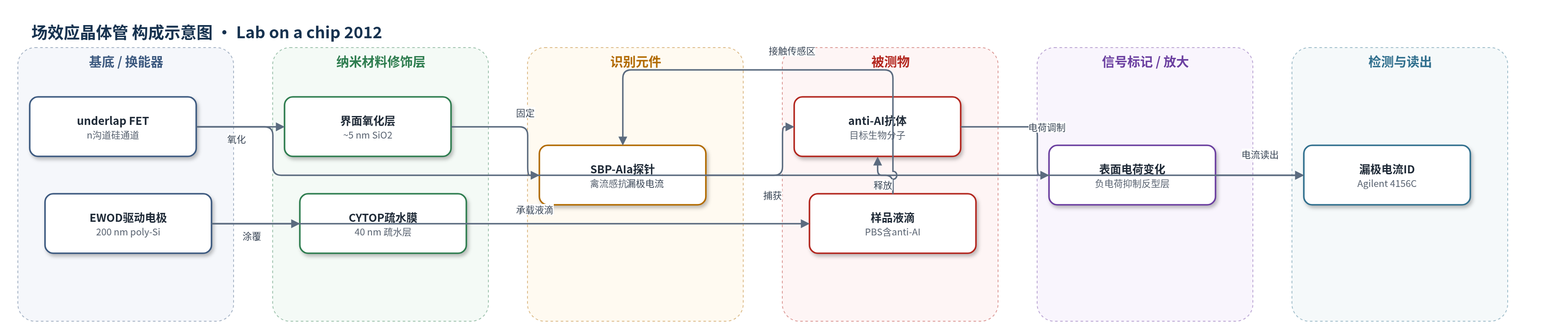
点击图片查看大图 · 依据论文自动绘制
传感器类型
场效应晶体管(FET)生物传感器
检测对象
禽流感抗体(anti-AI,avian influenza antibody);样品基质为 PBS 液滴(含 0.00005% Pluronic F127),对照样品为 anti-rabbit IgG 溶液
检测原理
该器件将 n 沟道 underlap FET 嵌入数字微流控电极之间,underlap 区经约 5 nm SiO2 修饰并固定 SBP-AIa 探针。EWOD 驱动含 anti-AI 的 PBS 液滴移动并与预存 PBS 液滴合并。anti-AI 与 SBP-AIa 特异性结合后,抗体所带负电荷在 underlap 区附近积累,改变界面电荷分布,抑制 n 沟道反型层形成,使源漏间漏极电流 ID 下降。仪器在栅压 0.7 V、漏压 0.05 V 下实时追踪 ID;结合越多,ID 越低,I1/I2 与抗体浓度呈线性关系。非特异性 anti-rabbit IgG 不引起明显电流变化,因此无需标记即可实现电学检测。
检测灵敏度
LOD: 0.5 pg ml⁻¹ (6.67 fM);测试浓度范围: 0.5 fg ml⁻¹–0.5 ng ml⁻¹ (66.7 aM–66.7 pM);线性关系: (I1/I2) 与 anti-AI 浓度呈线性关系
效应效果
选择性方面,10 mg mL⁻¹ anti-rabbit IgG 无特异性结合,漏极电流基本不变;10 mg mL⁻¹ anti-AI(133 nM)加入后,ID 由约 10⁻⁷ A 降至 10⁻¹¹ A,约 10⁴ 倍下降,显示宽传感窗口。独立芯片实验证实电流变化来自 SBP-AIa 与 anti-AI 特异性结合。响应较快,加入更高浓度 anti-AI 液滴后 ID 在 20 s 内变化,整体数十秒完成。作者认为单片集成 FET 与 EWOD 数字微流控无需泵、流道和笨重换能器,可集成供电与读出电路,适用于 POCT 和 m-TAS,但当前测量系统仍较笨重。
传感器的构成
- 换能器电极:n沟道 underlap FET,硅通道、源/漏/栅结构,underlap 区(300–1200 nm,实验 900 nm)作为生物结合与电流传感区
- 界面氧化层:约5 nm SiO2,覆盖 underlap 硅表面,提供 SBP-AIa 结合位点并降低漏极电流波动
- 识别元件:SBP-AIa(silica-binding proteins 偶联禽流感抗原),固定于 underlap 区,特异性捕获 anti-AI
- 隔离层:200 nm SiO2 ILD,覆盖 FET 并开孔暴露 underlap 区,隔离微流控电极与 FET
- 驱动电极:200 nm poly-Si 液滴驱动电极、预充电电极和探针焊盘,用于 EWOD 液滴移动与电信号接入
- 钝化疏水层:50 nm SiO2 与 150 nm Si3N4 钝化层,以及 40 nm CYTOP 疏水膜,防止短路并维持 EWOD 液滴运动
中文摘要
本文提出一种用于芯片实验室的新型平台,将场效应晶体管(FET)生物传感器阵列嵌入数字微流控器件中。underlap FET 位于液滴驱动电极之间,可通过电润湿(EWOD)驱动含目标分子的液滴从入口移动到传感器区域,并与预存液滴合并。器件无需标记即可实时电学检测禽流感抗体(anti-AI):当含 anti-AI 的液滴与传感器上的预存液滴合并后,抗原与抗体特异性结合引起界面电荷变化,使 n 沟道 underlap FET 的漏极电流下降。该平台将生物分子运输、检测、信号记录、处理与数据传输完全电学化,无需泵、流道或笨重换能器,且与现有控制与读出电路制造技术兼容,有助于构建一体化芯片。
英文摘要
A new platform for lab-on-a-chip system is suggested that utilizes a biosensor array embedded in a digital microfluidic device. With field effect transistor (FET)-based biosensors embedded in the middle of droplet-driving electrodes, the proposed digital microfluidic device can electrically detect avian influenza antibody (anti-AI) in real time by tracing the drain current of the FET-based biosensor without a labeling process. Digitized transport of a target droplet enclosing anti-AI from an inlet to the embedded sensor is enabled by the actuation of electrowetting-on-dielectrics (EWOD). A reduction of the drain current is observed when the target droplet is merged with a pre-existing droplet on the embedded sensor. This reduction of the drain current is attributed to the specific binding of the antigen and the antibody of the AI. The proposed hybrid device consisting of the FET-based sensor and an EWOD device, built on a coplanar substrate by monolithic integration, is fully compatible with current fabrication technology for control and read-out circuitry. Such a completely electrical manner of inducing the transport of bio-molecules, the detection of bio-molecules, the recording of signals, signal processing, and the data transmission process does not require a pump, a fluidic channel, or a bulky transducer. Thus, the proposed platform can contribute to the construction of an all-in-one chip.