组成图示
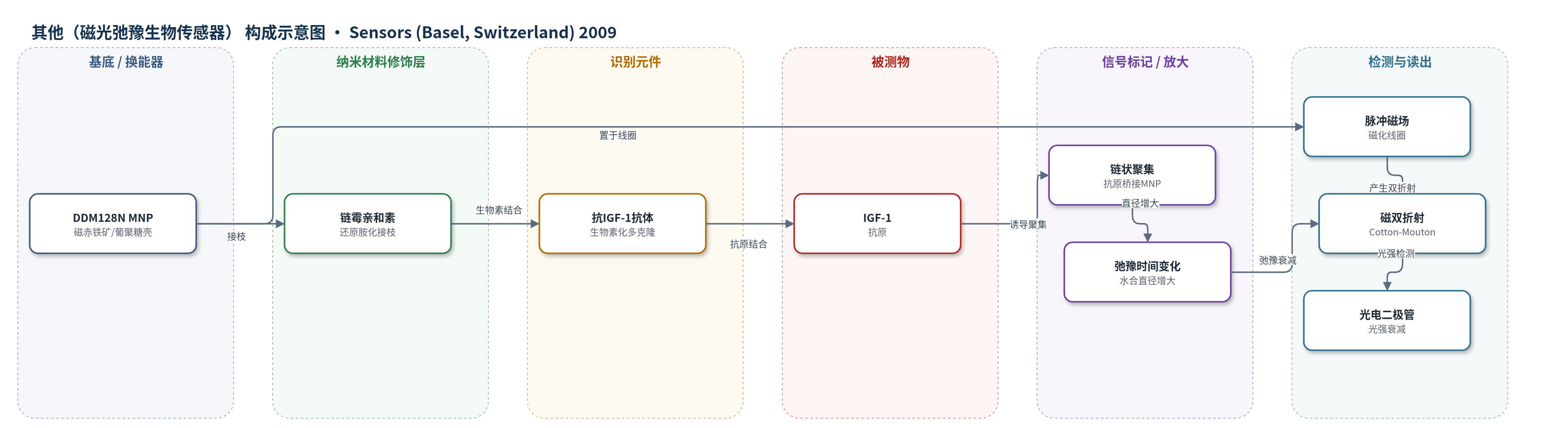
点击图片查看大图 · 依据论文自动绘制
传感器类型
其他(磁光弛豫生物传感器)
检测对象
胰岛素样生长因子1(IGF-1);样品基质:10 mM磷酸盐缓冲液、PBS、10%人血浆
检测原理
该传感器以超顺磁性纳米颗粒为换能元件。抗IGF-1抗体经生物素-链霉亲和素固定于MNP表面;加入IGF-1后,抗原桥接相邻颗粒形成链状聚集,使水合直径增大。根据布朗弛豫关系,τB随dhyd^3增大,因此抗原浓度越高,聚集程度越大,弛豫时间越长。测量时,脉冲磁场使MNP沿磁场排列,悬浮液出现磁双折射(Cotton-Mouton效应);撤场后双折射随颗粒布朗弛豫衰减,光强按指数衰减,光电二极管记录衰减曲线。通过单指数拟合获得弛豫时间和水合直径,再结合链状聚集动力学模型可推算抗原浓度、KD和抗体负载。聚集使直径立方放大,提高信号变化。
检测灵敏度
LOD: 100 fmol·mL-1(MNP);LOD: 24.2 ng/mL(IGF-1)
效应效果
以3 nM BSA为对照时MNP直径不变,表明非特异结合较低。颗粒在不同介质中ζ电位为水-35 mV、磷酸盐-29 mV、NaCl -27 mV、PBS -0.4 mV、10%人血浆-2.3 mV,离子和蛋白浓度升高会降低稳定性。6.6 nM及以上IGF-1在120 min内使平均水合直径增至初始1.5倍,90–120 min达稳态;KD为70 nM,抗体负载78 nM。IGF-1 LOD为24.2 ng/mL,可覆盖儿童130–485 ng/mL、成人95–250 ng/mL及病理浓度。相比其他免疫分析LOD 0.1–100 ng/mL,MORFF为均相、免洗涤、无需磁屏蔽,但血浆中IGFBP干扰仍需IGF-2辅助。
传感器的构成
- 换能载体:DDM128N磁赤铁矿核-羧基葡聚糖壳磁性纳米颗粒(MNP),提供超顺磁性和磁光弛豫信号。
- 纳米材料修饰层:链霉亲和素(Streptavidin)经还原胺化接枝于MNP表面,提供生物素结合位点。
- 识别元件:生物素化多克隆抗IGF-1抗体(anti-IGF-1)通过生物素-链霉亲和素结合固定于MNP,识别IGF-1。
- 封闭剂:生物素(biotin)饱和剩余链霉亲和素位点,减少非特异结合。
- 信号放大/换能元件:IGF-1诱导抗体-MNP链状聚集,水合直径增大,改变布朗弛豫时间。
- 光学读出组件:635 nm激光、偏振器、磁化线圈、四分之一波片、检偏器和光电二极管,检测磁双折射弛豫光强衰减。
中文摘要
本文报道了一种基于功能化磁性纳米颗粒磁光弛豫测量的新型生物传感方法。在脉冲磁场中,激光穿过磁性纳米颗粒悬浮液时,颗粒沿磁场排列并产生磁双折射;撤去磁场后,颗粒因布朗运动弛豫,双折射衰减,光电二极管记录光强变化。通过拟合弛豫时间可得到颗粒水合直径,从而识别生物分子结合导致的聚集事件。作者以磁赤铁矿核-羧基葡聚糖壳纳米颗粒为载体,经链霉亲和素和生物素化抗IGF-1抗体功能化,利用IGF-1抗原诱导颗粒聚集,演示了均相免疫分析。该方法无需洗涤步骤,可在缓冲液或血浆等介质中分析,并可结合动力学模型计算结合常数与抗体负载,同时用于磁性纳米颗粒尺寸及分布表征。
英文摘要
Measurements of magneto-optical relaxation signals of magnetic nanoparticles functionalized with biomolecules are a novel biosensing tool. Upon transmission of a laser beam through a nanoparticle suspension in a pulsed magnetic field, the properties of the laser beam change. This can be detected by optical methods. Biomolecular binding events leading to aggregation of nanoparticles are ascertainable by calculating the relaxation time and from this, the hydrodynamic diameters of the involved particles from the optical signal. Interaction between insulin-like growth factor 1 (IGF-1) and its antibody was utilized for demonstration of the measurement setup applicability as an immunoassay. Furthermore, a formerly developed kinetic model was utilized in order to determine kinetic parameters of the interaction. Beside utilization of the method as an immunoassay it can be applied for the characterization of diverse magnetic nanoparticles regarding their size and size distribution.